Chaves Márcia L, Camozzato Ana L, Köhler Cristiano, Kaye Jeffrey
Dementia Outpatient Clinic and Behavioral Sciences Program, Neurology Service and Medical Sciences Post-Graduation Course, Hospital de Clínicas de Porto Alegre, Universidade Federal do Rio Grande do Sul School of Medicine, Porto Alegre 90035-903, Brazil.
Int J Alzheimers Dis. 2010 Mar 14;2010:673581. doi: 10.4061/2010/673581.
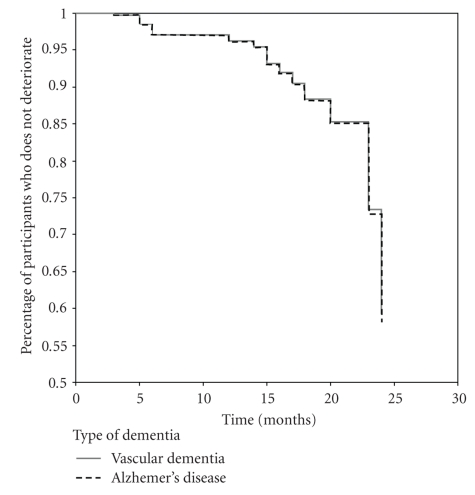
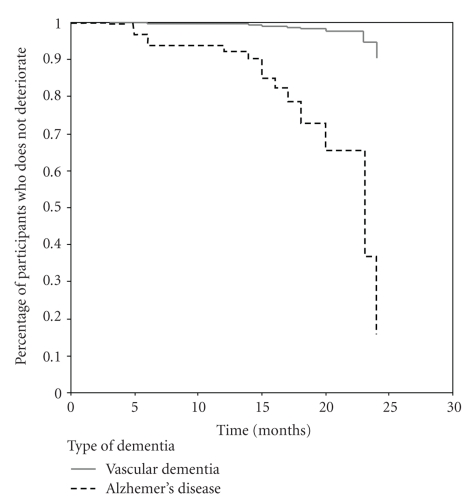
Introduction. This study evaluates the progression of dementia and identifies prognostic risk factors for dementia. Methods. A group of 80 Brazilian community residents with dementia (34 with Alzheimer's disease and 46 with vascular dementia) was assessed over the course of 2 years. Data were analyzed with Cox regression survival analysis. Results. The data showed that education predicted cognitive decline (HR = 1.2; P < .05) when analyzed without controlling for vascular risk factors. After the inclusion of vascular risk factors, education (HR = 1.32; P < .05) and hypertension were predictive for cognitive decline (HR = 38; P < .05), and Alzheimer's disease diagnosis was borderline predictive (P = .055). Conclusion. Vascular risk factors interacted with the diagnosis of vascular dementia. Education was a strong predictor of decline.
引言。本研究评估痴呆症的进展情况,并确定痴呆症的预后风险因素。方法。对一组80名患有痴呆症的巴西社区居民(34例阿尔茨海默病患者和46例血管性痴呆患者)进行了为期2年的评估。采用Cox回归生存分析对数据进行分析。结果。数据显示,在未控制血管危险因素进行分析时,受教育程度可预测认知能力下降(风险比=1.2;P<.05)。纳入血管危险因素后,受教育程度(风险比=1.32;P<.05)和高血压可预测认知能力下降(风险比=38;P<.05),阿尔茨海默病诊断具有临界预测性(P=0.055)。结论。血管危险因素与血管性痴呆的诊断相互作用。受教育程度是认知能力下降的有力预测因素。