Department of Neurology, Hanyang University Guri Hospital, Hanyang University College of Medicine, 153 Gyeongchun-ro, Guri, 11923, Republic of Korea.
Department of Neurology, Inha University School of Medicine, 27 Inhang-ro, Jung-gu, Incheon, Republic of Korea.
Alzheimers Res Ther. 2022 Jan 7;14(1):6. doi: 10.1186/s13195-021-00953-x.
Neurofilament light chain (NFL) level has been suggested as a blood-based biomarker for neurodegeneration in dementia. However, the association between baseline NFL levels and cognitive stage transition or cortical thickness is unclear. This study aimed to investigate whether baseline NFL levels are associated with cognitive stage transition or cortical thickness in mild cognitive impairment (MCI) and cognitively unimpaired (CU) participants.
This study analyzed data on participants from the independent validation cohort of the Korea Brain Aging Study for the Early Diagnosis and Prediction of Alzheimer's disease (KBASE-V) study. Among the participants of KBASE-V study, 53 MCI and 146 CU participants who were followed up for ≥ 2 years and had data on the serum NFL levels were eligible for inclusion in this study. Participants were classified into three groups according to baseline serum NFL levels of low, middle, or high.
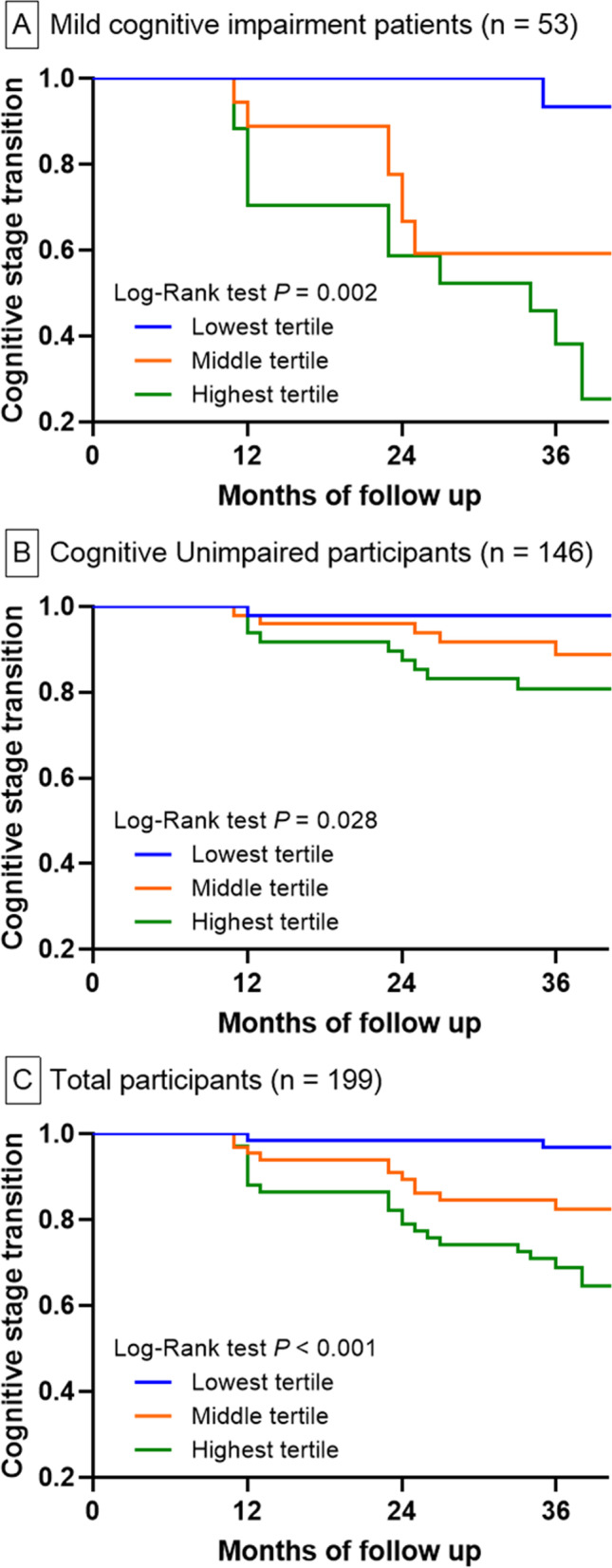
The Kaplan-Meier analysis showed association between the serum NFL tertiles and risk of cognitive stage transition in MCI (P = 0.002) and CU (P = 0.028) participants, analyzed separately. The same is true upon analysis of MCI and CU participants together (P < 0.001). In MCI participants, the highest serum NFL tertile and amyloid-beta positivity were independent predictors for cognitive stage transition after adjusting for covariates. For CU participants, only amyloid-beta positivity was identified to be an independent predictor.
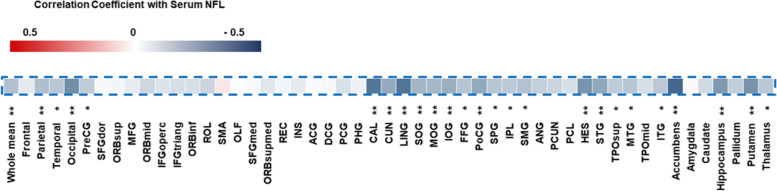
The study shows that higher serum NFL tertile levels correlate with increased risk of cognitive stage transition in both MCI and CU participants. Serum NFL levels were negatively correlated with the mean cortical thickness of the whole-brain and specific brain regions.
神经丝轻链(NFL)水平被认为是痴呆症中神经退行性变的基于血液的生物标志物。然而,基线 NFL 水平与认知阶段转变或皮质厚度之间的关系尚不清楚。本研究旨在调查基线 NFL 水平是否与轻度认知障碍(MCI)和认知正常(CU)参与者的认知阶段转变或皮质厚度有关。
本研究分析了韩国大脑衰老研究用于阿尔茨海默病早期诊断和预测的独立验证队列(KBASE-V)研究中参与者的数据。在 KBASE-V 研究的参与者中,符合以下条件的 53 名 MCI 和 146 名 CU 参与者被纳入本研究:随访时间≥2 年,且具有血清 NFL 水平数据。根据基线血清 NFL 水平将参与者分为低、中、高三组。
Kaplan-Meier 分析显示,血清 NFL 三分位与 MCI(P = 0.002)和 CU(P = 0.028)参与者的认知阶段转变风险之间存在关联,单独分析也是如此。当分析 MCI 和 CU 参与者时,结果也同样显著(P < 0.001)。在 MCI 参与者中,在调整协变量后,最高血清 NFL 三分位和淀粉样蛋白-β阳性是认知阶段转变的独立预测因素。对于 CU 参与者,只有淀粉样蛋白-β阳性被确定为独立预测因素。
该研究表明,较高的血清 NFL 三分位水平与 MCI 和 CU 参与者认知阶段转变的风险增加相关。血清 NFL 水平与全脑和特定脑区的平均皮质厚度呈负相关。