Evelyn F. McKnight Brain Institute, Department of Psychology, University of Arizona, Tucson, AZ 85721-0068, USA.
Neuroimage. 2011 Jan 15;54(2):1565-77. doi: 10.1016/j.neuroimage.2010.08.052. Epub 2010 Sep 6.
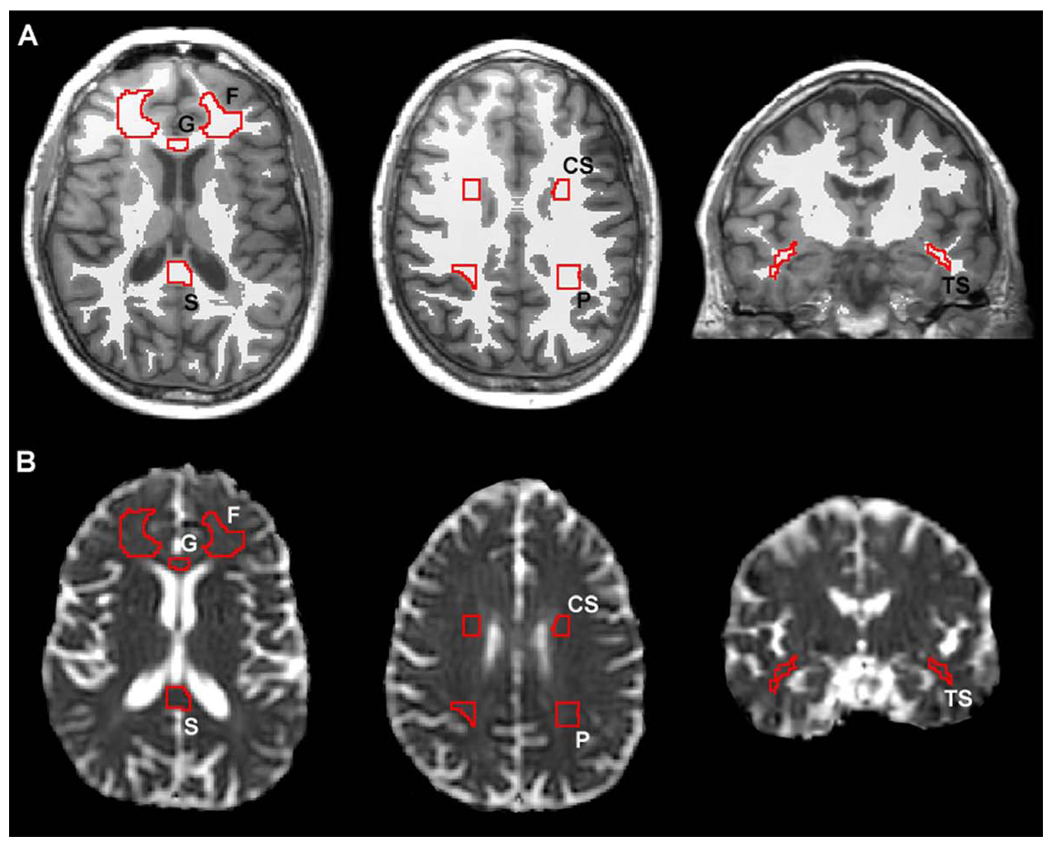
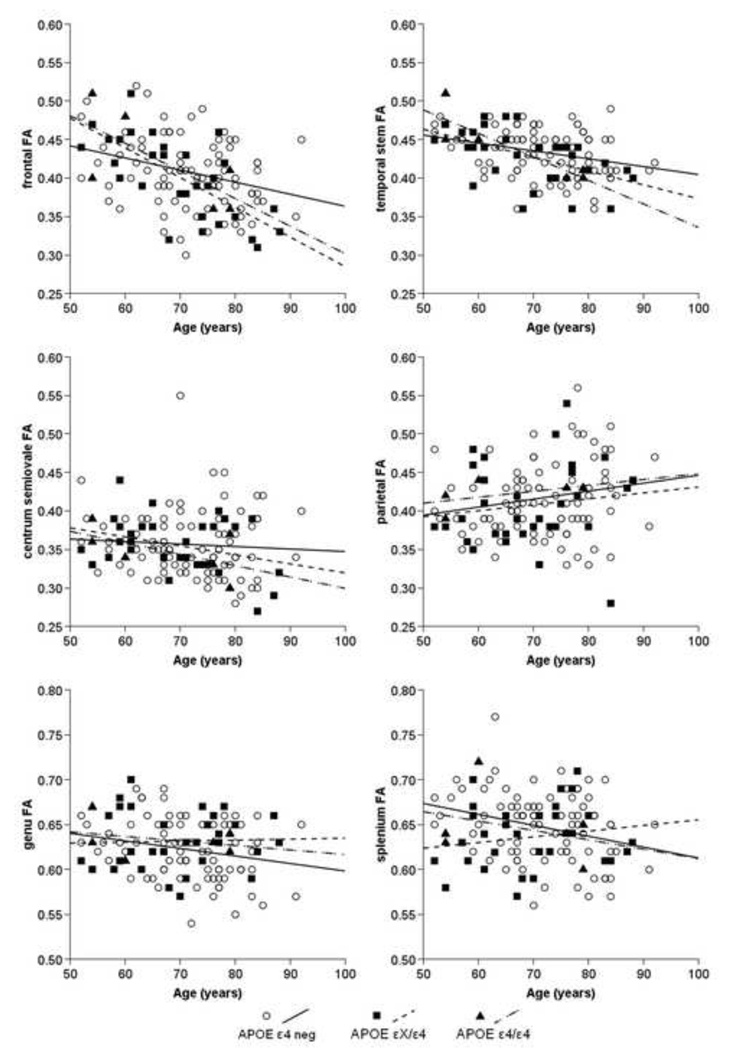
While an extensive literature is now available on age-related differences in white matter integrity measured by diffusion MRI, relatively little is known about the relationships between diffusion and cognitive functions in older adults. Even less is known about whether these relationships are influenced by the apolipoprotein (APOE) ε4 allele, despite growing evidence that ε4 increases cognitive impairment in older adults. The purpose of the present study was to examine these relationships in a group of community-dwelling cognitively normal older adults. Data were obtained from a sample of 126 individuals (ages 52-92) that included 32 ε4 heterozygotes, 6 ε4 homozygotes, and 88 noncarriers. Two measures of diffusion, the apparent diffusion coefficient (ADC) and fractional anisotropy (FA), were obtained from six brain regions-frontal white matter, lateral parietal white matter, the centrum semiovale, the genu and splenium of the corpus callosum, and the temporal stem white matter-and were used to predict composite scores of cognitive function in two domains, executive function and memory function. Results indicated that ADC and FA differed with increasing age in all six brain regions, and these differences were significantly greater for ε4 carriers compared to noncarriers. Importantly, after controlling for age, diffusion measures predicted cognitive function in a region-specific way that was also influenced by ε4 status. Regardless of APOE status, frontal ADC and FA independently predicted executive function scores for all participants, while temporal lobe ADC additionally predicted executive function for ε4 carriers but not noncarriers. Memory scores were predicted by temporal lobe ADC but not frontal diffusion for all participants, and this relationship was significantly stronger in ε4 carriers compared to noncarriers. Taken together, age and temporal lobe ADC accounted for a striking 53% of the variance in memory scores within the ε4 carrier group. The results provide further evidence that APOE ε4 has a significant impact on the trajectory of age-related cognitive functioning in older adults. Possible mechanisms are discussed that could account for the associations between ε4, diffusion, and cognitive function, including the influence of ε4 on neural repair, oxidative stress, and the health of myelin-producing oligodendroglia.
虽然现在已经有大量关于弥散磁共振成像测量的与年龄相关的白质完整性差异的文献,但对于老年人中弥散和认知功能之间的关系知之甚少。尽管越来越多的证据表明 ε4 会增加老年人的认知障碍,但对于这种关系是否受到载脂蛋白(APOE)ε4 等位基因的影响,人们知之甚少。本研究的目的是在一组居住在社区的认知正常的老年人中研究这些关系。数据来自包括 32 个 ε4 杂合子、6 个 ε4 纯合子和 88 个非携带者在内的 126 名个体的样本。从六个脑区(额叶白质、外侧顶叶白质、半卵圆中心、胼胝体膝部和压部以及颞叶干白质)获得了两种弥散测量值,即表观扩散系数(ADC)和各向异性分数(FA),并用于预测两个认知功能领域的综合评分,即执行功能和记忆功能。结果表明,在所有六个脑区中,ADC 和 FA 均随年龄的增加而变化,并且与非携带者相比,ε4 携带者的差异更为显著。重要的是,在控制年龄后,弥散测量以一种特定于区域的方式预测认知功能,这种方式也受到 ε4 状态的影响。无论 APOE 状态如何,额叶 ADC 和 FA 都独立地预测了所有参与者的执行功能评分,而颞叶 ADC 除了非携带者外,还可以预测 ε4 携带者的执行功能评分。对于所有参与者,记忆评分均由颞叶 ADC 预测,但不受额叶扩散影响,并且这种关系在 ε4 携带者中比非携带者更强。总之,年龄和颞叶 ADC 共同解释了 ε4 携带者组记忆评分中高达 53%的变异。研究结果进一步证明,APOE ε4 对老年人认知功能与年龄相关的轨迹有显著影响。讨论了可能的机制,可以解释 ε4、弥散和认知功能之间的关联,包括 ε4 对神经修复、氧化应激和产生髓鞘的少突胶质细胞健康的影响。