Dipartimento di Fisica, Università degli Studi di Milano Bicocca, Milano, Italy.
PLoS One. 2010 Aug 17;5(8):e12216. doi: 10.1371/journal.pone.0012216.
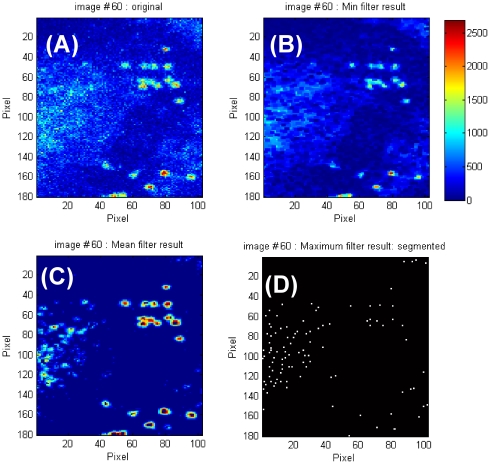
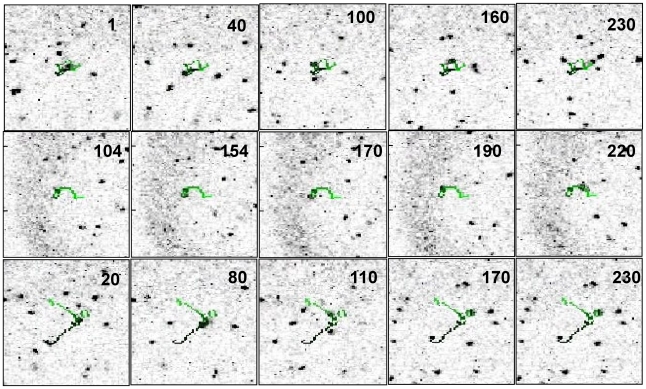
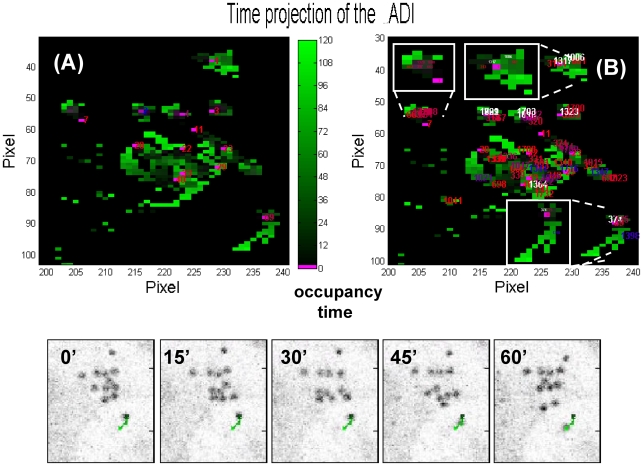
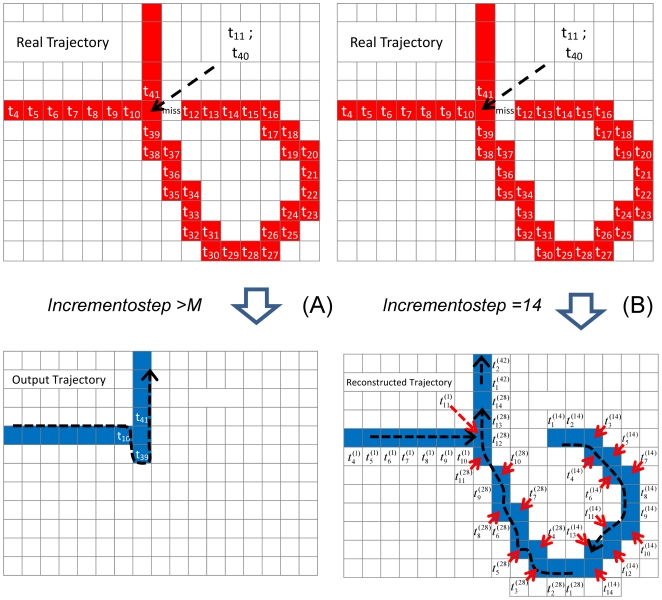
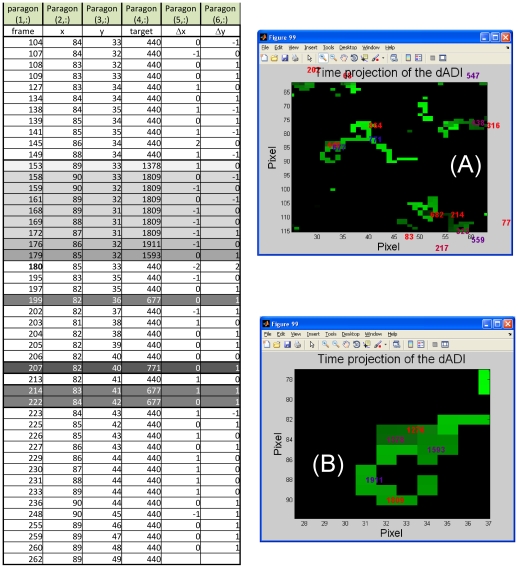
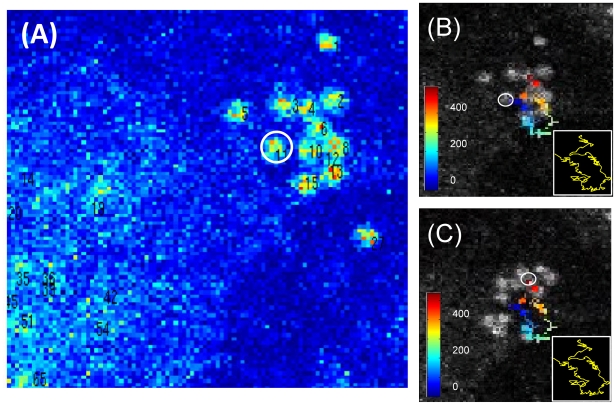
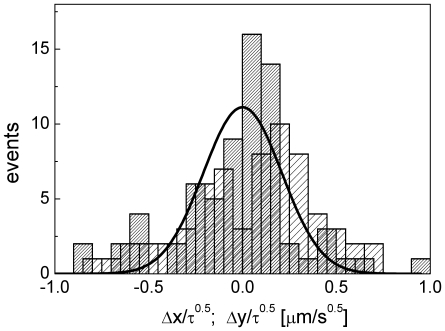
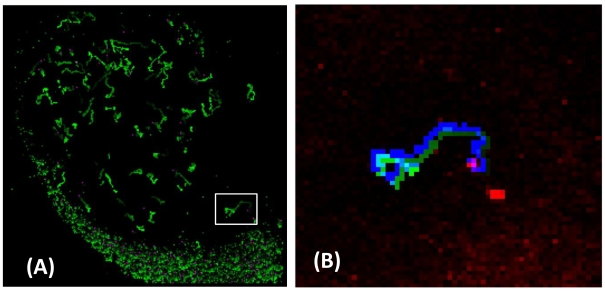
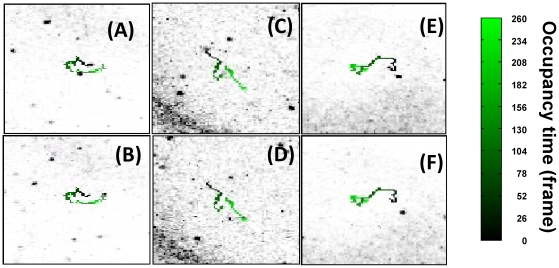
The basic research in cell biology and in medical sciences makes large use of imaging tools mainly based on confocal fluorescence and, more recently, on non-linear excitation microscopy. Substantially the aim is the recognition of selected targets in the image and their tracking in time. We have developed a particle tracking algorithm optimized for low signal/noise images with a minimum set of requirements on the target size and with no a priori knowledge of the type of motion. The image segmentation, based on a combination of size sensitive filters, does not rely on edge detection and is tailored for targets acquired at low resolution as in most of the in-vivo studies. The particle tracking is performed by building, from a stack of Accumulative Difference Images, a single 2D image in which the motion of the whole set of the particles is coded in time by a color level. This algorithm, tested here on solid-lipid nanoparticles diffusing within cells and on lymphocytes diffusing in lymphonodes, appears to be particularly useful for the cellular and the in-vivo microscopy image processing in which few a priori assumption on the type, the extent and the variability of particle motions, can be done.
细胞生物学和医学领域的基础研究大量使用基于共焦荧光的成像工具,最近还使用基于非线性激发的显微镜。其主要目的是识别图像中的选定目标并跟踪其随时间的变化。我们开发了一种粒子跟踪算法,该算法针对低信噪比图像进行了优化,对目标大小的要求最小,并且对运动类型没有先验知识。基于大小敏感滤波器的图像分割不依赖于边缘检测,并且针对在大多数体内研究中以低分辨率采集的目标进行了调整。通过从累积差分图像堆栈构建单个 2D 图像,粒子跟踪可以完成,其中整个粒子集的运动通过颜色级别在时间上进行编码。该算法已在细胞内扩散的固体脂质纳米粒子和淋巴结内扩散的淋巴细胞上进行了测试,对于细胞和体内显微镜图像处理非常有用,因为可以对粒子运动的类型、程度和可变性进行很少的先验假设。