Department of Otolaryngology-Head and Neck Surgery, Washington University School of Medicine, St. Louis, Missouri 63110, USA.
Otol Neurotol. 2010 Oct;31(8):1221-6. doi: 10.1097/MAO.0b013e3181f0c649.
This study is designed to test the hypothesis that preservation of residual hearing in a pediatric population is possible using standard electrode arrays with full-length insertions. Surgical technique during implantation also is described.
Retrospective review of patient medical records.
Academic tertiary care center.
Thirty-one severely to profoundly hearing impaired pediatric patients with some residual hearing precochlear implantation.
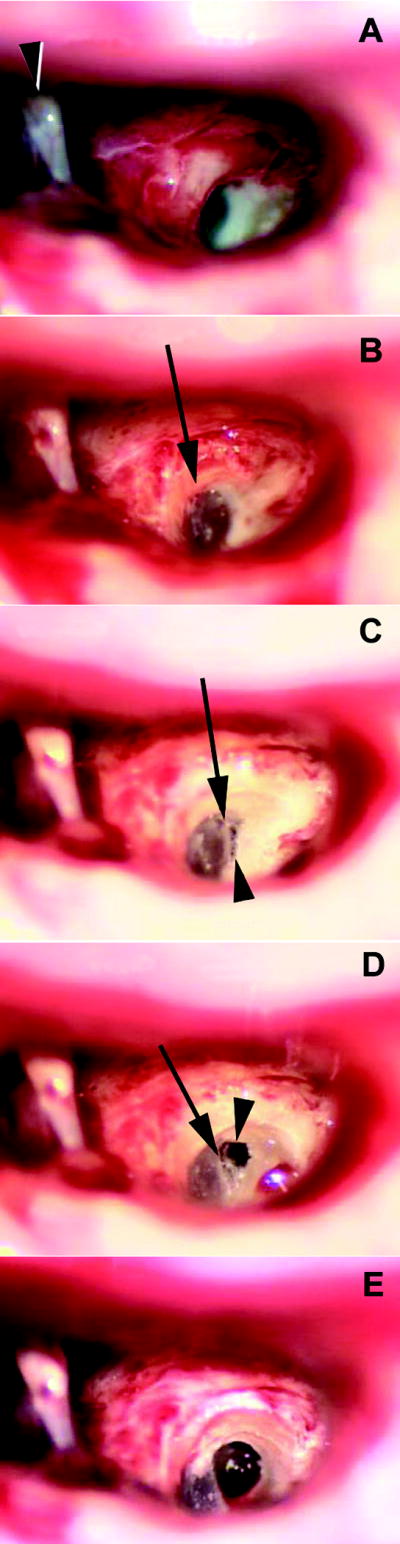
Cochlear implantation using a modified "soft surgery" protocol.
Preimplant and postimplant pure tone thresholds and pure-tone average were calculated from unaided preoperative and postoperative audiograms from 250, 500, and 1,000 Hz. Hearing preservation rates were determined to be complete (loss of ≤10 dB), moderate (loss of 11-20 dB), marginal (loss of 21-40 dB), or none (loss of >40 dB or no response at the limits of the audiometer). Functional residual hearing rates (defined in this study as at least 1 threshold better than or equal to 75 dB HL for 250, 500, or 1,000 Hz were calculated.
Complete hearing preservation was achieved in 14 (45.2%) of 31 patients, whereas 28 (90.3%) of 31 had at least partial hearing preservation (loss of ≤40 dB). The preoperative to postoperative low-frequency pure-tone average had a mean change of 18.5 dB and median change of 20 dB. Of the patients who had preoperative functional hearing, 9 (50.0%) of 18 maintained functional residual hearing postoperatively for at least 1 pitch.
Preservation of residual hearing is feasible in pediatric cochlear implant patients using standard-length electrode arrays with full insertions. These data have implications for cochlear implantation in pediatric patients who are at higher risk of progressive hearing loss than adults.
本研究旨在验证以下假设,即使用全长插入的标准电极阵列,在儿童人群中保留残余听力是可行的。同时也描述了植入过程中的手术技术。
回顾性患者病历分析。
学术性三级护理中心。
31 名严重至极重度听力障碍的儿童患者,在植入前有一定的残余听力。
使用改良的“软手术”方案进行人工耳蜗植入。
术前和术后未助听纯音阈值和纯音平均值,通过术前和术后 250、500 和 1000Hz 的听力图计算得出。听力保留率确定为完全(损失≤10dB)、中度(损失 11-20dB)、边缘(损失 21-40dB)或无(损失>40dB 或听力计极限无反应)。功能性残余听力率(在本研究中定义为至少 1 个阈值在 250、500 或 1000Hz 时比听力计极限好 1 倍或以上)也进行了计算。
31 名患者中有 14 名(45.2%)达到完全听力保留,而 31 名患者中有 28 名(90.3%)有至少部分听力保留(损失≤40dB)。低频纯音平均术前至术后的平均变化为 18.5dB,中位数变化为 20dB。在术前有功能性听力的患者中,有 9 名(50.0%)在术后至少有 1 个音保持功能性残余听力。
使用全长插入的标准电极阵列,在儿童人工耳蜗植入患者中保留残余听力是可行的。这些数据对那些比成年人更有进行性听力损失风险的儿童患者的耳蜗植入具有重要意义。