Frisbee Stephanie J, Shankar Anoop, Knox Sarah S, Steenland Kyle, Savitz David A, Fletcher Tony, Ducatman Alan M
Department of Community Medicine, West Virginia University School of Medicine, Robert C. Byrd Health Sciences Center, 1 Medical Center Drive, Morgantown, WV 26506-9105, USA.
Arch Pediatr Adolesc Med. 2010 Sep;164(9):860-9. doi: 10.1001/archpediatrics.2010.163.
Perfluorooctanoic acid (PFOA) and perfluorooctanesulfonate (PFOS) are man-made compounds with widespread presence in human sera. In previous occupational and adult studies, PFOA and PFOS were positively associated with serum lipid levels.
To interrogate associations between PFOA and PFOS and serum lipids in children and adolescents.
Cross-sectional community-based study.
Mid-Ohio River Valley.
A total of 12 476 children and adolescents included in the C8 Health Project, which resulted from the pretrial settlement of a class action lawsuit pursuant to PFOA contamination of the drinking water supply.
Serum lipids (total, high-density lipoprotein [HDL-C], and low-density lipoprotein [LDL-C] cholesterol and fasting triglycerides).
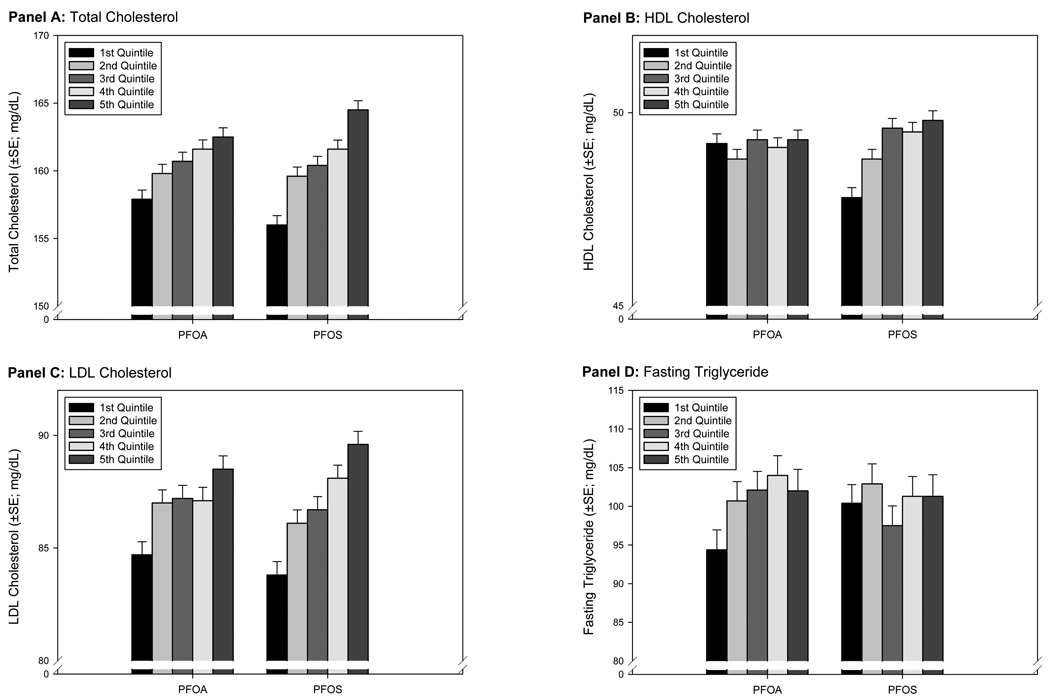
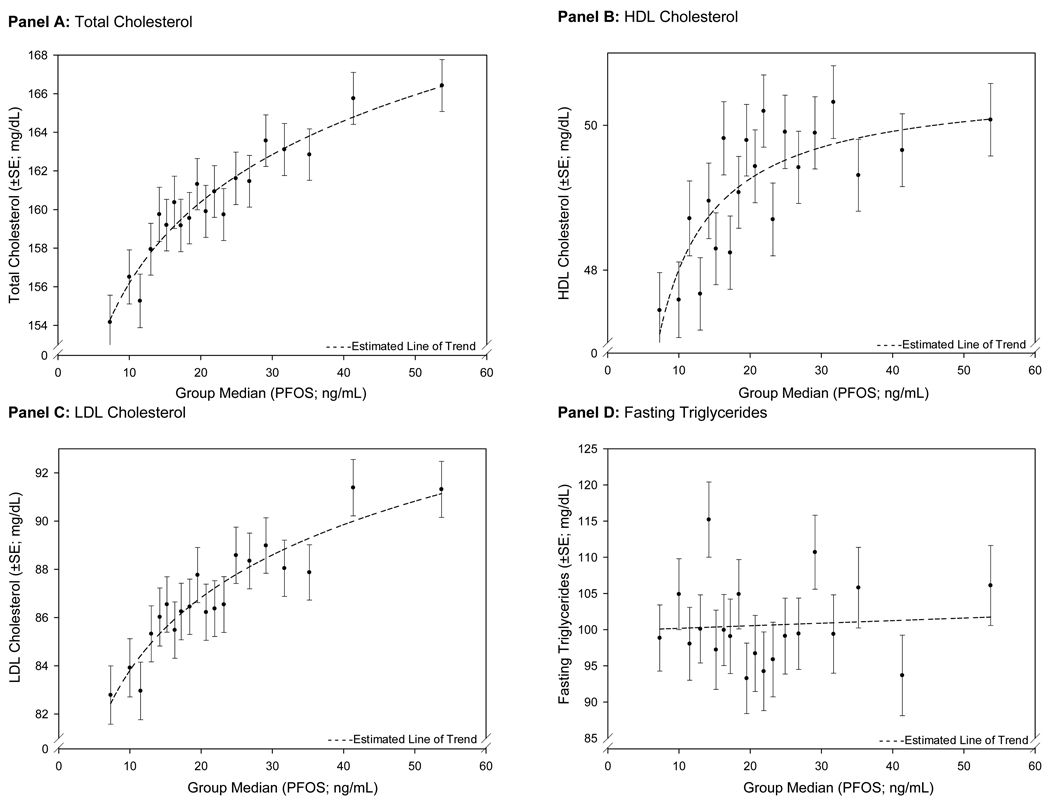
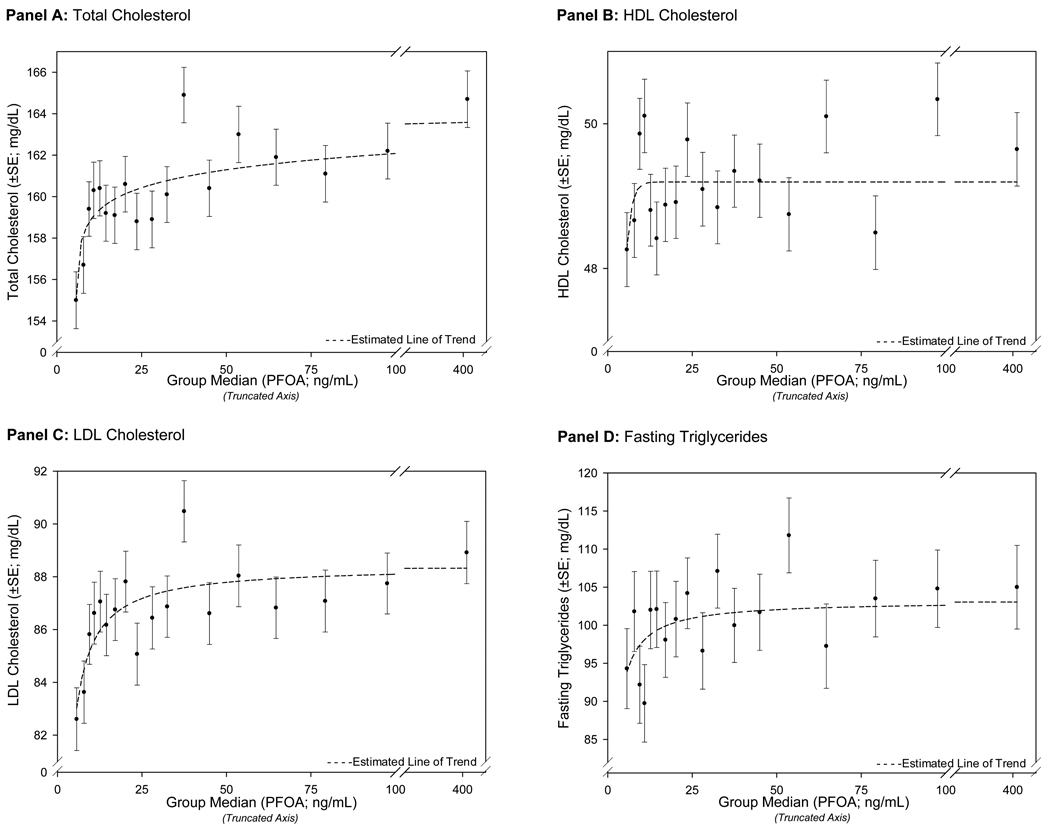
Mean (SD) serum PFOA and PFOS concentrations were 69.2 (111.9) ng/mL and 22.7 (12.6) ng/mL, respectively. In linear regression after adjustment for covariables, PFOA was significantly associated with increased total cholesterol and LDL-C, and PFOS was significantly associated with increased total cholesterol, HDL-C, and LDL-C. Using general linear model analysis of covariance, between the first and fifth quintiles of PFOA there was a 4.6-mg/dL and a 3.8-mg/dL increase in the adjusted mean levels of total cholesterol and LDL-C levels, respectively, and an 8.5-mg/dL and a 5.8-mg/dL increase in the adjusted mean levels of total cholesterol and LDL-C, respectively, between the first and fifth quintiles of PFOS. Increases were 10 mg/dL for some age- and sex-group strata. Observed effects were nonlinear, with larger increases in total cholesterol and LDL-C levels occurring at the lowest range, particularly of PFOA.
Although the epidemiologic and cross-sectional natures of this study limit causal inferences, the consistently observed associations between increasing PFOA and PFOS and elevated total cholesterol and LDL-C levels warrant further study.
全氟辛酸(PFOA)和全氟辛烷磺酸(PFOS)是在人体血清中广泛存在的人造化合物。在以往的职业和成人研究中,PFOA和PFOS与血清脂质水平呈正相关。
探究儿童和青少年中PFOA和PFOS与血清脂质之间的关联。
基于社区的横断面研究。
俄亥俄河中游流域。
共有12476名儿童和青少年纳入了C8健康项目,该项目源于一起因饮用水供应受PFOA污染的集体诉讼的审前和解。
血清脂质(总胆固醇、高密度脂蛋白[HDL-C]、低密度脂蛋白[LDL-C]胆固醇和空腹甘油三酯)。
血清PFOA和PFOS浓度的平均值(标准差)分别为69.2(111.9)ng/mL和22.7(12.6)ng/mL。在对协变量进行调整后的线性回归中,PFOA与总胆固醇和LDL-C升高显著相关,PFOS与总胆固醇、HDL-C和LDL-C升高显著相关。使用协方差的一般线性模型分析,在PFOA的第一和第五五分位数之间,调整后的总胆固醇和LDL-C水平的平均水平分别增加了4.6mg/dL和3.8mg/dL,在PFOS的第一和第五五分位数之间,调整后的总胆固醇和LDL-C水平的平均水平分别增加了8.5mg/dL和5.8mg/dL。在某些年龄和性别组中增加了10mg/dL。观察到的影响是非线性的,总胆固醇和LDL-C水平在最低范围内增加幅度更大,尤其是PFOA。
尽管本研究的流行病学和横断面性质限制了因果推断,但PFOA和PFOS升高与总胆固醇和LDL-C水平升高之间始终观察到的关联值得进一步研究。