Alam Dewan S, van Raaij Joop M A, Hautvast Joseph G A J, Yunus M, Wahed M A, Fuchs G J
Health Systems and Infectious Diseases Division, ICDDR,B, Mohakhali, Dhaka 1212, Bangladesh.
J Health Popul Nutr. 2010 Aug;28(4):333-42. doi: 10.3329/jhpn.v28i4.6039.
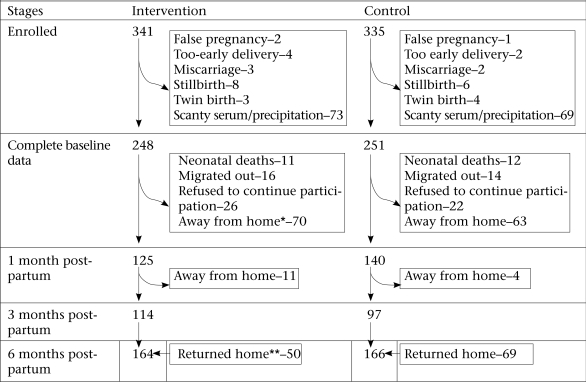
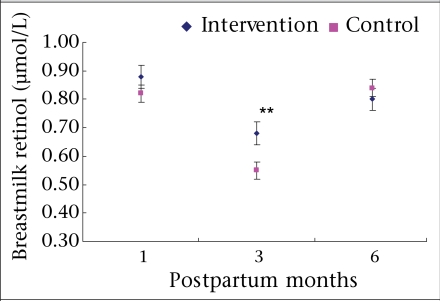
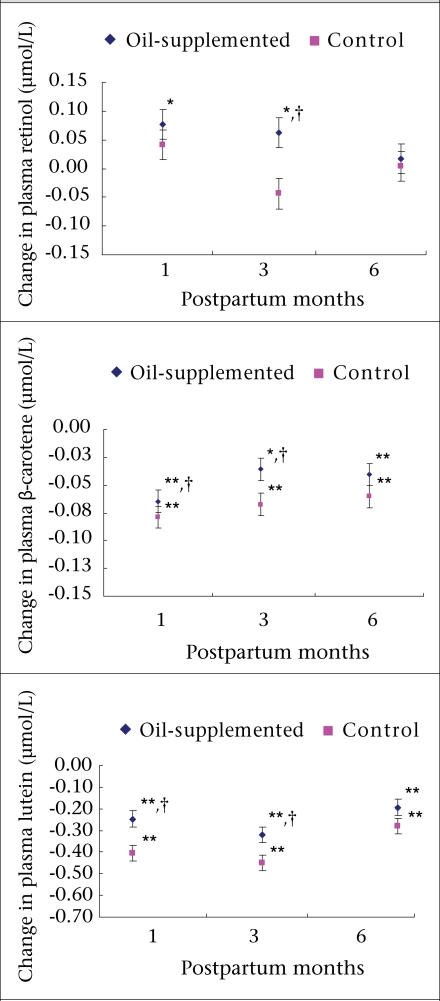
Dietary fat intake is extremely low in most communities with vitamin A deficiency. However, its role in vitamin A status of pregnant and lactating women is poorly understood. The aim of the study was to examine the effect of supplementing women with fat from mid-/late pregnancy until six months postpartum on their vitamin A status and that of their infants. Women recruited at 5-7 months of gestation were supplemented daily with 20 mL of soybean-oil (n = 248) until six months postpartum or received no supplement (n = 251). Dietary fat intake was assessed by 24-hour dietary recall at enrollment and at 1, 3 and 6 months postpartum. Concentrations of maternal plasma retinol, beta-carotene, and lutein were measured at enrollment and at 1, 3 and 6 months postpartum, and those of infants at six months postpartum. Concentration of breastmilk retinol was measured at 1, 3 and 6 months postpartum. The change in concentration of plasma retinol at three months postpartum compared to pregnancy was significantly higher in the supplemented compared to the control women (+0.04 vs -0.07 micromol/L respectively; p < 0.05). Concentrations of plasma beta-carotene and lutein declined in both the groups during the postpartum period but the decline was significantly less in the supplemented than in the control women at one month (beta-carotene -0.07 vs -0.13 micromol/L, p < 0.05); lutein -0.26 vs -0.49 micromol/L, p < 0.05) and three months (beta-carotene -0.04 vs -0.08 micromol/L, p < 0.05; lutein -0.31 vs -0.47 micromol/L, p < 0.05). Concentration of breastmilk retinol was also significantly greater in the supplemented group at three months postpartum than in the controls (0.68 +/- 0.35 vs 0.55 +/- 0.34 micromol/L respectively, p < 0.03). Concentrations of infants' plasma retinol, beta-carotene, and lutein, measured at six months of age, did not differ between the groups. Fat supplementation during pregnancy and lactation in women with a very low intake of dietary fat has beneficial effects on maternal postpartum vitamin A status.
在大多数存在维生素A缺乏的社区,膳食脂肪摄入量极低。然而,其在孕妇和哺乳期妇女维生素A状况中的作用却鲜为人知。本研究的目的是探讨在妊娠中后期至产后六个月为妇女补充脂肪对其自身及婴儿维生素A状况的影响。招募妊娠5 - 7个月的妇女,每天补充20毫升大豆油(n = 248)直至产后六个月,或不进行补充(n = 251)。通过在入组时以及产后1、3和6个月进行24小时膳食回顾来评估膳食脂肪摄入量。在入组时以及产后1、3和6个月测量孕妇血浆视黄醇、β - 胡萝卜素和叶黄素的浓度,在产后六个月测量婴儿的这些指标。在产后1、3和6个月测量母乳视黄醇浓度。与对照组妇女相比,补充组妇女产后三个月时血浆视黄醇浓度相对于孕期的变化显著更高(分别为 +0.04与 -0.07微摩尔/升;p < 0.05)。在产后期间,两组血浆β - 胡萝卜素和叶黄素浓度均下降,但在产后一个月(β - 胡萝卜素 -0.07与 -0.13微摩尔/升,p < 0.05;叶黄素 -0.26与 -0.49微摩尔/升,p < 0.05)和三个月时(β - 胡萝卜素 -0.04与 -0.08微摩尔/升,p < 0.05;叶黄素 -0.31与 -0.47微摩尔/升,p < 0.05),补充组的下降幅度明显小于对照组。产后三个月时,补充组母乳视黄醇浓度也显著高于对照组(分别为0.68±0.35与0.55±0.34微摩尔/升,p < 0.03)。在六个月龄时测量的婴儿血浆视黄醇、β - 胡萝卜素和叶黄素浓度在两组之间没有差异。对于膳食脂肪摄入量极低的妇女,在孕期和哺乳期补充脂肪对母体产后维生素A状况有有益影响。