Petitjean-Lecherbonnier J, Dina J, Nguyen E, Gouarin S, Lebigot E, Vabret A
Laboratoire de virologie humaine et moléculaire, CHU de Caen, avenue Georges-Clémenceau, 14033 Caen, France.
Pathol Biol (Paris). 2011 Apr;59(2):113-21. doi: 10.1016/j.patbio.2010.07.010. Epub 2010 Sep 9.
The PCR assays are currently used in diagnosis of enterovirus (EV) meningitis. Nevertheless, the use of molecular diagnosis of EV should be investigated in respiratory tract infections (RTI).
To perform enterovirus molecular diagnostic tools, PCR and genotyping, in nasal samples for diagnostic and epidemiologic purposes.
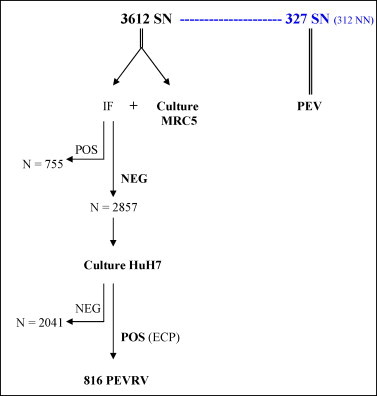
During 2008, 3612 nasal specimen (NS) were studied by IFD and MRC5 culture. Next, we realised successively viral isolation on HuH7 culture (for NS negative by IFD assay) and a duplex PCR enterovirus-rhinovirus for the 816 HuH7 positive supernatants. Furthermore, 327 NS collected from neonates were systematically tested by a real-time RT-PCR. This assay was used in routine for EV diagnosis setting in cerebrospinal fluid. Enterovirus genotyping was then performed for the 68 positive supernatants.
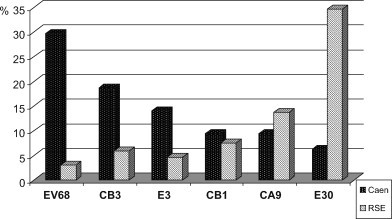
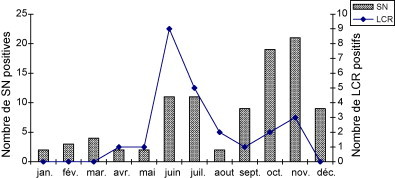
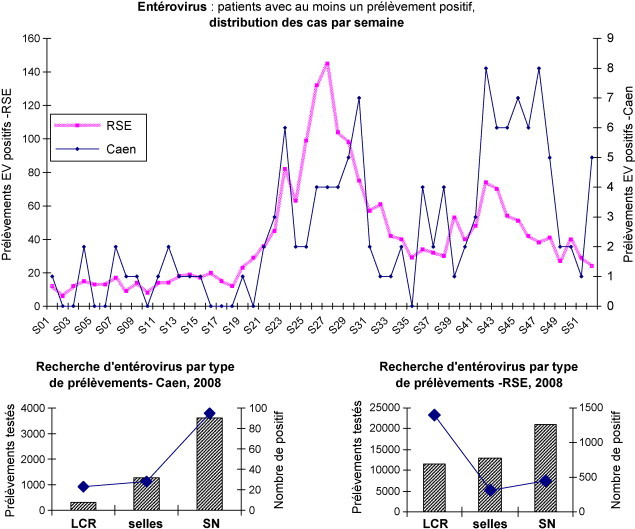
Thirty-five NS (0.97%) were positive for EV by culture (MRC5). A combination of both PCR assays, PEVRV and PEV, allowed an additional identification of 41 EV, eight EV-RV and 12 RV, increasing the number of positive to 96 NS (2.6%). Among the neonates, 32 NS (11.3%) were positive for EV by PEV. Of the 98 NS tested by the two PCR assays (PEV and PEVRV), 27 were positive and we detected 10 EV, five EV-RV and 12 RV. From January to December 2008, the circulation of EV showed the usual peak in June-July when a small outbreak of aseptic meningitis occurred and an additional autumnal peak corresponding to respiratory tract infections. Five main serotypes were isolated: 19 EV68 (29.7%), 12 CB3 (18.7%), nine E3 (14,1%), six CA9 (9.4%) and six CB1 (9.4%); the 19 EV68 were isolated in October-November and 17/19 (89.5%) of positive patients were hospitalised for severe respiratory diseases.
The use of molecular screening techniques (PCR assays and genotyping) on nasal samples collected from patients with respiratory infections allowed a prospective, effective and precise identification of circulating strains.
目前,聚合酶链反应(PCR)检测用于肠道病毒(EV)脑膜炎的诊断。然而,对于呼吸道感染(RTI),应研究EV的分子诊断方法。
为了诊断和流行病学目的,在鼻样本中进行肠道病毒分子诊断工具(PCR和基因分型)检测。
2008年期间,对3612份鼻标本(NS)进行了免疫荧光检测(IFD)和MRC5细胞培养研究。接下来,我们先后在HuH7细胞培养中进行病毒分离(针对IFD检测呈阴性的NS),并对816份HuH7阳性上清液进行肠道病毒-鼻病毒双重PCR检测。此外,对从新生儿收集的327份NS进行了实时逆转录PCR系统检测。该检测方法用于脑脊液中EV诊断的常规检测。然后对68份阳性上清液进行肠道病毒基因分型。
通过培养(MRC5),35份NS(0.97%)的肠道病毒呈阳性。两种PCR检测方法(PEVRV和PEV)结合使用,额外鉴定出41份EV、8份EV-RV和12份RV,使阳性NS数量增加到96份(2.6%)。在新生儿中,32份NS(11.3%)通过PEV检测显示肠道病毒呈阳性。在通过两种PCR检测方法(PEV和PEVRV)检测的98份NS中,27份呈阳性,我们检测到10份EV、5份EV-RV和12份RV。2008年1月至12月,EV的传播在6月至7月出现了通常的高峰,当时发生了小规模的无菌性脑膜炎疫情,以及对应呼吸道感染的秋季额外高峰。分离出五种主要血清型:19份EV68(29.7%)、12份CB3(18.7%)、9份E3(14.1%)、6份CA9(9.4%)和6份CB1(9.4%);19份EV68在10月至11月分离得到,19名阳性患者中有17名(89.5%)因严重呼吸道疾病住院。
对呼吸道感染患者收集的鼻样本使用分子筛查技术(PCR检测和基因分型),能够对循环毒株进行前瞻性、有效且精确的鉴定。