Braz J Otorhinolaryngol. 2010 Jul-Aug;76(4):423-7. doi: 10.1590/S1808-86942010000400003.
Noise-induced hearing loss has been studied for many years and today many experts also investigate the synergic action of chemical products, since they can be potentially ototoxic.
to investigate the audiological findings in workers exposed to occupational noise and pesticide and to compare it to data from noise-exposed workers.
Clinical retrospective.
individuals that had been exposed to pesticide and noise (group I), and individuals that had been exposed to noise only (group II).
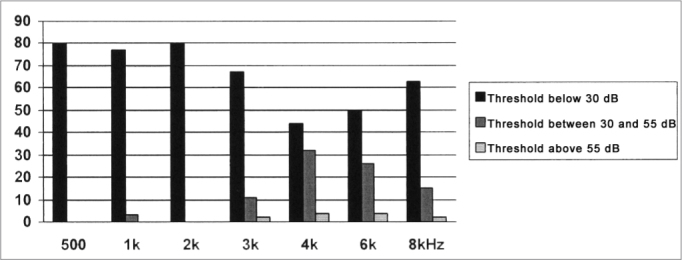
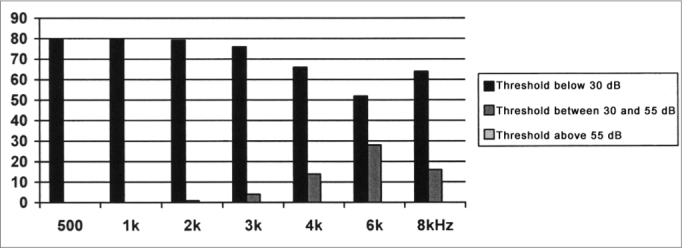
The classification of the audiometric findings showed in that group I: 35% had normal hearing thresholds, 53.75% had degree 1 hearing loss and 11.25% had degree 2 hearing loss; and group II had 57.5% of normal hearing, 40% had degree 1 hearing loss and only 2.5% had degree 2 hearing loss. The analysis of the audiometric findings also showed a significant worsening after comparing groups I and II thresholds, in the frequency of 3 kHz on the left ear and 4 kHz on both ears.
The analysis showed that group I had worse audiometric thresholds compared to group II.
噪声性听力损失已研究多年,如今许多专家还研究化学制品的协同作用,因为它们可能具有潜在的耳毒性。
调查接触职业噪声和农药的工人的听力学发现,并将其与接触噪声的工人的数据进行比较。
临床回顾性研究。
接触农药和噪声的个体(组 I),以及仅接触噪声的个体(组 II)。
听力测试结果的分类显示,在组 I 中:35%的人听力正常,53.75%的人有 1 度听力损失,11.25%的人有 2 度听力损失;而组 II 中有 57.5%的人听力正常,40%的人有 1 度听力损失,只有 2.5%的人有 2 度听力损失。对组 I 和组 II 的阈值进行比较后,对听力测试结果进行分析,在左耳 3 kHz 和双耳 4 kHz 的频率上显示出明显的恶化。
分析表明,与组 II 相比,组 I 的听力阈值更差。