Webster Ruth, Li Stephen Ch, Sullivan David R, Jayne Kathy, Su Steve Ys, Neal Bruce
The George Institute for International Health, Sydney, Australia.
J Med Internet Res. 2010 Sep 13;12(3):e42. doi: 10.2196/jmir.1364.
Elevated low-density lipoprotein (LDL) cholesterol is a leading risk factor for cardiovascular disease. Despite the availability of proven interventions to lower LDL cholesterol, their use remains subobtimal. Many websites provide interactive, tailored advice on cardiovascular risk in an attempt to help bridge this evidence-practice gap, yet there is little evidence that provision of such a tool is effective in changing practice.
The objective was to define the effects on use of cholesterol-lowering interventions of a consumer-targeted tailored advice website.
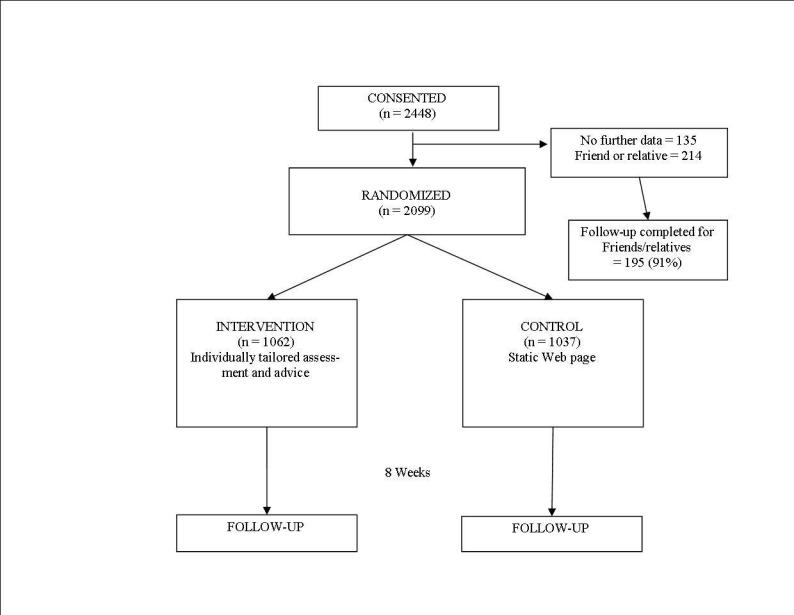
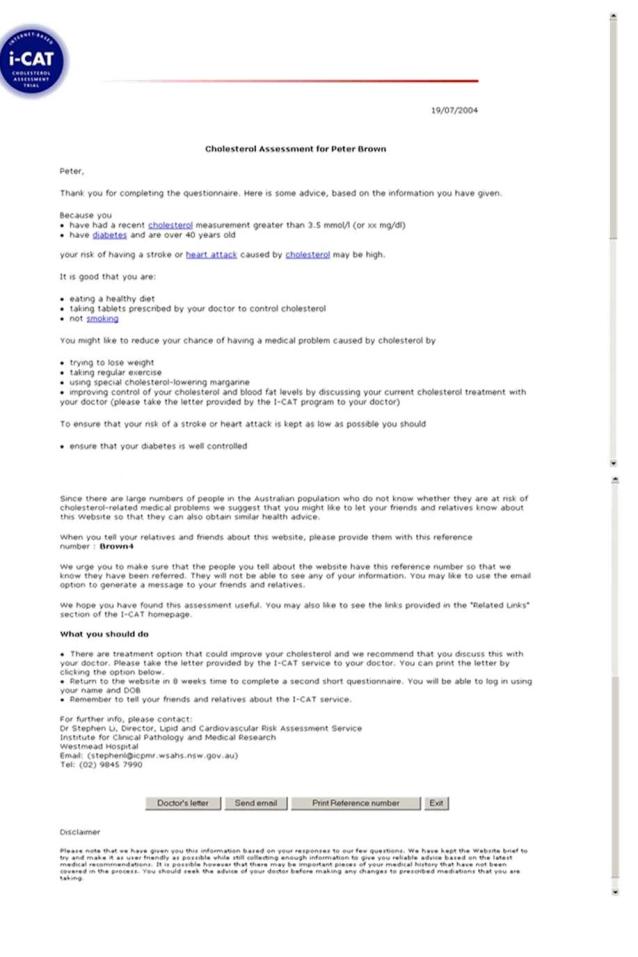
This was a prospective, double-blind, randomized controlled trial open to any adult Australian with access to the Internet. A total of 2099 participants were randomized. Of these, 45% were male, the mean age of all participants was 56, and 1385 (66%) self-reported hypercholesterolemia. Follow-up information was obtained for 1945 (93%). Participants completed a brief online questionnaire. Individuals assigned to intervention received immediate, fully automated, personally tailored advice (based on current guidelines) regarding the need for commencement of statin therapy, increased statin therapy in those already on treatment, and nondrug intervention strategies. Control group participants were directed to static Web pages providing general information about cholesterol management.
The primary outcome was the proportion of participants that commenced or increased use of prescribed cholesterol-lowering therapy. Of the total 2099 randomized participants, 304 (14%) met eligibility criteria for cholesterol-lowering therapy but were not prescribed treatment, and 254 (12%) were prescribed treatment but were not achieving the recommended target level. Treatment was commenced or increased in 64 (6.0%) of the 1062 intervention group participants and 79 (7.6%) of the 1037 control group participants (% difference = -1.6%, 95% confidence interval [CI] -3.75 to 0.57, P = .15). No differences were found between the randomized groups for the secondary outcomes of "discussed treatment with a health professional" (% difference = -3.8%, 95% confidence interval [CI] -8.16 to 0.19, P = .08), "had their cholesterol checked" (% difference = -1.5%, 95% CI -5.79 to 2.71, P = .48), "had their blood pressure checked" (% difference = 1.4%, 95% CI -2.55 to 5.34, P = .49) or made a lifestyle change (P values between .49 and .96).
Despite providing specific carefully tailored advice, this website had no detectable effect on cholesterol management strategies. This finding raises considerable uncertainty about the value of Internet-based tools providing tailored advice directly to consumers.
NCT00220974; http://clinicaltrials.gov/ct2/show/NCT00220974 (Archived by WebCite at http://www.webcitation.org/5sdq63rrY).
低密度脂蛋白(LDL)胆固醇升高是心血管疾病的主要危险因素。尽管有已证实的降低LDL胆固醇的干预措施,但这些措施的使用仍未达到最佳水平。许多网站提供关于心血管风险的交互式、个性化建议,试图弥合这一证据与实践之间的差距,但几乎没有证据表明提供这样的工具能有效改变实践。
目的是确定一个针对消费者的个性化建议网站对降低胆固醇干预措施使用的影响。
这是一项前瞻性、双盲、随机对照试验,面向任何能上网的澳大利亚成年人。总共2099名参与者被随机分组。其中,45%为男性,所有参与者的平均年龄为56岁,1385名(66%)自我报告患有高胆固醇血症。获得了1945名(93%)参与者的随访信息。参与者完成了一份简短的在线问卷。被分配到干预组的个体收到了关于开始他汀类药物治疗的必要性、对已接受治疗者增加他汀类药物治疗以及非药物干预策略的即时、完全自动化、个性化建议(基于当前指南)。对照组参与者被引导至提供有关胆固醇管理一般信息的静态网页。
主要结局是开始或增加使用规定的降低胆固醇治疗的参与者比例。在总共2099名随机分组的参与者中,304名(14%)符合降低胆固醇治疗的资格标准但未接受规定治疗,254名(12%)接受了规定治疗但未达到推荐的目标水平。干预组1062名参与者中有64名(6.0%)开始或增加了治疗,对照组1037名参与者中有79名(7.6%)开始或增加了治疗(差异百分比=-1.6%,95%置信区间[CI]-3.75至0.57,P=0.15)。在“与健康专业人员讨论治疗”(差异百分比=-3.8%,95%置信区间[CI]-8.16至0.19,P=0.08)、“检查胆固醇”(差异百分比=-1.5%,95%CI-5.79至2.71,P=0.48)、“检查血压”(差异百分比=1.4%,95%CI-2.55至5.34,P=0.49)或做出生活方式改变(P值在0.49至0.96之间)这些次要结局方面,随机分组的组间未发现差异。
尽管提供了具体的精心定制的建议,但该网站对胆固醇管理策略没有可检测到的影响。这一发现引发了对直接向消费者提供个性化建议的基于互联网工具的价值的极大不确定性。
NCT00220974;http://clinicaltrials.gov/ct2/show/NCT00220974(由WebCite存档于http://www.webcitation.org/5sdq63rrY)