Department of Medical Science/Clinical Research, Dr R Pfleger GmbH, Bamberg, Germany.
BMC Urol. 2010 Sep 14;10:15. doi: 10.1186/1471-2490-10-15.
Flexible dosing of anticholinergics used for overactive bladder (OAB) treatment is a useful strategy in clinical practice for achieving a maximum effective and maximum tolerated level of therapeutic benefit. In this post hoc analysis we evaluated the efficacy and tolerability of trospium chloride treatment for urinary urge incontinence (UUI) with focus on flexible dosing.
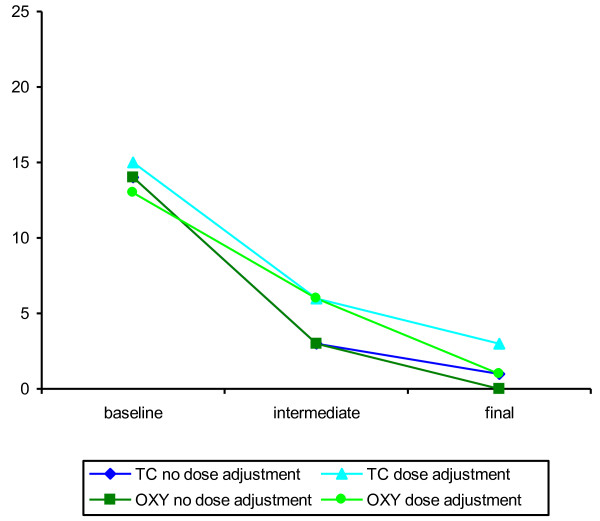
The data came from a 12-week, randomised, double-blind, phase IIIb study in which 1658 patients with urinary frequency plus urge incontinence received trospium chloride 15 mg TID (n = 828) or 2.5 mg oxybutynin hydrochloride TID (n = 830). After four weeks, daily doses were doubled and not readjusted in 29.2% (242/828) of patients in the trospium group, and in 23.3% (193/830) in the oxybuytnin group, until the end of treatment. We assessed the absolute reduction in weekly UUI episodes and the change in intensity of dry mouth, recorded in patients' micturition diaries. Adverse events were also evaluated. Statistics were descriptive.
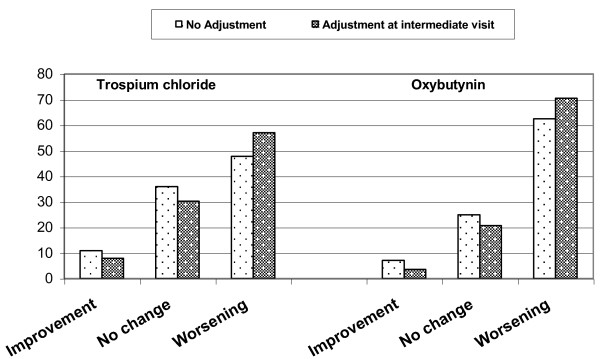
Dose escalation of either trospium or oxybutynin increased reduction in UUI episodes in the population studied. At study end, there were no relevant differences between the "dose adjustment" subgroups and the respective "no dose adjustment" subgroups (trospium: P = 0.249; oxybutynin: P = 0.349). After dose escalation, worsening of dry mouth was higher in both dose adjusted subgroups compared to the respective "no dose adjustment" subgroups (P < 0.001). Worsening of dry mouth was lower in the trospium groups than in the oxybutynin groups (P < 0.001). Adverse events were increased in the dose adjusted subgroups.
Flexible dosing of trospium was proven to be as effective, but better tolerated as the officially approved adjusted dose of oxybutynin. TRIAL REGISTRATION (PARENT STUDY): The study was registered with the German Federal Institute for Drugs and Medical Devices (BfArM, Berlin, Germany), registration number 4022383, as required at the time point of planning this study.
在治疗膀胱过度活动症(OAB)时,灵活调整抗胆碱能药物的剂量是临床实践中的一项有用策略,可达到最佳治疗效果和最大耐受水平。在本事后分析中,我们评估了曲司氯铵治疗急迫性尿失禁(UUI)的疗效和耐受性,重点关注灵活剂量。
该数据来自一项为期 12 周、随机、双盲、IIIb 期研究,1658 例尿频伴急迫性尿失禁患者接受曲司氯铵 15mg TID(n=828)或盐酸奥昔布宁 2.5mg TID(n=830)治疗。四周后,在曲司氯铵组中,29.2%(242/828)的患者将每日剂量加倍且不再调整,在奥昔布宁组中,23.3%(193/830)的患者将每日剂量加倍且不再调整,直至治疗结束。我们评估了每周 UUI 发作次数的绝对减少情况,并记录了患者排尿日记中口干的强度变化。还评估了不良事件。统计分析为描述性分析。
在研究人群中,增加曲司氯铵或奥昔布宁的剂量均可增加 UUI 发作次数的减少。研究结束时,“剂量调整”亚组与各自的“未剂量调整”亚组之间没有明显差异(曲司氯铵:P=0.249;奥昔布宁:P=0.349)。剂量调整后,两组剂量调整亚组的口干恶化程度均高于各自的“未剂量调整”亚组(P<0.001)。曲司氯铵组的口干恶化程度低于奥昔布宁组(P<0.001)。剂量调整亚组的不良事件增加。
曲司氯铵的灵活剂量与奥昔布宁经官方批准的调整剂量同样有效,但耐受性更好。
(原始研究):该研究在德国联邦药品和医疗器械研究所(柏林,德国)注册,注册号为 4022383,这是在计划本研究时的要求。