Department of Psychiatry, Tri-Service General Hospital, National Defense Medical Center, Taipei, Taiwan.
Ann Gen Psychiatry. 2010 Sep 17;9:35. doi: 10.1186/1744-859X-9-35.
To evaluate the overall long-term effectiveness of aripiprazole in patients with schizophrenia in a general psychiatric practice setting in Taiwan.
This was a prospective, open-label, multicenter, post-market surveillance study in Taiwanese patients with a Diagnostic and Statistical Manual of Mental Disorders, Fourth Edition (DSM-IV) diagnosis of schizophrenia or schizoaffective disorder requiring a switch in antipsychotic medication because current medication was not well tolerated and/or clinical symptoms were not well controlled. Eligible patients were titrated to aripiprazole (5-30 mg/day) over a 12-week switching phase, during which their previous medication was discontinued. Patients could then enter a 52-week, long-term treatment phase. Aripiprazole was flexibly dosed (5-30 mg/day) at the discretion of the treating physicians. Efficacy was assessed using the Clinical Global Impression scale Improvement (CGI-I) score, the Clinical Global Impression scale Severity (CGI-S) score, The Brief Psychiatry Rating Scale (BPRS), and the Quality of Life (QOL) scale, as well as Preference of Medicine (POM) ratings by patients and caregivers. Safety and tolerability were also assessed.
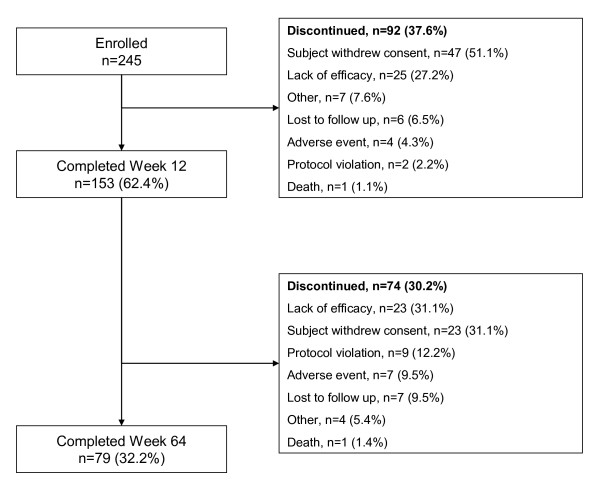
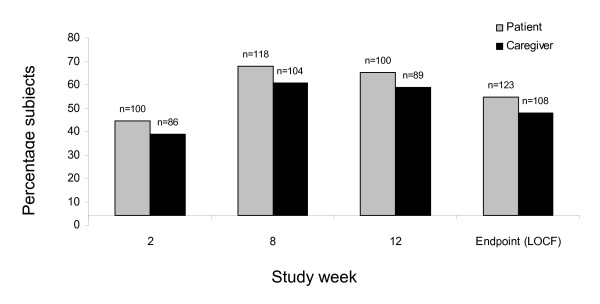
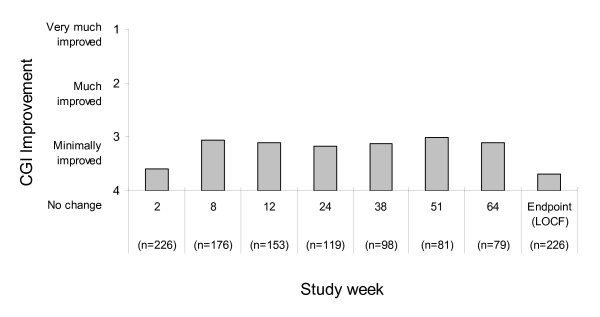
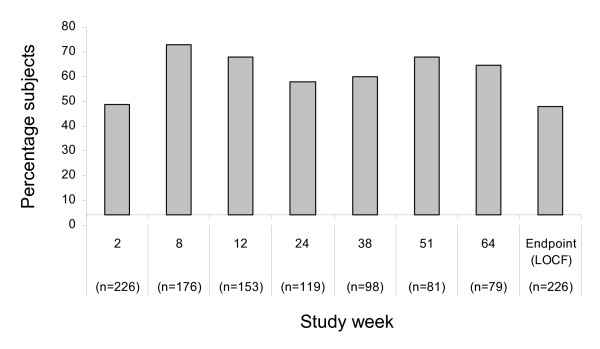
A total of 245 patients were enrolled and switched from their prior antipsychotic medications, and 153 patients entered the 52-week extension phase. In all, 79 patients (32.2%) completed the study. At week 64, the mean CGI-I score was 3.10 and 64.6% of patients who showed response. Compared to baseline, scores of CGI-S, QOL, and BPRS after 64 weeks of treatment also showed significant improvements. At week 12, 65.4% of subjects and 58.9% of caregivers rated aripiprazole as better than the prestudy medication on the POM. The most frequently reported adverse events (AEs) were headache, auditory hallucinations and insomnia. A total of 13 patients (5.3%) discontinued treatment due to AEs. No statistically significant changes were noted with respect to fasting plasma glucose, lipid profile, body weight, and body mass index after long-term treatment with aripiprazole.
Although the discontinuation rate was high, aripiprazole was found to be effective, safe and well tolerated in the long-term treatment of Taiwanese patients with schizophrenia who continued to receive treatment for 64 weeks.
评估阿立哌唑在台湾一般精神科实践环境中治疗精神分裂症患者的总体长期疗效。
这是一项在台湾患有精神分裂症或分裂情感障碍的 DSM-IV 诊断患者中进行的前瞻性、开放性、多中心、上市后监测研究,这些患者需要更换抗精神病药物,因为当前的药物不能很好地耐受和/或临床症状不能很好地控制。符合条件的患者在 12 周的转换期内滴定阿立哌唑(5-30mg/天),在此期间停用之前的药物。然后,患者可以进入 52 周的长期治疗期。阿立哌唑的剂量可根据医生的判断灵活调整(5-30mg/天)。使用临床总体印象量表改善(CGI-I)评分、临床总体印象量表严重程度(CGI-S)评分、简明精神病评定量表(BPRS)和生活质量(QOL)量表以及患者和护理人员的药物偏好(POM)评分来评估疗效。还评估了安全性和耐受性。
共有 245 名患者入组并从之前的抗精神病药物转换,其中 153 名患者进入 52 周扩展期。共有 79 名患者(32.2%)完成了研究。在第 64 周时,平均 CGI-I 评分为 3.10,64.6%的患者有应答。与基线相比,治疗 64 周后 CGI-S、QOL 和 BPRS 的评分也有显著改善。在第 12 周时,65.4%的受试者和 58.9%的护理人员在 POM 上评定阿立哌唑优于研究前的药物。报告最频繁的不良事件(AE)是头痛、幻听和失眠。共有 13 名患者(5.3%)因 AE 而停止治疗。长期使用阿立哌唑后,空腹血糖、血脂谱、体重和体重指数没有出现统计学上显著的变化。
尽管停药率较高,但在继续接受治疗 64 周的台湾精神分裂症患者的长期治疗中,阿立哌唑被发现是有效、安全且耐受良好的。