Department of Agricultural Biotechnology, WCU Biomodulation Major, Research Institute for Agriculture and Life Sciences, Seoul National University, Seoul 151-921, Korea.
BMC Biotechnol. 2010 Sep 19;10:69. doi: 10.1186/1472-6750-10-69.
Recent successes in biotechnological application of birds are based on their unique physiological traits such as unlimited manipulability onto developing embryos and simple protein constituents of the eggs. However it is not likely that target protein is produced as kinetically expected because various factors affect target gene expression. Although there have been various attempts to minimize the silencing of transgenes, a generalized study that uses multiple cis-acting elements in chicken has not been made. The aim of the present study was to analyze whether various cis-acting elements can help to sustain transgene expression in chicken fibroblasts.
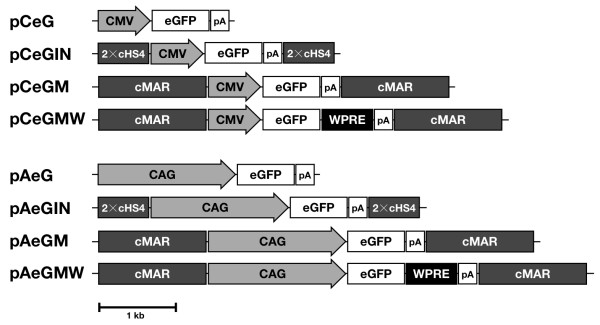
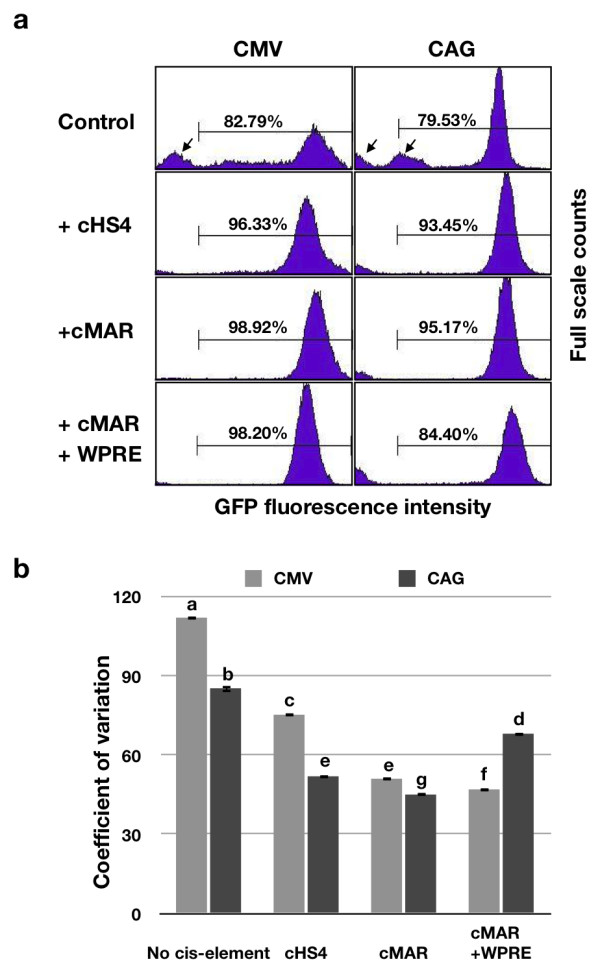
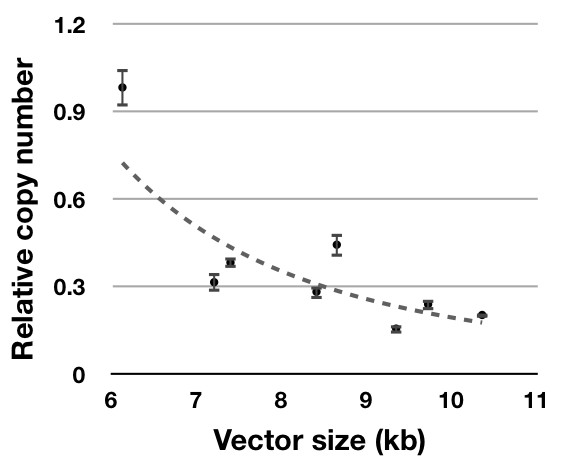
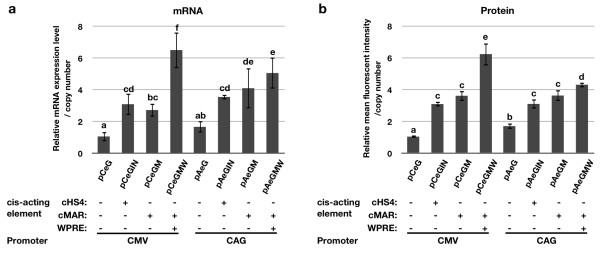
We investigated the optimal transcriptional regulatory elements for enhancing stable transgene expression in chicken cells. We generated eight constructs that encode enhanced green fluorescent protein (eGFP) driven by either CMV or CAG promoters (including the control), containing three types of key regulatory elements: a chicken lysozyme matrix attachment region (cMAR), 5'-DNase I-hypersensitive sites 4 (cHS4), and the woodchuck hepatitis virus posttranscriptional regulatory element (WPRE). Then we transformed immortalized chicken embryonic fibroblasts with these constructs by electroporation, and after cells were expanded under G418 selection, analyzed mRNA levels and mean fluorescence intensity (MFI) by quantitative real-time PCR and flow cytometry, respectively. We found that the copy number of each construct significantly decreased as the size of the construct increased (R2 = 0.701). A significant model effect was found in the expression level among various constructs in both mRNA and protein (P < 0.0001). Transcription with the CAG promoter was 1.6-fold higher than the CMV promoter (P = 0.027) and the level of eGFP expression activity in cMAR- or cHS4-flanked constructs increased by two- to three-fold compared to the control CMV or CAG promoter constructs. In addition, flow cytometry analysis showed that constructs having cis-acting elements decreased the level of gene silencing as well as the coefficient of variance of eGFP-expressing cells (P < 0.0001).
Our current data show that an optimal combination of cis-acting elements and promoters/enhancers for sustaining gene expression in chicken cells is suggested. These results provide important information for avian transgenesis and gene function studies in poultry.
生物技术在鸟类中的应用最近取得了成功,这是基于它们独特的生理特征,如对发育中的胚胎进行无限操作的能力以及卵子中简单的蛋白质成分。然而,由于各种因素会影响靶基因的表达,目标蛋白的产生并不一定符合动力学预期。尽管人们已经尝试了各种方法来最小化转基因的沉默,但尚未在鸡中使用多种顺式作用元件进行综合研究。本研究旨在分析各种顺式作用元件是否有助于维持鸡成纤维细胞中转基因的表达。
我们研究了增强鸡细胞中转基因稳定表达的最佳转录调控元件。我们生成了八个构建体,这些构建体由 CMV 或 CAG 启动子(包括对照)驱动,编码增强型绿色荧光蛋白(eGFP),包含三种关键调控元件:鸡溶菌酶基质附着区(cMAR)、5'-DNase I 超敏位点 4(cHS4)和土拨鼠肝炎病毒转录后调控元件(WPRE)。然后,我们通过电穿孔将这些构建体转染到永生化鸡胚胎成纤维细胞中,在 G418 选择下细胞扩增后,通过实时定量 PCR 分别分析 mRNA 水平和平均荧光强度(MFI),通过流式细胞术。我们发现,随着构建体大小的增加,每个构建体的拷贝数都显著降低(R2 = 0.701)。在 mRNA 和蛋白质中,各种构建体之间的表达水平存在显著的模型效应(P < 0.0001)。与 CMV 启动子相比,CAG 启动子的转录效率高 1.6 倍(P = 0.027),并且 cMAR 或 cHS4 侧翼构建体中的 eGFP 表达活性比对照 CMV 或 CAG 启动子构建体高 2 到 3 倍。此外,流式细胞术分析表明,含有顺式作用元件的构建体降低了基因沉默水平和表达 eGFP 的细胞的变异系数(P < 0.0001)。
我们目前的数据表明,建议在鸡细胞中维持基因表达的顺式作用元件和启动子/增强子的最佳组合。这些结果为禽类转基因和家禽基因功能研究提供了重要信息。