Radiology and Biomedical Imaging, University of California, San Francisco, San Francisco, California 94158, USA.
Cancer Res. 2010 Oct 1;70(19):7400-10. doi: 10.1158/0008-5472.CAN-10-0883. Epub 2010 Sep 21.
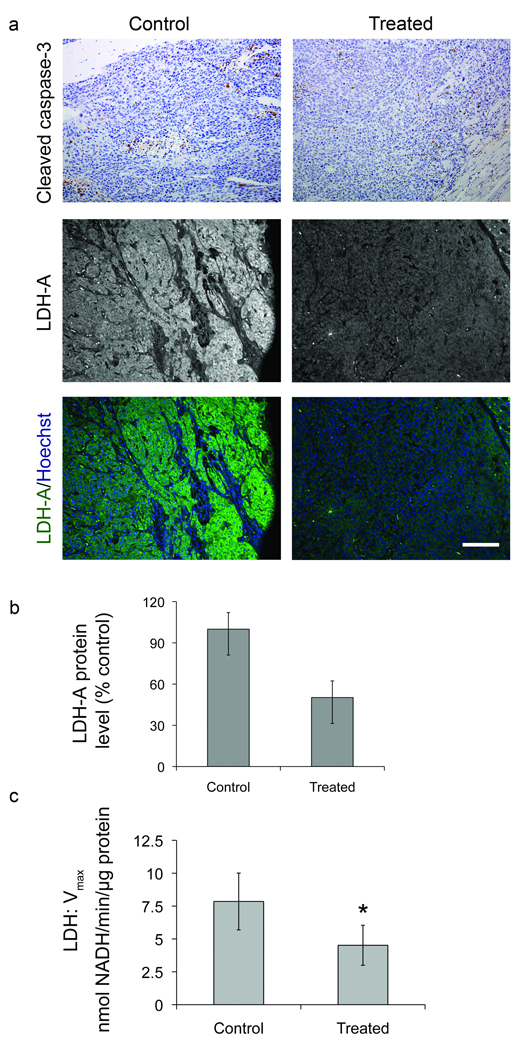
The recent development of hyperpolarized (13)C magnetic resonance spectroscopic imaging provides a novel method for in vivo metabolic imaging with potential applications for detection of cancer and response to treatment. Chemotherapy-induced apoptosis was shown to decrease the flux of hyperpolarized (13)C label from pyruvate to lactate due to depletion of NADH, the coenzyme of lactate dehydrogenase. In contrast, we show here that in PC-3MM2 tumors, inhibition of platelet-derived growth factor receptor with imatinib reduces the conversion of hyperpolarized pyruvate to lactate by lowering the expression of lactate dehydrogenase itself. This was accompanied by reduced expression of vascular endothelial growth factor and glutaminase, and is likely mediated by reduced expression of their transcriptional factors hypoxia-inducible factor-1 and c-Myc. Our results indicate that hyperpolarized (13)C MRSI could potentially detect the molecular effect of various cell signaling inhibitors, thus providing a radiation-free method to predict tumor response.
近年来,高极化(13)C 磁共振波谱成像是一种新的代谢成像方法,在癌症检测和治疗反应评估方面具有应用潜力。有研究表明,由于 NADH(乳酸脱氢酶的辅酶)耗竭,化疗诱导的细胞凋亡会降低从丙酮酸到乳酸的高极化(13)C 标记物的通量。相比之下,我们在这里发现,在 PC-3MM2 肿瘤中,通过抑制血小板衍生生长因子受体的伊马替尼治疗会降低乳酸脱氢酶本身的表达,从而减少高极化丙酮酸向乳酸的转化。这伴随着血管内皮生长因子和谷氨酰胺酶表达的降低,可能是由其转录因子缺氧诱导因子-1 和 c-Myc 表达降低介导的。我们的研究结果表明,高极化(13)C MRSI 可能能够检测各种细胞信号抑制剂的分子作用,从而提供一种无辐射的方法来预测肿瘤反应。