Even-Desrumeaux Klervi, Baty Daniel, Chames Patrick
INSERM U624, 163 avenue de Luminy-case 915, 13288 Marseille Cedex 09, France.
Mol Biosyst. 2010 Nov;6(11):2241-8. doi: 10.1039/c005279e. Epub 2010 Sep 21.
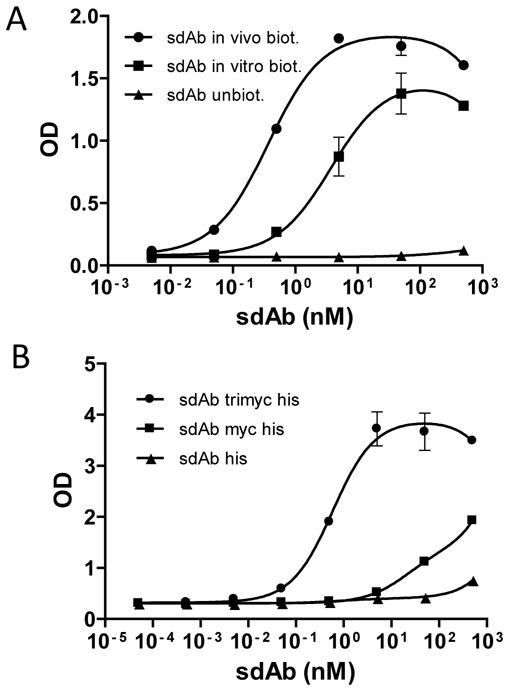
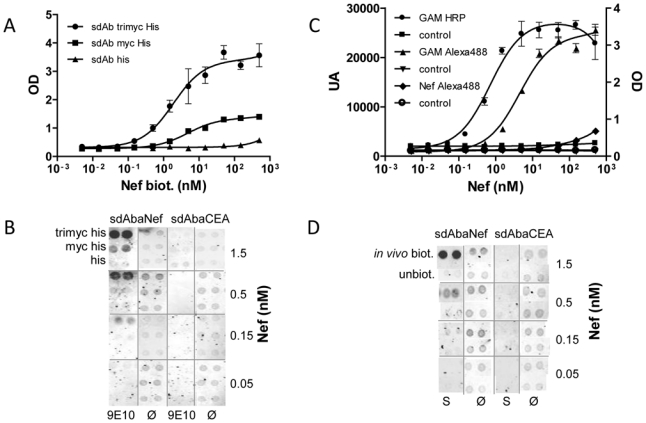
Antibody microarrays are among the novel class of rapidly emerging proteomic technologies that will allow us to efficiently perform specific diagnoses and proteomic analysis. Recombinant antibody fragments are especially suited for this approach but their stability is often a limiting factor. Camelids produce functional antibodies devoid of light chains (HCAbs) of which the single N-terminal domain is fully capable of antigen binding. When produced as an independent domain, these so-called single domain antibody fragments (sdAbs) have several advantages for biotechnological applications thanks to their unique properties of size (15 kDa), stability, solubility, and expression yield. These features should allow sdAbs to outperform other antibody formats in a number of applications, notably as capture molecules for antibody arrays. In this study, we have produced antibody microarrays using direct and oriented immobilization of sdAbs, produced in crude bacterial lysates, to generate a proof-of-principle of a high-throughput compatible array design. Several sdAb immobilization strategies have been explored. Immobilization of in vivo biotinylated sdAbs by direct spotting of bacterial lysate on streptavidin and sandwich detection was developed to achieve high sensitivity and specificity, whereas immobilization of "multi-tagged" sdAbs via anti-tag antibodies and a direct labeled sample detection strategy was optimized for the design of high-density antibody arrays for high-throughput proteomics and identification of potential biomarkers.
抗体微阵列是迅速兴起的新型蛋白质组学技术之一,它将使我们能够高效地进行特异性诊断和蛋白质组学分析。重组抗体片段特别适合这种方法,但其稳定性往往是一个限制因素。骆驼科动物产生不含轻链的功能性抗体(重链抗体),其单个N端结构域完全能够结合抗原。当作为一个独立结构域产生时,这些所谓的单结构域抗体片段(sdAbs)由于其大小(15 kDa)、稳定性、溶解性和表达产量的独特特性,在生物技术应用中具有几个优势。这些特性应使sdAbs在许多应用中优于其他抗体形式,特别是作为抗体阵列的捕获分子。在本研究中,我们使用直接和定向固定化在粗细菌裂解物中产生的sdAbs制备了抗体微阵列,以生成高通量兼容阵列设计的原理验证。我们探索了几种sdAb固定化策略。通过将细菌裂解物直接点样在链霉亲和素上并进行夹心检测来固定体内生物素化的sdAbs,以实现高灵敏度和特异性,而通过抗标签抗体固定“多标签”sdAbs以及直接标记样品检测策略则针对高通量蛋白质组学的高密度抗体阵列设计和潜在生物标志物的鉴定进行了优化。