Ludwig Institute for Cancer Research Ltd, New York Branch at Memorial Sloan-Kettering Cancer Center, New York, New York, USA.
PLoS One. 2010 Sep 16;5(9):e12773. doi: 10.1371/journal.pone.0012773.
Cancer/testis (CT) genes are expressed only in the germ line and certain tumors and are most frequently located on the X-chromosome (the CT-X genes). Amongst the best studied CT-X genes are those encoding several MAGE protein families. The function of MAGE proteins is not well understood, but several have been shown to potentially influence the tumorigenic phenotype.
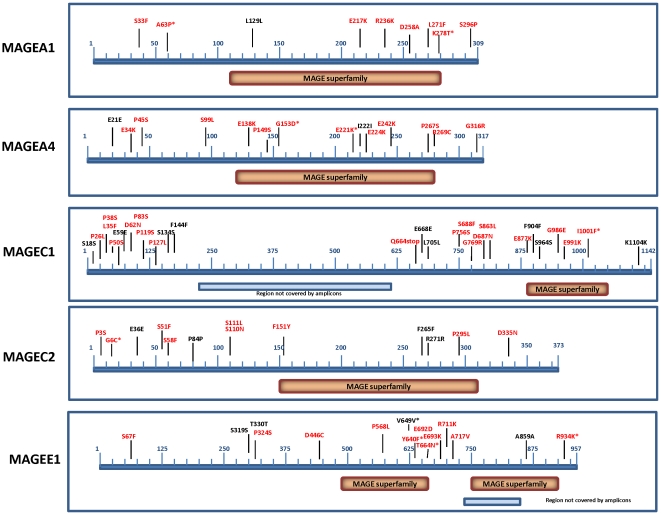
METHODOLOGY/PRINCIPAL FINDINGS: We undertook a mutational analysis of coding regions of four CT-X MAGE genes, MAGEA1, MAGEA4, MAGEC1, MAGEC2 and the ubiquitously expressed MAGEE1 in human melanoma samples. We first examined cell lines established from tumors and matching blood samples from 27 melanoma patients. We found that melanoma cell lines from 37% of patients contained at least one mutated MAGE gene. The frequency of mutations in the coding regions of individual MAGE genes varied from 3.7% for MAGEA1 and MAGEA4 to 14.8% for MAGEC2. We also examined 111 fresh melanoma samples collected from 86 patients. In this case, samples from 32% of the patients exhibited mutations in one or more MAGE genes with the frequency of mutations in individual MAGE genes ranging from 6% in MAGEA1 to 16% in MAGEC1.
These results demonstrate for the first time that the MAGE gene family is frequently mutated in melanoma.
癌症/睾丸(CT)基因仅在生殖系和某些肿瘤中表达,并且最常位于 X 染色体上(CT-X 基因)。在研究最多的 CT-X 基因中,有编码几种 MAGE 蛋白家族的基因。MAGE 蛋白的功能尚未完全了解,但已发现其中几种可能影响肿瘤发生表型。
方法/主要发现:我们对来自人类黑色素瘤样本的四个 CT-X MAGE 基因(MAGEA1、MAGEA4、MAGEC1、MAGEC2 和普遍表达的 MAGEE1)的编码区进行了突变分析。我们首先检查了来自 27 名黑色素瘤患者的肿瘤和匹配血液样本建立的细胞系。我们发现,37%的患者的黑色素瘤细胞系至少含有一个突变的 MAGE 基因。个别 MAGE 基因编码区的突变频率从 MAGEA1 和 MAGEA4 的 3.7%到 MAGEC2 的 14.8%不等。我们还检查了从 86 名患者中收集的 111 个新鲜黑色素瘤样本。在这种情况下,32%的患者的一个或多个 MAGE 基因发生突变,个别 MAGE 基因的突变频率从 MAGEA1 的 6%到 MAGEC1 的 16%不等。
这些结果首次证明 MAGE 基因家族在黑色素瘤中经常发生突变。