Department of Biology, Stanford University, Stanford, California, USA.
Cytoskeleton (Hoboken). 2010 Dec;67(12):755-72. doi: 10.1002/cm.20485. Epub 2010 Nov 2.
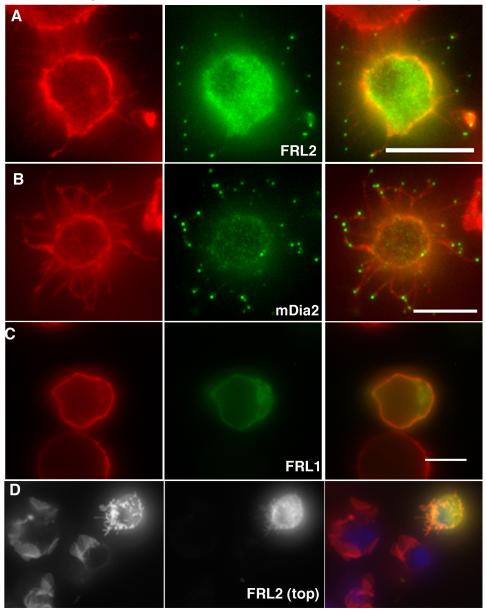
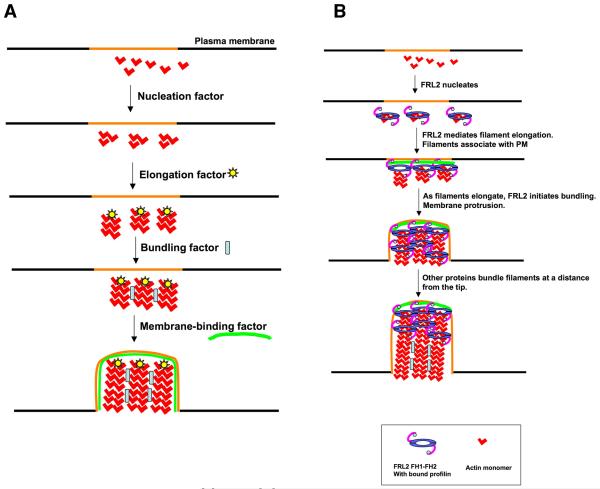
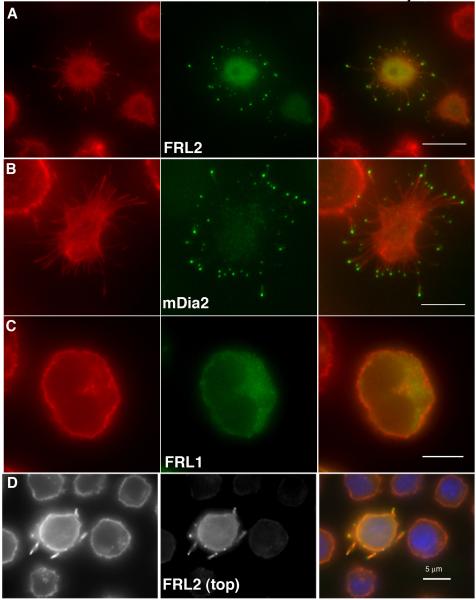
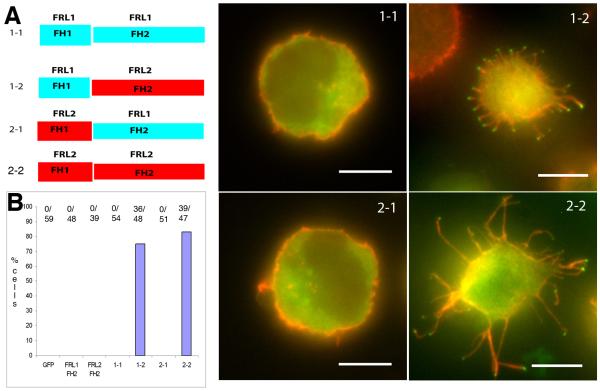
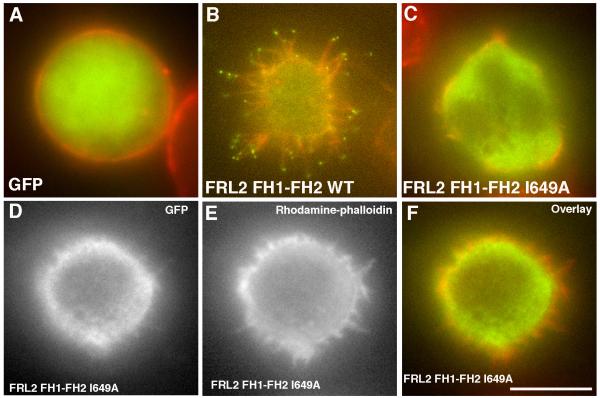
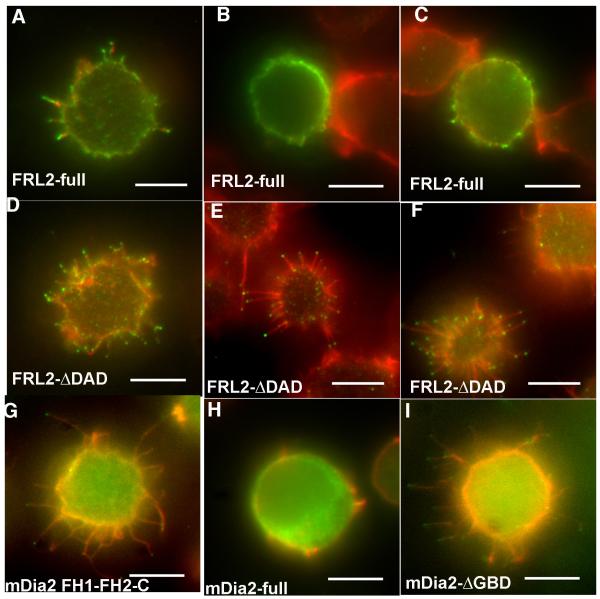
Actin-dependent finger-like protrusions such as filopodia and microvilli are widespread in eukaryotes, but their assembly mechanisms are poorly understood. Filopodia assembly requires at least three biochemical activities on actin: actin filament nucleation, prolonged actin filament elongation, and actin filament bundling. These activities are shared by several mammalian formin proteins, including mDia2, FRL1 (also called FMNL1), and FRL2 (FMNL3). In this paper, we compare the abilities of constructs from these three formins to induce filopodia. FH1-FH2 constructs of both FRL2 and mDia2 stimulate potent filopodia assembly in multiple cell types, and enrich strongly at filopodia tips. In contrast, FRL1 FH1-FH2 lacks this activity, despite possessing similar biochemical activities and being highly homologous to FRL2. Chimeric FH1-FH2 experiments between FRL1 and FRL2 show that, while both an FH1 and an FH2 are needed, either FH1 domain supports filopodia assembly but only FRL2's FH2 domain allows this activity. A mutation that compromises FRL2's barbed end binding ability abolishes filopodia assembly. FRL2's ability to stimulate filopodia assembly is not altered by additional domains (GBD, DID, DAD), but is significantly reduced in the full-length construct, suggesting that FRL2 is subject to inhibitory regulation. The data suggest that the FH2 domain of FRL2 possesses properties not shared by FRL1 that allow it to generate filopodia.
依赖肌动蛋白的指状突起,如丝状伪足和微绒毛,广泛存在于真核生物中,但它们的组装机制尚不清楚。丝状伪足的组装需要肌动蛋白至少三种生化活性:肌动蛋白丝核形成、肌动蛋白丝的延长和肌动蛋白丝的束集。这些活性由几种哺乳动物formin 蛋白共享,包括 mDia2、FRL1(也称为 FMNL1)和 FRL2(FMNL3)。在本文中,我们比较了这三种formin 蛋白的构建体诱导丝状伪足的能力。FRL2 和 mDia2 的 FH1-FH2 构建体均可在多种细胞类型中强烈刺激丝状伪足的组装,并在丝状伪足的尖端强烈富集。相比之下,尽管 FRL1 具有相似的生化活性和高度同源性,但 FRL1 的 FH1-FH2 缺乏这种活性。FRL1 和 FRL2 之间的 FH1-FH2 嵌合实验表明,虽然需要 FH1 和 FH2,但任何一个 FH1 结构域都支持丝状伪足的组装,但只有 FRL2 的 FH2 结构域允许这种活性。破坏 FRL2 的加帽末端结合能力的突变会导致丝状伪足的组装被破坏。FRL2 刺激丝状伪足组装的能力不受额外结构域(GBD、DID、DAD)的影响,但在全长构建体中显著降低,这表明 FRL2 受到抑制调节。这些数据表明,FRL2 的 FH2 结构域具有 FRL1 所不具备的特性,使其能够产生丝状伪足。