Department of Biology and Biochemistry, University of Bath, Claverton Down, Bath BA2 7AY, UK.
Biochem J. 2010 Dec 15;432(3):515-23. doi: 10.1042/BJ20100717.
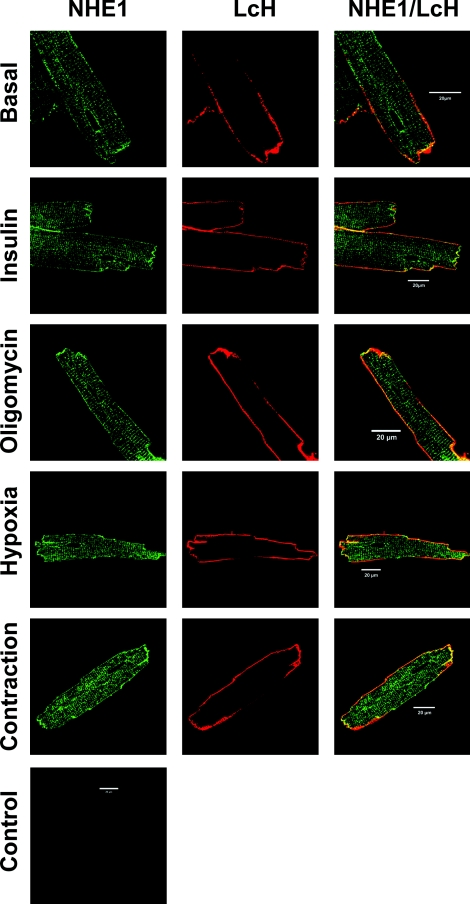
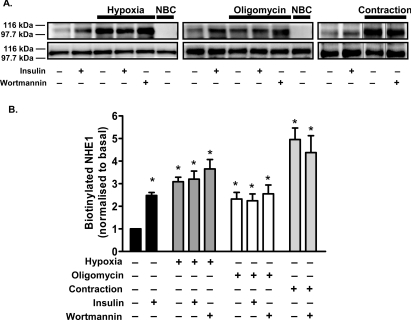
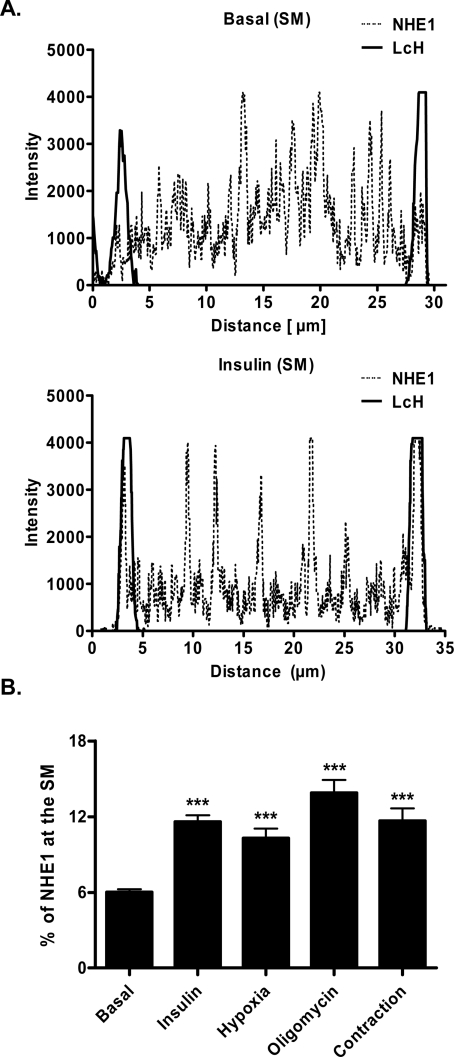
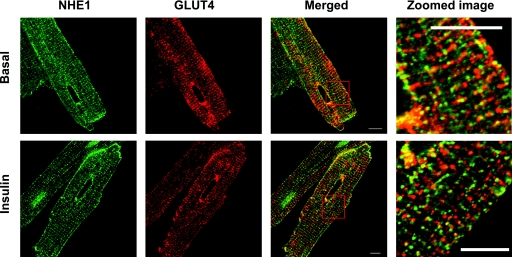
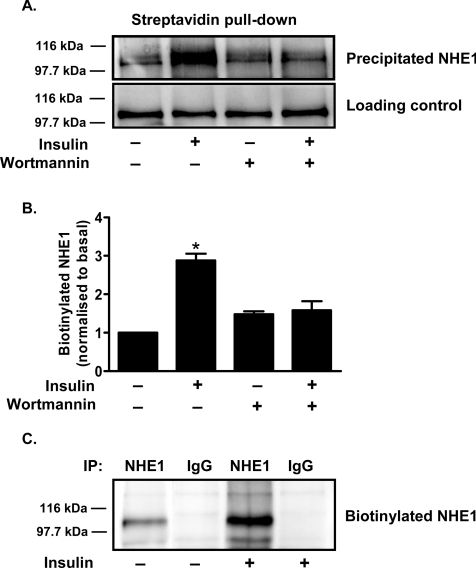
The Na+/H+ exchanger NHE1 is a highly regulated membrane protein that is required for pH homoeostasis in cardiomyocytes. The activation of NHE1 leads to proton extrusion, which is essential for counteracting cellular acidity that occurs following increased metabolic activity or ischaemia. The activation of NHE1 intrinsic catalytic activity has been well characterized and established experimentally. However, we have examined in the present study whether a net translocation of NHE1 to the sarcolemma of cardiomyocytes may also be involved in the activation process. We have determined the distribution of NHE1 by means of immunofluorescence microscopy and cell-surface biotinylation. We have discovered changes in the distribution of NHE1 that occur when cardiomyocytes are stimulated with insulin that are PI3K (phosphoinositide 3-kinase)-dependent. Translocation of NHE1 also occurs when cardiomyocytes are challenged by hypoxia, or inhibition of mitochondrial oxidative metabolism or electrically induced contraction, but these responses occur through a PI3K-independent process. As the proposed additional level of control of NHE1 through translocation was unexpected, we have compared this process with the well-established translocation of the glucose transporter GLUT4. In immunofluorescence microscopy comparisons, the translocation of NHE1 and GLUT4 to the sarcolemma that occur in response to insulin appear to be very similar. However, in basal unstimulated cells the two proteins are mainly located, with the exception of some co-localization in the perinuclear region, in distinct subcellular compartments. We propose that the mechanisms of translocation of NHE1 and GLUT4 are linked such that they provide spatially and temporally co-ordinated responses to cardiac challenges that necessitate re-adjustments in glucose transport, glucose metabolism and cell pH.
钠/氢交换器 NHE1 是一种高度调节的膜蛋白,对于心肌细胞的 pH 平衡至关重要。NHE1 的激活导致质子外排,这对于抵消代谢活动增加或缺血时发生的细胞酸中毒至关重要。NHE1 内在催化活性的激活已得到很好的描述和实验验证。然而,我们在本研究中检查了 NHE1 是否也可能通过向心肌细胞的肌膜净转位参与激活过程。我们通过免疫荧光显微镜和细胞膜生物素化来确定 NHE1 的分布。我们发现,当心肌细胞受到胰岛素刺激时,NHE1 的分布会发生变化,这种变化依赖于 PI3K(磷酸肌醇 3-激酶)。当心肌细胞受到缺氧、线粒体氧化代谢抑制或电诱导收缩的挑战时,NHE1 也会发生转位,但这些反应是通过 PI3K 独立的过程发生的。由于通过转位对 NHE1 进行额外控制的提议出乎意料,我们将这个过程与葡萄糖转运体 GLUT4 的既定转位进行了比较。在免疫荧光显微镜比较中,胰岛素引起的 NHE1 和 GLUT4 向肌膜的转位似乎非常相似。然而,在基础未刺激的细胞中,除了核周区域的一些共定位外,两种蛋白主要位于不同的亚细胞隔室中。我们提出,NHE1 和 GLUT4 的转位机制是相互关联的,它们为需要重新调整葡萄糖转运、葡萄糖代谢和细胞 pH 的心脏挑战提供了空间和时间上协调的反应。