School of Software, Tsinghua University, Beijing 100084, China.
BMC Bioinformatics. 2010 Sep 24;11:480. doi: 10.1186/1471-2105-11-480.
Many molecules are flexible and undergo significant shape deformation as part of their function, and yet most existing molecular shape comparison (MSC) methods treat them as rigid bodies, which may lead to incorrect shape recognition.
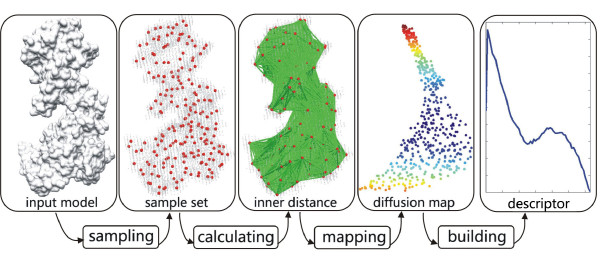
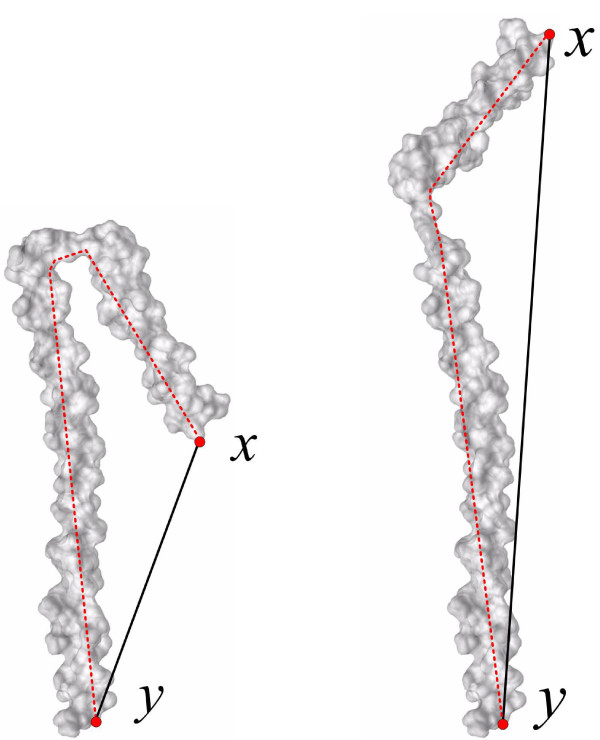
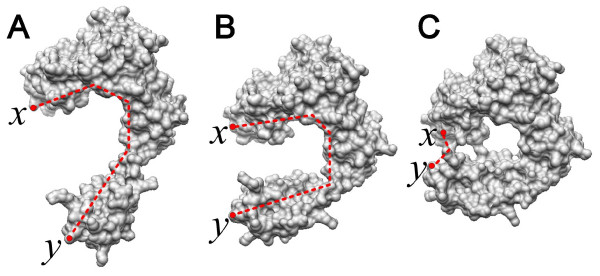
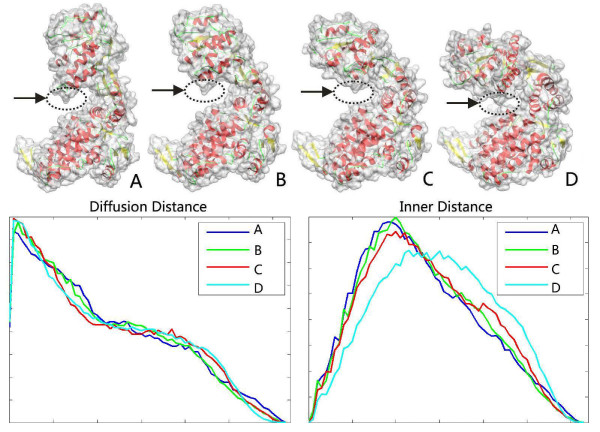
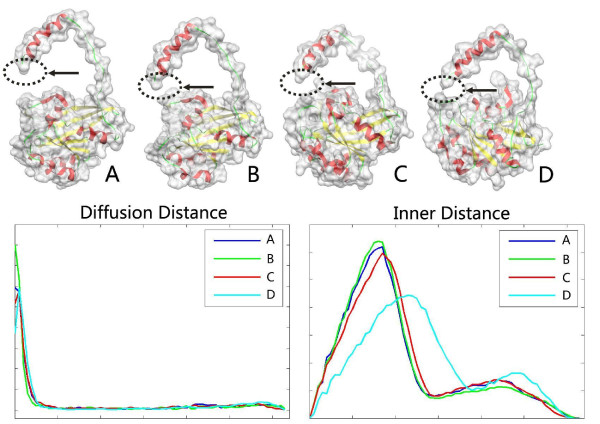
In this paper, we present a new shape descriptor, named Diffusion Distance Shape Descriptor (DDSD), for comparing 3D shapes of flexible molecules. The diffusion distance in our work is considered as an average length of paths connecting two landmark points on the molecular shape in a sense of inner distances. The diffusion distance is robust to flexible shape deformation, in particular to topological changes, and it reflects well the molecular structure and deformation without explicit decomposition. Our DDSD is stored as a histogram which is a probability distribution of diffusion distances between all sample point pairs on the molecular surface. Finally, the problem of flexible MSC is reduced to comparison of DDSD histograms.
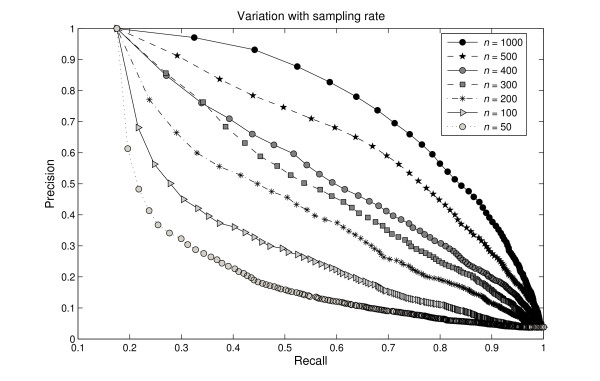
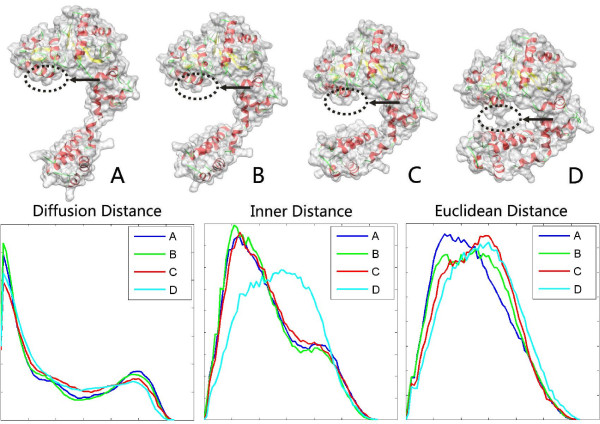
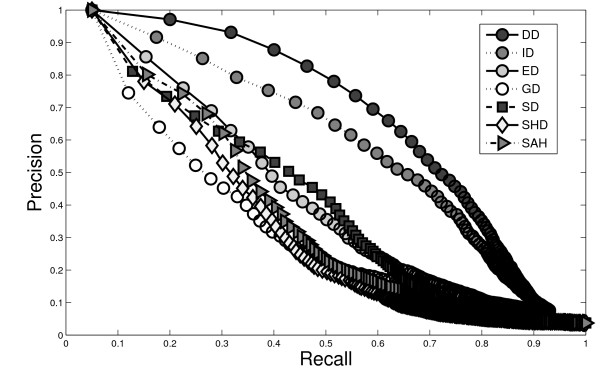
We illustrate that DDSD is insensitive to shape deformation of flexible molecules and more effective at capturing molecular structures than traditional shape descriptors. The presented algorithm is robust and does not require any prior knowledge of the flexible regions.
许多分子是灵活的,并在其功能的一部分经历显著的形状变形,但大多数现有的分子形状比较(MSC)方法将它们作为刚体处理,这可能导致不正确的形状识别。
在本文中,我们提出了一种新的形状描述符,称为扩散距离形状描述符(DDSD),用于比较柔性分子的 3D 形状。在我们的工作中,扩散距离被认为是连接分子形状上两个基准点的路径的平均长度,在内部距离的意义上。扩散距离对柔性形状变形具有鲁棒性,特别是对拓扑变化具有鲁棒性,并且它在没有显式分解的情况下很好地反映了分子结构和变形。我们的 DDSD 存储为一个直方图,这是分子表面上所有样本点对之间的扩散距离的概率分布。最后,柔性 MSC 的问题被简化为 DDSD 直方图的比较。
我们表明,DDSD 对柔性分子的形状变形不敏感,并且比传统的形状描述符更有效地捕获分子结构。所提出的算法是鲁棒的,不需要任何关于柔性区域的先验知识。