MRC Social and Public Health Sciences Unit, 4 Lilybank Gardens, Glasgow G12 8RZ, UK.
Soc Sci Med. 2010 Nov;71(10):1819-30. doi: 10.1016/j.socscimed.2010.08.012. Epub 2010 Sep 15.
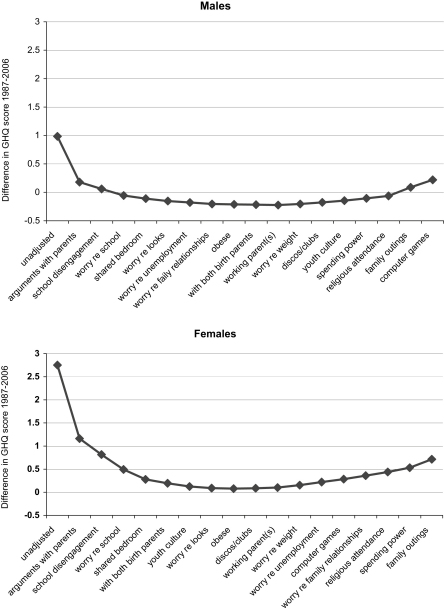
This paper aims to explain previously described increases in self-reported psychological distress between 1987 and 2006 among samples identical in respect of age (15 years), school year and geographical location (West of Scotland). Such increases might be explained by changes in exposure (changes in levels of risk or protective factors) and/or by changes in vulnerability (changes in the relationship between risk/protective factors and psychological distress). Key areas of social change over this time period allow identification of potential explanatory factors, categorised as economic, family, educational, values and lifestyle and represented by variables common to each study. Psychological distress was measured via the 12-item General Health Questionnaire, Likert scored. Analyses were conducted on those with complete data on all variables (N = 3276 of 3929), and separately for males and females. Between 1987 and 2006, levels of almost every potential explanatory factor changed in line with general societal trends. Associations between explanatory factors and GHQ tended to be stronger among females, and at the later date. The strongest associations were with worries, arguments with parents, and, at the later date, school disengagement. The factors which best accounted for the increase in mean GHQ between 1987 and 2006 were arguments with parents, school disengagement, worry about school and, for females, worry about family relationships, reflecting both increasing exposure and vulnerability to these risk factors. A number of limitations to our analysis can be identified. However, our results reinforce the conclusions of others in highlighting the role of family and educational factors as plausible explanations for increases in young people's psychological distress.
本文旨在解释在年龄(15 岁)、学年和地理位置(苏格兰西部)相同的样本中,1987 年至 2006 年间自我报告的心理困扰增加的现象。这种增加可能是由于暴露(风险或保护因素水平的变化)和/或易感性(风险/保护因素与心理困扰之间关系的变化)的变化所致。在此期间,社会的关键变化领域允许确定潜在的解释因素,这些因素可分为经济、家庭、教育、价值观和生活方式,并由每个研究共有的变量表示。心理困扰通过 12 项一般健康问卷(Likert 评分)进行测量。对所有变量都有完整数据的人(3929 人中的 3276 人)进行了分析,并分别对男性和女性进行了分析。在 1987 年至 2006 年期间,几乎所有潜在解释因素的水平都与一般社会趋势一致。在女性中,解释因素与 GHQ 之间的关联更为强烈,而且在后期更为强烈。最强的关联是与父母的争吵,以及在后期,与学校的脱节。在解释 1987 年至 2006 年间 GHQ 均值增加方面,最佳的因素是与父母的争吵、与学校的脱节、对学校的担忧,以及对于女性而言,对家庭关系的担忧,这反映了对这些危险因素的暴露和易感性都在增加。我们的分析存在一些局限性。然而,我们的结果强化了其他人的结论,即强调家庭和教育因素是年轻人心理困扰增加的合理解释。