Division of Rheumatology, University of Colorado School of Medicine, Aurora, CO 80045, USA.
J Immunol. 2010 Nov 1;185(9):5598-606. doi: 10.4049/jimmunol.1001564. Epub 2010 Sep 24.
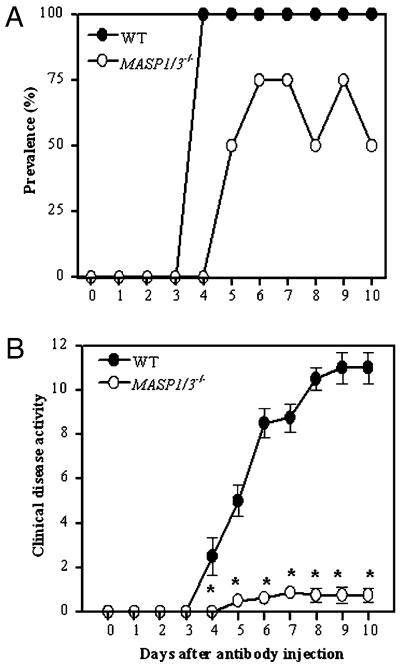
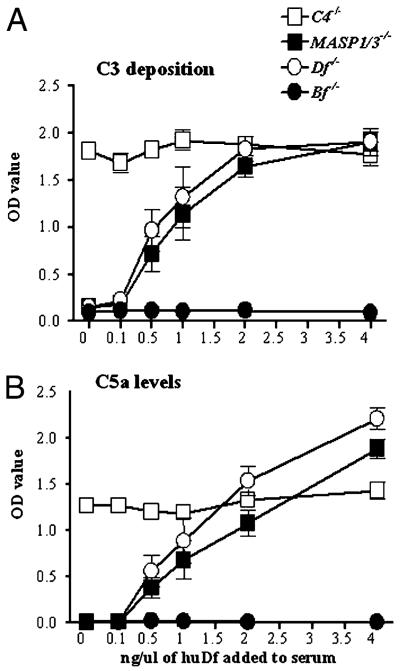
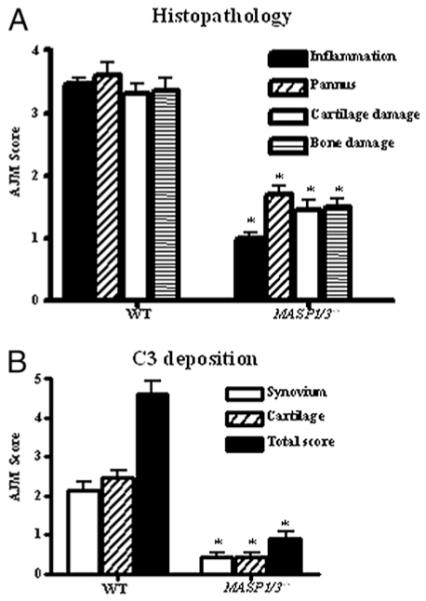
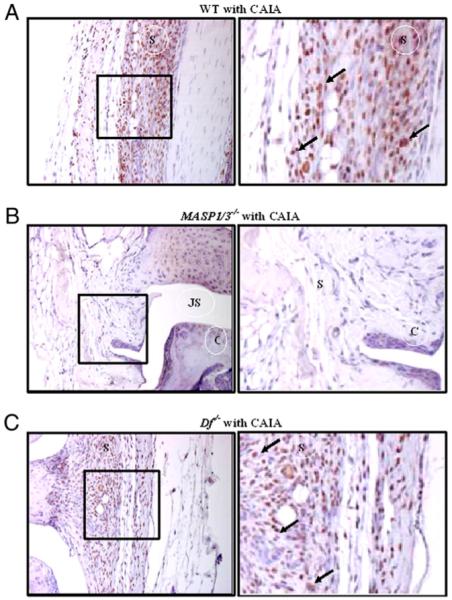
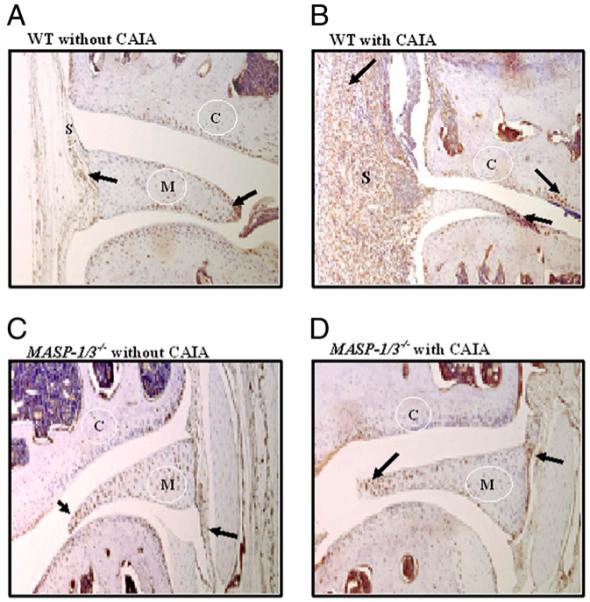
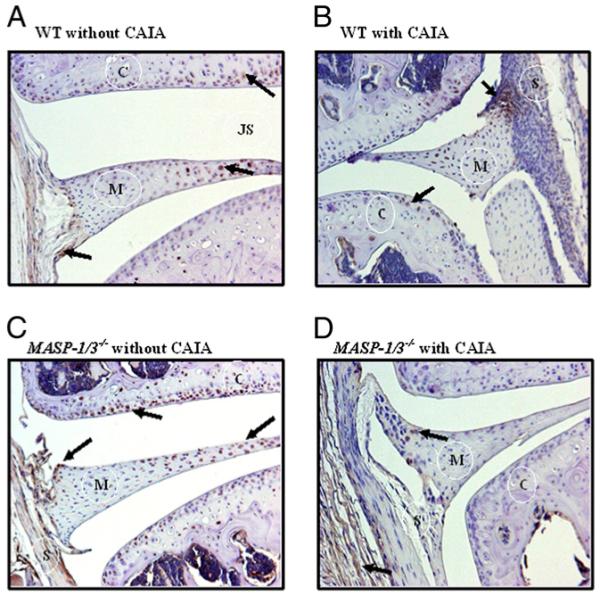
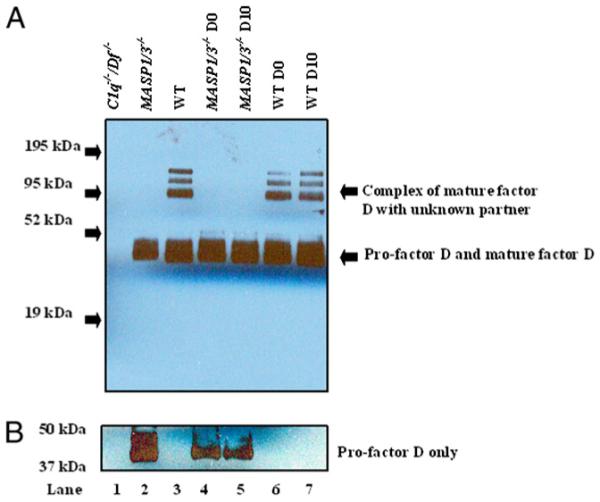
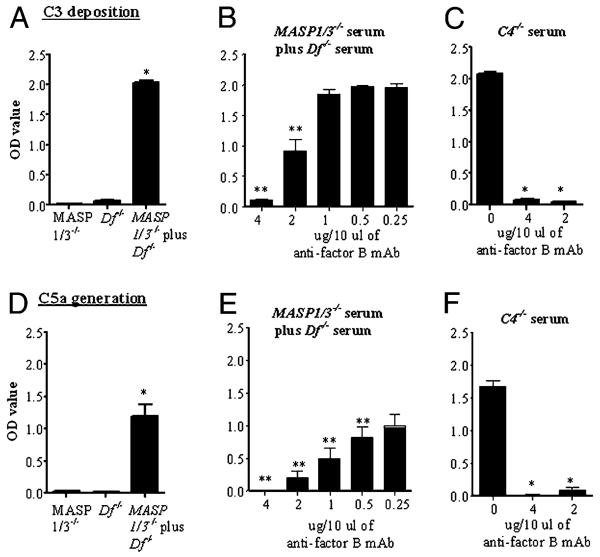
Gene-targeted mice deficient in the complement mannose-binding lectin-associated serine protease-1 and -3 (MASP1/3(-/-)) express only the zymogen of factor D (pro-factor D [pro-Df]), a necessary component of the alternative pathway (AP). We used the murine collagen Ab-induced arthritis (CAIA) model, in which the AP is unique among complement pathways in being both necessary and sufficient for disease induction, to determine whether MASP-1/3 are required in vivo for the development of tissue injury. Disease activity scores, complement C3 tissue deposition in the joint, and histopathologic injury scores were markedly decreased in MASP1/3(-/-) as compared with wild-type (WT) mice. MASP-1 protein was immunochemically localized to synovial cells of knees of WT mice with arthritis. Pro-Df was present in both synovial cells and chondrocytes of knees of WT and MASP1/3(-/-) mice without arthritis, with increased amounts present in synovial cells of WT mice with CAIA. No conversion of pro-Df to mature Df was detectable in the serum of MASP1/3(-/-) mice during the evolution of CAIA. C3 activation and deposition as well as C5a generation induced in vitro by adherent anti-type II collagen mAbs were absent using sera from MASP1/3(-/-) mice under conditions in which only the AP was active. The addition of human Df fully reconstituted in vitro C3 activation and C5a generation using sera from MASP1/3(-/-) mice. Our studies demonstrate for the first time, to our knowledge, the absolute requirement for the activity of MASP-1 protein in autoimmune-associated inflammatory tissue injury in vivo through activation of the AP of complement by cleavage of pro-Df to mature Df.
基因敲除小鼠缺乏补体甘露糖结合凝集素相关丝氨酸蛋白酶-1 和 -3(MASP1/3(-/-))仅表达因子 D 的酶原(前因子 D [pro-Df]),因子 D 是替代途径(AP)的必要组成部分。我们使用了鼠胶原 Ab 诱导的关节炎(CAIA)模型,在该模型中,AP 是补体途径中唯一既需要又足以诱导疾病的途径,以确定 MASP-1/3 是否在体内对组织损伤的发展是必需的。与野生型(WT)小鼠相比,MASP1/3(-/-)小鼠的疾病活动评分、关节组织中补体 C3 的沉积和组织病理学损伤评分均显著降低。MASP-1 蛋白在关节炎 WT 小鼠的滑膜细胞中免疫化学定位。在没有关节炎的 WT 和 MASP1/3(-/-)小鼠的膝关节滑膜细胞和软骨细胞中均存在前因子 Df,而在 CAIA 的 WT 小鼠的滑膜细胞中存在更多的前因子 Df。在 CAIA 演变过程中,在 MASP1/3(-/-)小鼠的血清中未检测到前因子 Df 向成熟 Df 的转化。在仅激活 AP 的条件下,使用来自 MASP1/3(-/-)小鼠的血清,无法检测到体外粘附抗 II 型胶原 mAb 诱导的 C3 激活和沉积以及 C5a 的生成。用来自 MASP1/3(-/-)小鼠的血清在体外完全重建 C3 激活和 C5a 生成,加入人 Df。我们的研究首次证明,在体内自身免疫相关的炎症性组织损伤中,MASP-1 蛋白的活性通过裂解前因子 Df 产生成熟 Df 来激活补体的 AP,这是绝对必需的。