College of Plant Science & Technology, Hubei Key Laboratory of Utilization of Insect Resources and Sustainable Control of Pests, Huazhong Agricultural University, Shizi Mountain Road, Wuhan 430070, China.
Ecotoxicology. 2010 Nov;19(8):1612-9. doi: 10.1007/s10646-010-0546-4. Epub 2010 Sep 26.
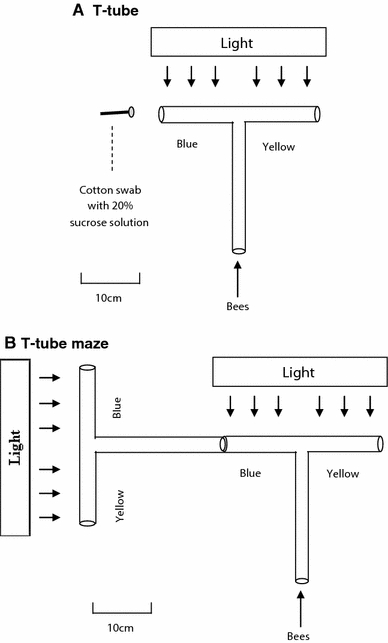
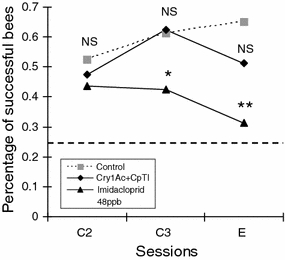
Transgenic Cry1Ac+CpTI cotton (CCRI41) is a promising cotton cultivar throughout China but side effects and especially sublethal effects of this transgenic cultivar on beneficial insects remain poorly studied. More specifically potential sublethal effects on behavioural traits of the honey bee Apis mellifera L. have not been formally assessed despite the importance of honey bees for pollination. The goal of our study was to assess potential effects of CCRI41 cotton pollen on visual and olfactory learning by honey bees. After a 7-day oral chronic exposure to honey mixed with either CCRI41 pollen, imidacloprid-treated conventional pollen (used as positive sublethal control) or conventional pollen (control), learning performance was evaluated by the classical proboscis extension reflex (PER) procedure as well as a T-tube maze test. The latter assay was designed as a new device to assess potential side effects of pesticides on visual associative learning of honey bees. These two procedures were complementary because the former focused on olfactory learning while the latter was involved in visual learning based on visual orientation ability. Oral exposure to CCRI41 pollen did not affect learning capacities of honey bees in both the T-tube maze and PER tests. However, exposure to imidacloprid resulted in reduced visual learning capacities in T-tube maze evaluation and decreased olfactory learning performances measured with PER. The implications of these results are discussed in terms of risks of transgenic CCRI41 cotton crops for honey bees.
转 Cry1Ac+CpTI 基因抗虫棉(CCRI41)在中国是一种很有前景的棉花品种,但这种转基因品种对有益昆虫的副作用,尤其是亚致死效应,仍研究甚少。特别是,尽管蜜蜂对授粉很重要,但这种转基因品种对蜜蜂行为特征的潜在亚致死效应尚未得到正式评估。我们的研究目的是评估 CCRI41 棉花花粉对蜜蜂视觉和嗅觉学习的潜在影响。在经过 7 天的口服慢性接触与 CCRI41 花粉、用吡虫啉处理的常规花粉(用作阳性亚致死对照)或常规花粉(对照)混合的蜂蜜后,通过经典的触角延伸反射(PER)程序以及 T 型管迷宫测试来评估学习表现。后者的测定设计是一种新的设备,用于评估农药对蜜蜂视觉联想学习的潜在副作用。这两种程序是互补的,因为前者侧重于嗅觉学习,而后者则基于视觉定向能力涉及视觉学习。口服接触 CCRI41 花粉对蜜蜂在 T 型管迷宫和 PER 测试中的学习能力均无影响。然而,吡虫啉暴露导致 T 型管迷宫评估中的视觉学习能力下降,以及 PER 测量的嗅觉学习表现下降。这些结果的意义是从转 CCRI41 棉花作物对蜜蜂的风险角度来讨论的。