Health Protection Agency Centre for Infections, London, UK.
Emerg Infect Dis. 2010 Oct;16(10):1532-8. doi: 10.3201/eid1610.100560.
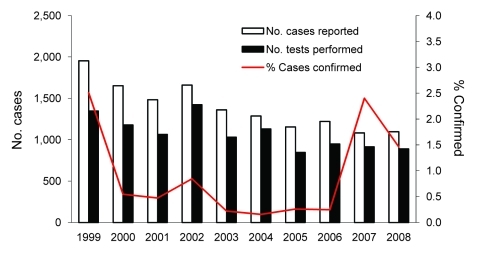
Surveillance of rubella in England and Wales has included immunoglobulin M testing of oral (crevicular) fluid from reported case-patients since 1994. The need for laboratory confirmation to monitor rubella elimination is emphasized by poor sensitivity (51%, 95% confidence interval 48.9%-54.0%) and specificity (55%, 95% confidence interval 53.7%-55.6%) of the clinical case definition. During 1999-2008, oral fluid from 11,709 (84%) of 13,952 reported case-patients was tested; 143 (1.0%) cases were confirmed and 11,566 (99%) were discarded (annual investigation and discard rate of clinically suspected rubella cases was 2,208/100,000 population). Incidence of confirmed rubella increased from 0.50 to 0.77/1 million population when oral fluid testing was included. Oral fluid tests confirmed that cases were more likely to be in older, unvaccinated men. Testing of oral fluid has improved ascertainment of confirmed rubella in children and men and provided additional information for assessing UK progress toward the World Health Organization elimination goal.
自 1994 年以来,英国和威尔士的风疹监测包括对报告病例患者的口腔(龈沟)液进行免疫球蛋白 M 检测。由于临床病例定义的敏感性(51%,95%置信区间为 48.9%-54.0%)和特异性(55%,95%置信区间为 53.7%-55.6%)较差,因此需要实验室确认来监测风疹消除情况。1999-2008 年期间,对 13952 名报告病例患者中的 11709 名(84%)进行了口腔液检测;确诊 143 例(1.0%),丢弃 11566 例(99%)(疑似风疹病例的年调查和丢弃率为 2208/10 万人口)。包括口腔液检测后,确诊风疹的发病率从 0.50 增至 0.77/10 万人口。口腔液检测证实,病例更可能发生在年龄较大、未接种疫苗的男性中。口腔液检测提高了对儿童和男性确诊风疹的检出率,并为评估英国在实现世界卫生组织消除目标方面的进展提供了更多信息。