Medical School, Department of Pathology and Laboratory Medicine, University of Texas-Houston, Houston, Tex 77030, USA.
Transl Res. 2010 Oct;156(4):207-15. doi: 10.1016/j.trsl.2010.06.001. Epub 2010 Jun 30.
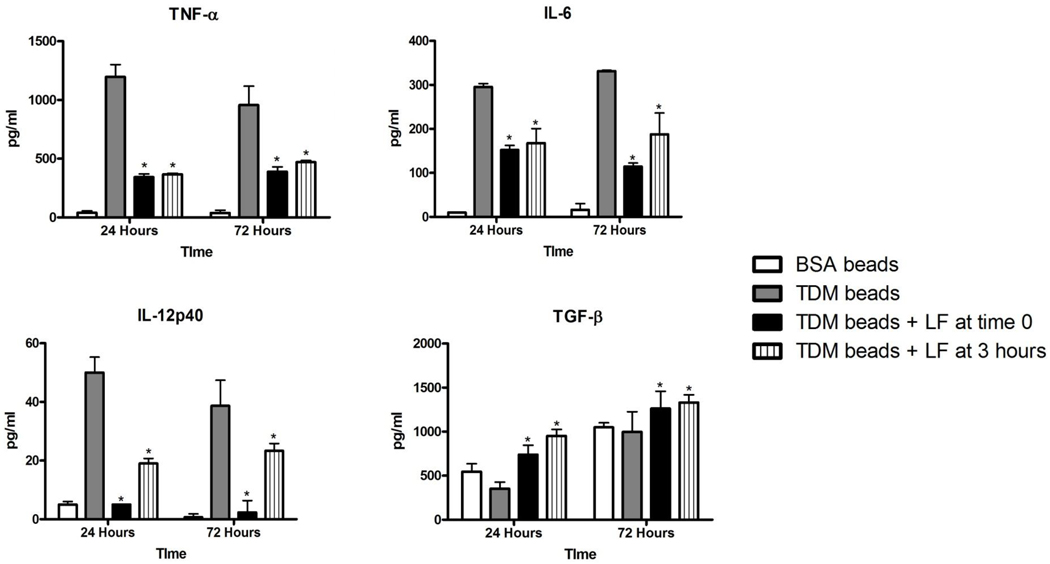
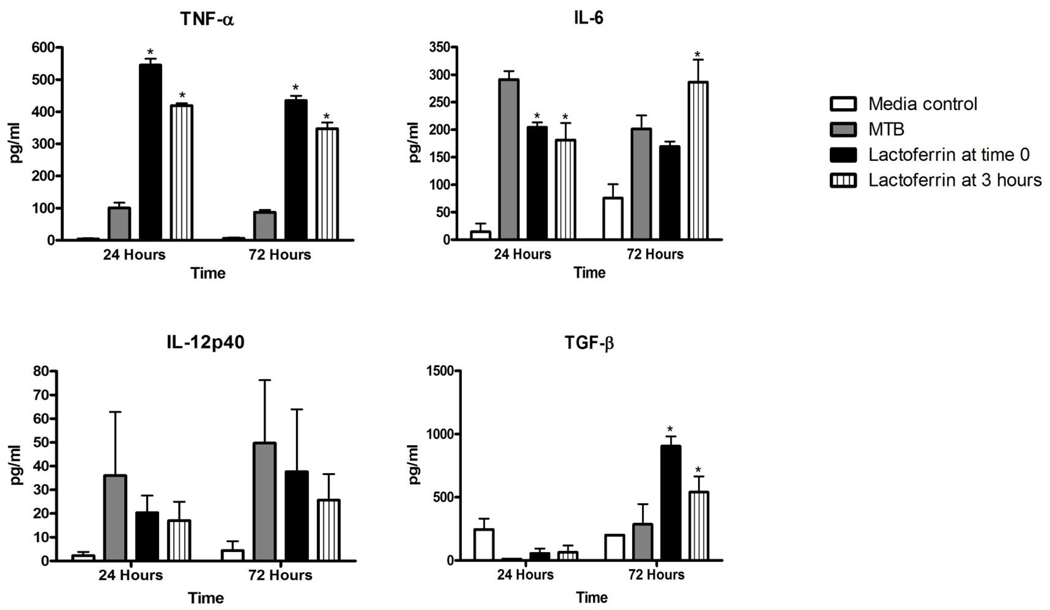
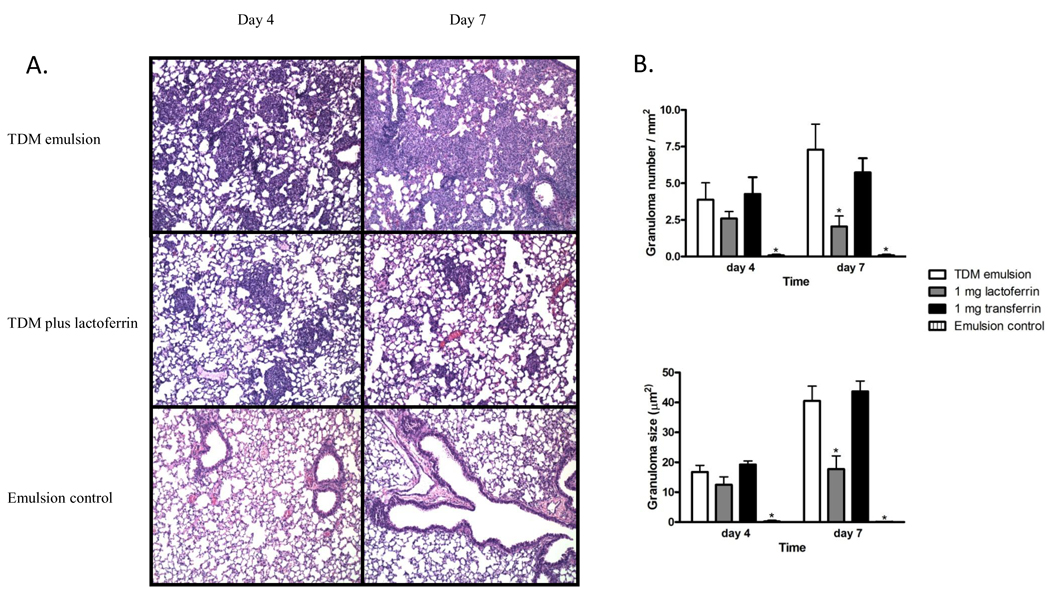
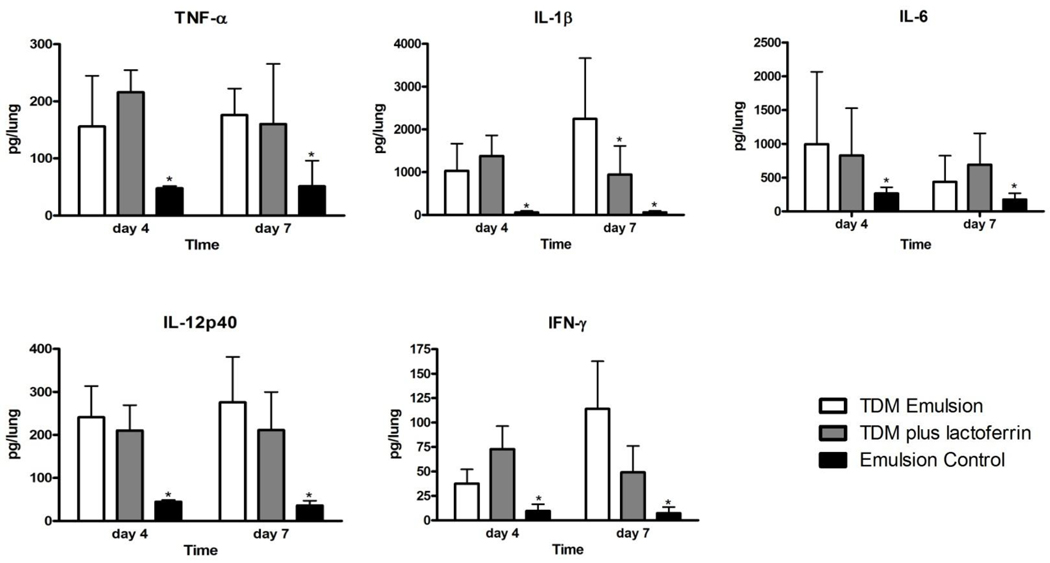
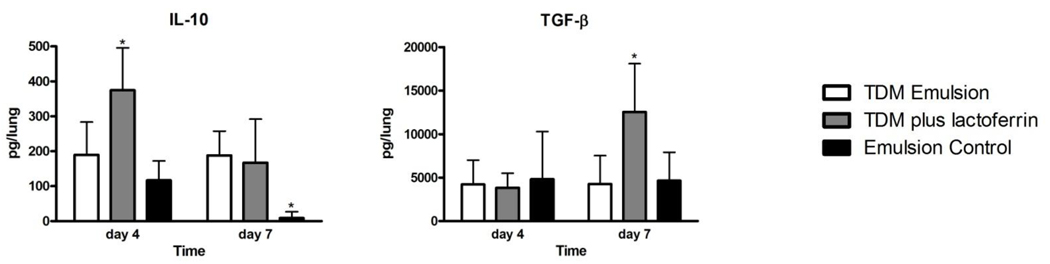
The immune system responds to tuberculosis (TB) infection by forming granulomas. However, subsequent immune-mediated destruction of lung tissue is a cause of significant morbidity and contributes to disease transmission. Lactoferrin, an iron-binding glycoprotein, has demonstrated immunomodulatory properties that decrease tissue destruction and promote T(H)1 immune responses, both of which are essential for controlling TB infection. The cord factor trehalose 6,6'-dimycolate (TDM) model of granuloma formation mimics many aspects of TB infection with a similar histopathology accompanied by proinflammatory cytokine production. C57BL/6 mice were injected intravenously with TDM. A subset of mice was given 1 mg of bovine lactoferrin 24 h post-TDM challenge. Lung tissue was analyzed for histological response and for the production of proinflammatory mediators. C57BL/6 mice demonstrated a granuloma formation that correlated with an increased production of interleukin (IL)-1β, IL-6, tumor necrosis factor-α (TNF-α,) IL-12p40, interferon-gamma (IFN-γ), and IL-10 protein. Mice treated with lactoferrin postchallenge had significantly fewer and smaller granulomas compared with those given TDM alone. Proinflammatory and T(H)1 cytokines essential to the control of mycobacterial infections, such as TNF-α and IFN-γ, were not significantly different in mice treated with lactoferrin. Furthermore, the anti-inflammatory cytokines IL-10 and transforming growth factor-β were increased. A potential mechanism for decreased tissue damage observed in the lactoferrin-treated mice is proposed. Because of its influence to modulate immune responses, lactoferrin may be a useful adjunct in the treatment of granulomatous inflammation occurring during mycobacterial infection.
免疫系统通过形成肉芽肿来应对结核分枝杆菌(TB)感染。然而,随后的免疫介导的肺组织破坏是导致发病率显著增加的原因,并有助于疾病传播。乳铁蛋白是一种铁结合糖蛋白,具有免疫调节特性,可减少组织破坏并促进 T(H)1 免疫应答,这两者对于控制 TB 感染都是必不可少的。棉子糖 6,6'-二-mycolate(TDM)模型模拟了 TB 感染的许多方面,具有相似的组织病理学,伴随着促炎细胞因子的产生。C57BL/6 小鼠静脉内注射 TDM。一部分小鼠在 TDM 挑战后 24 小时给予 1 毫克牛乳铁蛋白。分析肺组织的组织学反应和促炎介质的产生。C57BL/6 小鼠形成的肉芽肿与白细胞介素(IL)-1β、IL-6、肿瘤坏死因子-α(TNF-α)、IL-12p40、干扰素-γ(IFN-γ)和 IL-10 蛋白的产生增加相关。与单独给予 TDM 的小鼠相比,乳铁蛋白处理的小鼠的肉芽肿数量和体积明显减少。在接受乳铁蛋白治疗的小鼠中,对控制分枝杆菌感染至关重要的促炎和 T(H)1 细胞因子,如 TNF-α和 IFN-γ,与单独给予 TDM 的小鼠没有显著差异。此外,抗炎细胞因子 IL-10 和转化生长因子-β增加。提出了观察到的乳铁蛋白处理小鼠组织损伤减少的潜在机制。由于其影响调节免疫反应,乳铁蛋白可能是分枝杆菌感染期间发生的肉芽肿性炎症治疗的有用辅助手段。