Swiss Federal Institute of Technology Lausanne, School of Life Sciences, Swiss Institute for Experimental Cancer Research, CH-1015 Lausanne, Switzerland.
J Cell Biol. 2010 Oct 4;191(1):129-39. doi: 10.1083/jcb.201005026. Epub 2010 Sep 27.
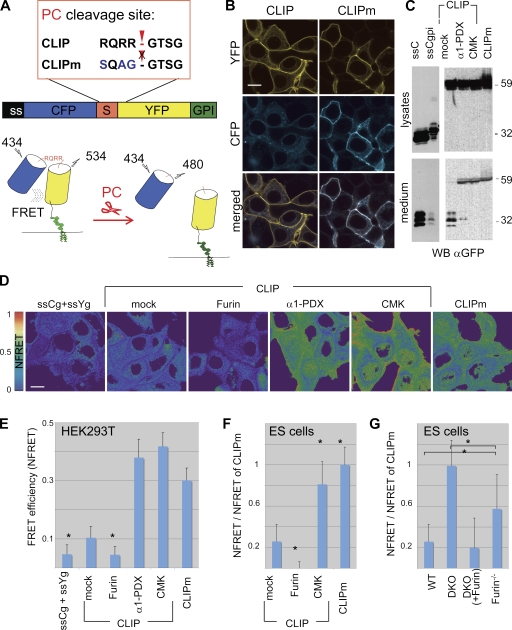
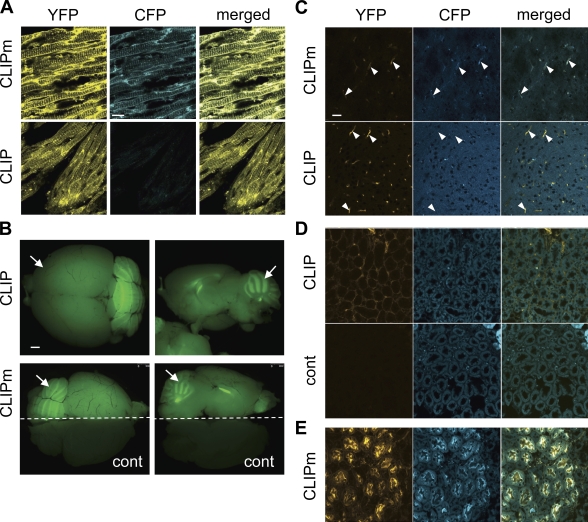
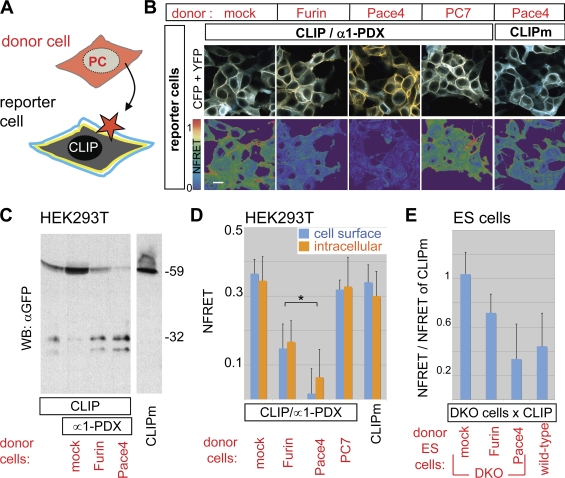
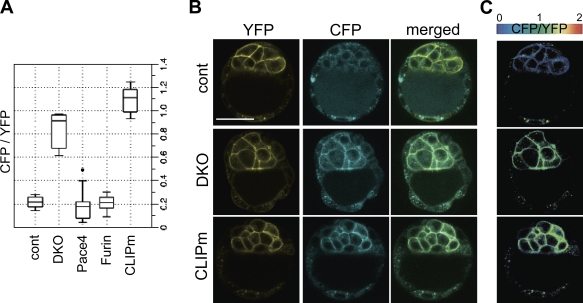
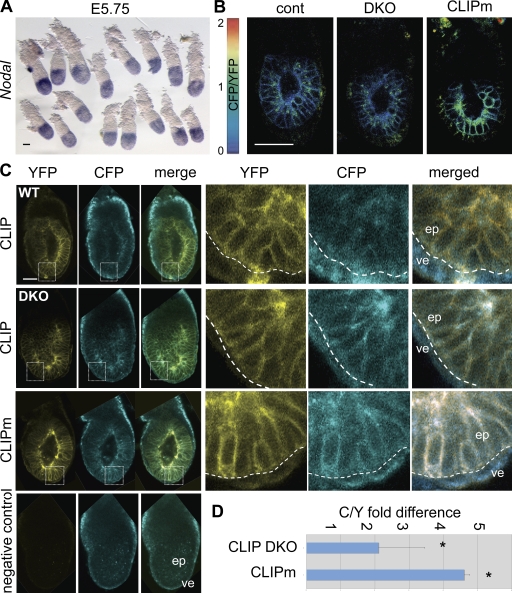
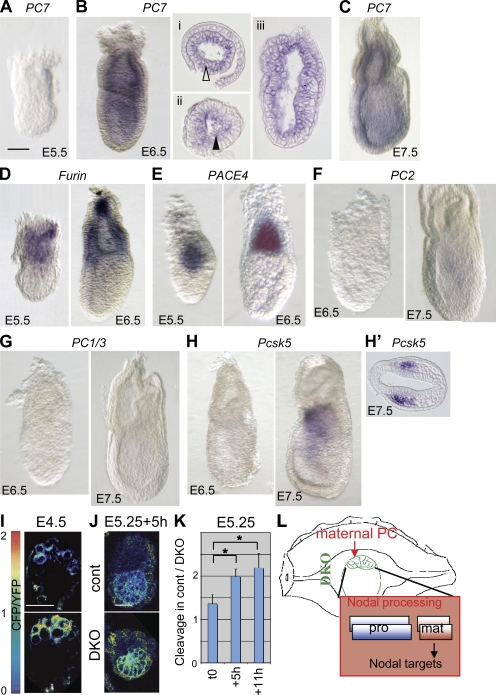
Axis formation and allocation of pluripotent progenitor cells to the germ layers are governed by the TGF-β-related Nodal precursor and its secreted proprotein convertases (PCs) Furin and Pace4. However, when and where Furin and Pace4 first become active have not been determined. To study the distribution of PCs, we developed a novel cell surface-targeted fluorescent biosensor (cell surface-linked indicator of proteolysis [CLIP]). Live imaging of CLIP in wild-type and Furin- and Pace4-deficient embryonic stem cells and embryos revealed that Furin and Pace4 are already active at the blastocyst stage in the inner cell mass and can cleave membrane-bound substrate both cell autonomously and nonautonomously. CLIP was also cleaved in the epiblast of implanted embryos, in part by a novel activity in the uterus that is independent of zygotic Furin and Pace4, suggesting a role for maternal PCs during embryonic development. The unprecedented sensitivity and spatial resolution of CLIP opens exciting new possibilities to elucidate PC functions in vivo.
轴形成和多能祖细胞向胚层的分配受 TGF-β 相关的 Nodal 前体及其分泌的蛋白水解酶原(PCs)Furin 和 Pace4 调控。然而,Furin 和 Pace4 何时以及何地首次变得活跃尚未确定。为了研究 PCs 的分布,我们开发了一种新型细胞表面靶向荧光生物传感器(细胞表面连接的蛋白水解指示剂 [CLIP])。CLIP 在野生型和 Furin 和 Pace4 缺陷型胚胎干细胞和胚胎中的实时成像显示,Furin 和 Pace4 在内细胞团的胚泡阶段已经活跃,并且可以自主和非自主地切割膜结合的底物。CLIP 也在植入胚胎的上胚层中被切割,部分是由子宫中的一种新的活性引起的,这种活性独立于合子 Furin 和 Pace4,表明母体 PCs 在胚胎发育过程中发挥作用。CLIP 的空前灵敏度和空间分辨率为阐明体内 PCs 的功能开辟了令人兴奋的新可能性。