INRA, UMR CBGP (INRA/IRD/Cirad/Montpellier SupAgro), Campus international de Baillarguet, CS 30016, F-34988 Montferrier-sur-Lez cedex, France.
BMC Evol Biol. 2010 Sep 28;10:295. doi: 10.1186/1471-2148-10-295.
Most aphid species complete their life cycle on the same set of host-plant species, but some (heteroecious species) alternate between different hosts, migrating from primary (woody) to secondary (herbaceous) host plants. The evolutionary processes behind the evolution of this complex life cycle have often been debated. One widely accepted scenario is that heteroecy evolved from monoecy on woody host plants. Several shifts towards monoecy on herbaceous plants have subsequently occurred and resulted in the radiation of aphids. Host alternation would have persisted in some cases due to developmental constraints preventing aphids from shifting their entire life cycle to herbaceous hosts (which are thought to be more favourable). According to this scenario, if aphids lose their primary host during evolution they should not regain it. The genus Brachycaudus includes species with all the types of life cycle (monoecy on woody plants, heteroecy, monoecy on herbs). We used this genus to test hypotheses concerning the evolution of life cycles in aphids.
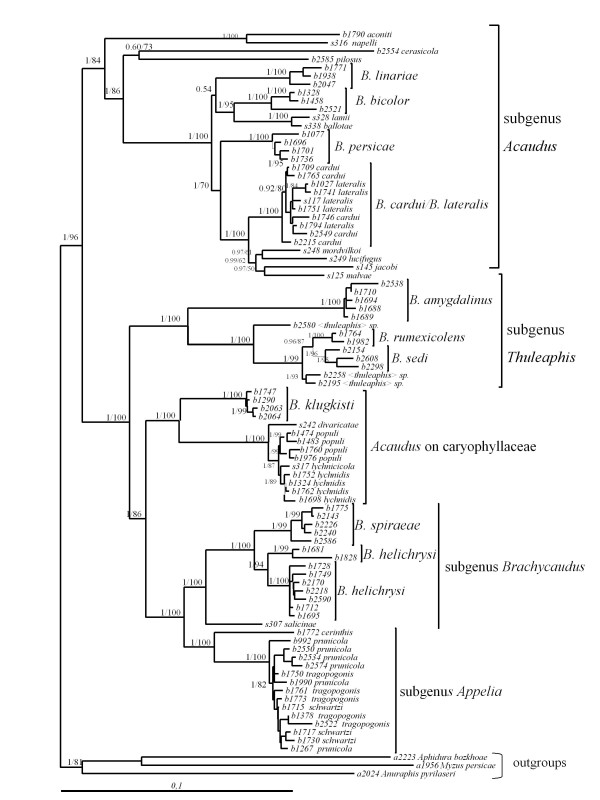
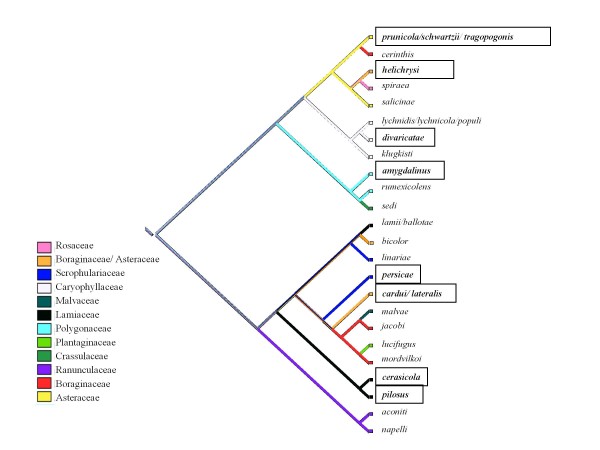
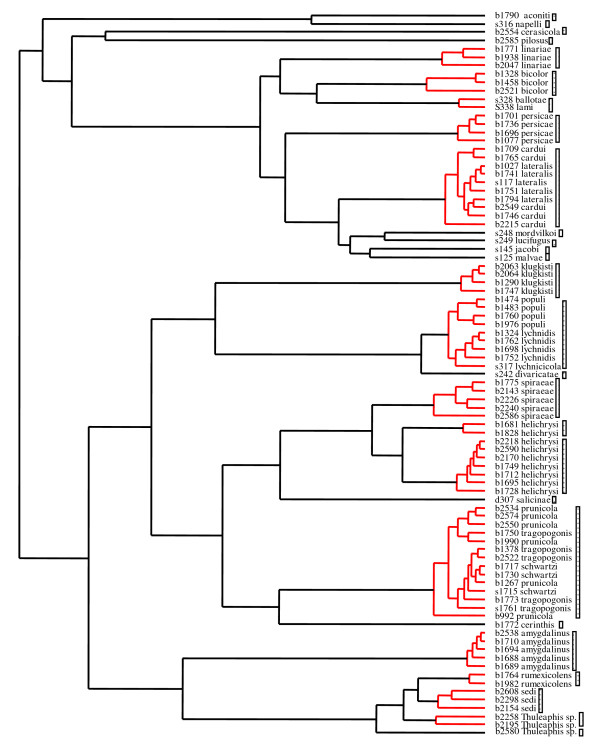
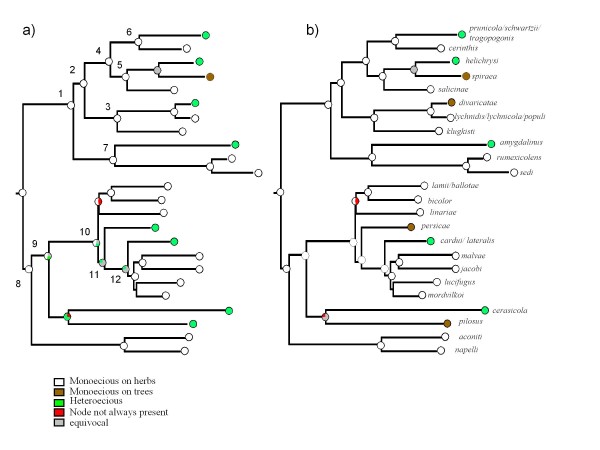
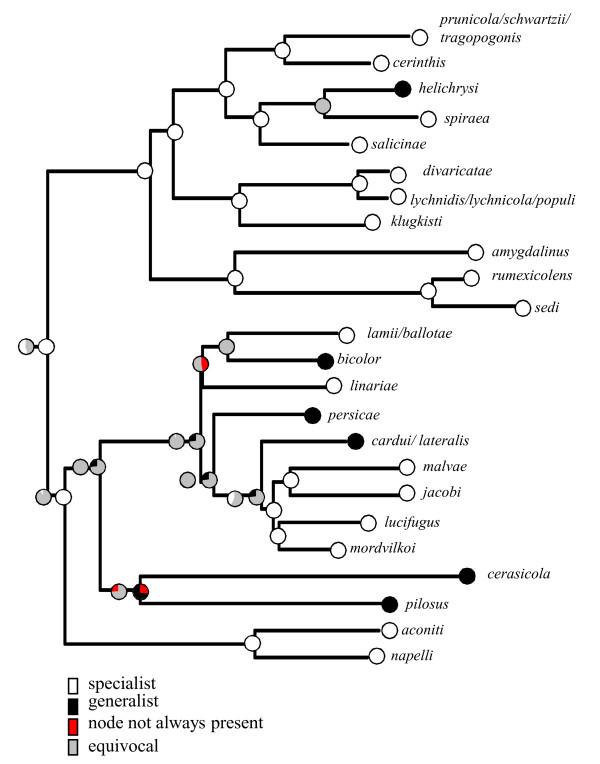
Phylogenetic investigation and character reconstruction suggest that life cycle is evolutionary labile in the genus. Though ancestral character states can be ambiguous depending on optimization methods, all analyses suggest that transitions from monoecy on herbs towards heteroecy have occurred several times. Transitions from heteroecy towards monoecy, are also likely. There have been many shifts in feeding behaviour but we found no significant correlation between life cycle changes and changes in diet.
The transitions from monoecy on herbs towards heteroecy observed in this study go against a widely accepted evolutionary scenario: aphids in the genus Brachycaudus seem to be able to recapture their supposedly ancestral woody host. This suggests that the determinants of host alternation are probably not as complicated as previously thought. Definitive proofs of the lability of life cycle in Brachycaudus will necessitate investigation of these determinants. Life cycle changes, whether corresponding to the loss or acquisition of a primary host, necessarily promote speciation, by inducing shifts of the reproductive phase on different plants. We suggest that the evolutionary lability of life cycle may have driven speciation events in the Brachycaudus genus.
大多数蚜虫在同一组宿主植物上完成其生命周期,但有些(异宿主种)在不同的宿主之间交替,从主要(木本)宿主植物迁移到次要(草本)宿主植物。这种复杂生命周期进化背后的进化过程经常被争论。一个被广泛接受的情景是,异宿主从木本宿主植物上的单宿主进化而来。随后,几个向草本植物单宿主的转变发生了,导致了蚜虫的辐射。在某些情况下,由于发育限制阻止蚜虫将其整个生命周期转移到草本宿主(被认为更有利),宿主交替将持续存在。根据这一情景,如果蚜虫在进化过程中失去了主要宿主,它们就不应该重新获得它。Brachycaudus 属包括具有所有生命周期类型的物种(木本植物上单宿主,异宿主,草本植物上单宿主)。我们使用这个属来测试关于蚜虫生命周期进化的假设。
系统发育研究和特征重建表明,该属的生命周期在进化上是不稳定的。尽管祖先特征状态可能取决于优化方法而变得模糊,但所有分析都表明,从草本植物上单宿主向异宿主的转变已经发生了多次。从异宿主向单宿主的转变也很可能发生。摄食行为发生了多次转变,但我们没有发现生命周期变化与饮食变化之间存在显著相关性。
本研究中观察到的从草本植物上单宿主向异宿主的转变与广泛接受的进化情景背道而驰:Brachycaudus 属中的蚜虫似乎能够重新获得它们所谓的祖先木本宿主。这表明宿主交替的决定因素可能不像以前想象的那么复杂。要确定 Brachycaudus 属生命周期的易变性,需要调查这些决定因素。生命周期的变化,无论是对应于主要宿主的丧失还是获得,必然会通过在不同植物上转移繁殖阶段来促进物种形成。我们认为,生命周期的进化易变性可能推动了 Brachycaudus 属的物种形成事件。