Division of Biological Sciences, University of California, San Diego, La Jolla, CA 92093-0366, USA.
Neuron. 2010 Oct 6;68(1):9-18. doi: 10.1016/j.neuron.2010.09.007.
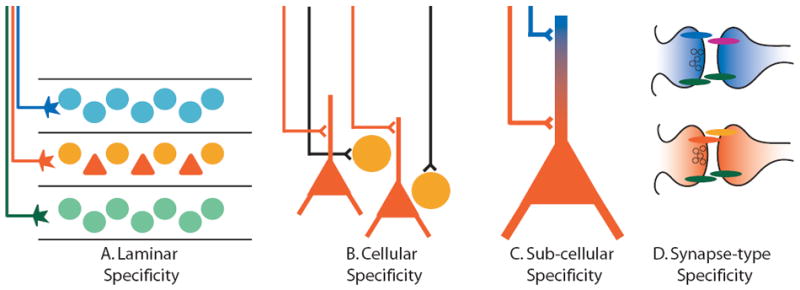
The function of the brain depends on highly specific patterns of connections between populations of neurons. The establishment of these connections requires the targeting of axons and dendrites to defined zones or laminae, the recognition of individual target cells, the formation of synapses on particular regions of the dendritic tree, and the differentiation of pre- and postsynaptic specializations. Recent studies provide compelling evidence that transmembrane adhesion proteins of the immunoglobulin, cadherin, and leucine-rich repeat protein families, as well as secreted proteins such as semaphorins and FGFs, regulate distinct aspects of neuronal connectivity. These observations suggest that the coordinated actions of a number of molecular signals contribute to the specification and differentiation of synaptic connections in the developing brain.
大脑的功能取决于神经元群体之间高度特异的连接模式。这些连接的建立需要轴突和树突靶向到特定的区域或层,识别单个靶细胞,在树突的特定区域形成突触,以及前突触和后突触特化的分化。最近的研究提供了令人信服的证据,表明免疫球蛋白、钙粘蛋白和富含亮氨酸重复蛋白家族的跨膜粘附蛋白,以及分泌蛋白如 semaphorins 和 FGFs,调节神经元连接的不同方面。这些观察结果表明,许多分子信号的协调作用有助于发育中大脑中突触连接的特化和分化。