Institute for Biomaterials and Biomedical Engineering, University of Toronto, Toronto, Ontario, Canada.
Mol Syst Biol. 2010 Oct 5;6:417. doi: 10.1038/msb.2010.71.
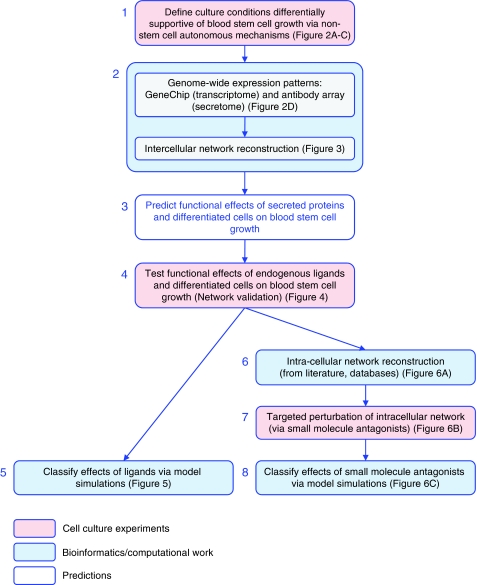
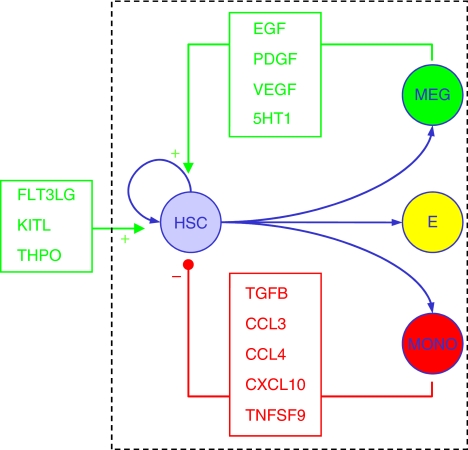
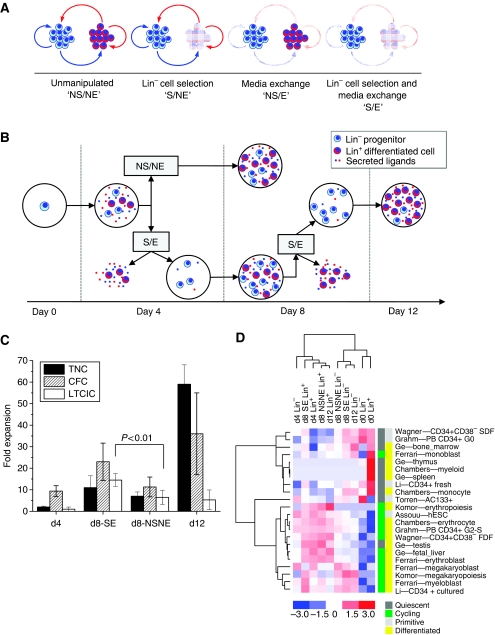
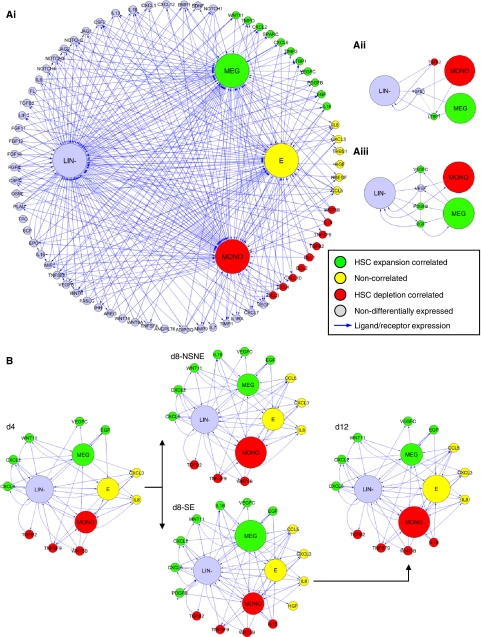
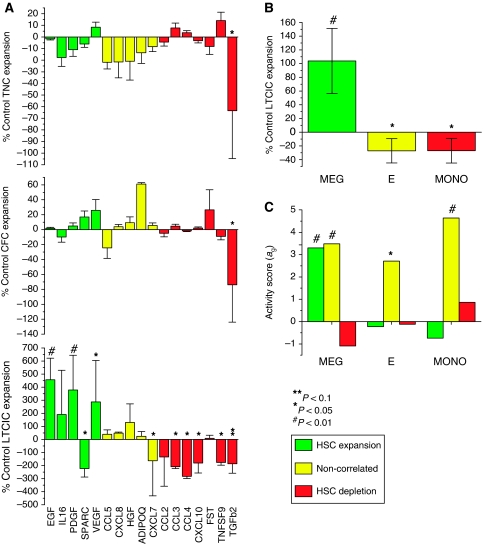
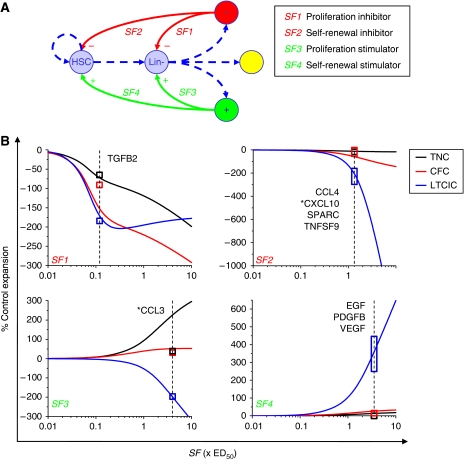
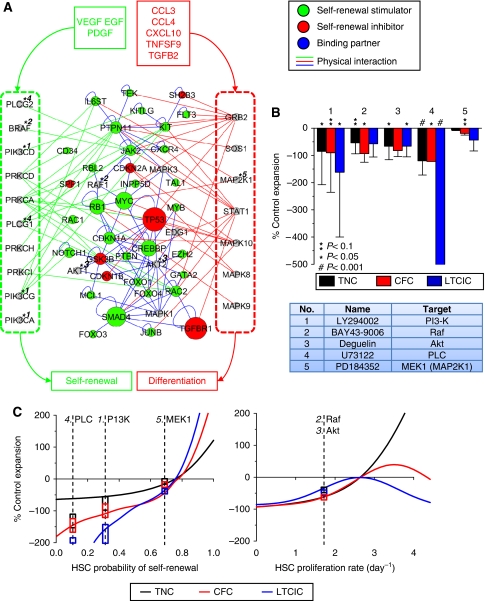
Intercellular (between cell) communication networks maintain homeostasis and coordinate regenerative and developmental cues in multicellular organisms. Despite the importance of intercellular networks in stem cell biology, their rules, structure and molecular components are poorly understood. Herein, we describe the structure and dynamics of intercellular and intracellular networks in a stem cell derived, hierarchically organized tissue using experimental and theoretical analyses of cultured human umbilical cord blood progenitors. By integrating high-throughput molecular profiling, database and literature mining, mechanistic modeling, and cell culture experiments, we show that secreted factor-mediated intercellular communication networks regulate blood stem cell fate decisions. In particular, self-renewal is modulated by a coupled positive-negative intercellular feedback circuit composed of megakaryocyte-derived stimulatory growth factors (VEGF, PDGF, EGF, and serotonin) versus monocyte-derived inhibitory factors (CCL3, CCL4, CXCL10, TGFB2, and TNFSF9). We reconstruct a stem cell intracellular network, and identify PI3K, Raf, Akt, and PLC as functionally distinct signal integration nodes, linking extracellular, and intracellular signaling. This represents the first systematic characterization of how stem cell fate decisions are regulated non-autonomously through lineage-specific interactions with differentiated progeny.
细胞间(细胞之间)通讯网络维持着多细胞生物的内稳态,并协调再生和发育信号。尽管细胞间网络在干细胞生物学中非常重要,但它们的规则、结构和分子组成仍知之甚少。在此,我们使用培养的人脐血祖细胞的实验和理论分析,描述了来源于干细胞的、层次化组织中细胞间和细胞内网络的结构和动态。通过整合高通量分子谱分析、数据库和文献挖掘、机制建模和细胞培养实验,我们表明,细胞因子介导的细胞间通讯网络调节血液干细胞命运决定。特别是,自我更新受到由巨核细胞衍生的刺激生长因子(VEGF、PDGF、EGF 和 5-羟色胺)与单核细胞衍生的抑制因子(CCL3、CCL4、CXCL10、TGFB2 和 TNFSF9)组成的正反馈和负反馈的耦合反馈回路所调节。我们重建了一个干细胞的细胞内网络,并确定了 PI3K、Raf、Akt 和 PLC 作为功能不同的信号整合节点,连接细胞外和细胞内信号。这代表了对非自主调控干细胞命运决定的第一个系统描述,即通过与分化后代的谱系特异性相互作用进行调控。