Lander Arthur D, Gokoffski Kimberly K, Wan Frederic Y M, Nie Qing, Calof Anne L
Department of Developmental and Cell Biology, University of California, Irvine, Irvine, California, USA.
PLoS Biol. 2009 Jan 20;7(1):e15. doi: 10.1371/journal.pbio.1000015.
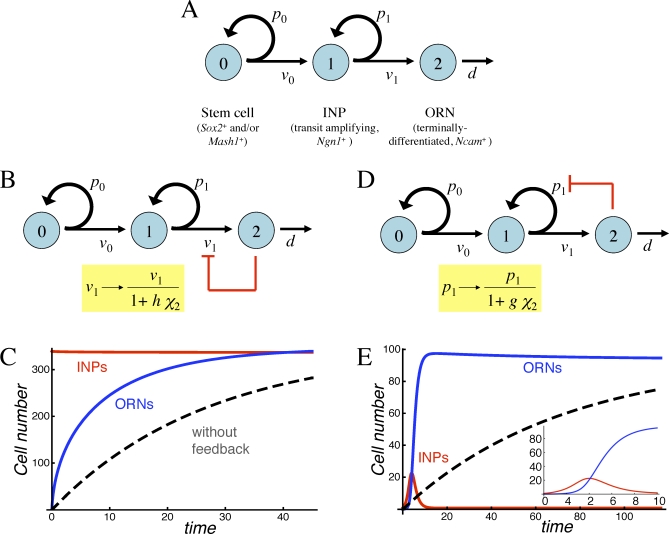
It is widely accepted that the growth and regeneration of tissues and organs is tightly controlled. Although experimental studies are beginning to reveal molecular mechanisms underlying such control, there is still very little known about the control strategies themselves. Here, we consider how secreted negative feedback factors ("chalones") may be used to control the output of multistage cell lineages, as exemplified by the actions of GDF11 and activin in a self-renewing neural tissue, the mammalian olfactory epithelium (OE). We begin by specifying performance objectives-what, precisely, is being controlled, and to what degree-and go on to calculate how well different types of feedback configurations, feedback sensitivities, and tissue architectures achieve control. Ultimately, we show that many features of the OE-the number of feedback loops, the cellular processes targeted by feedback, even the location of progenitor cells within the tissue-fit with expectations for the best possible control. In so doing, we also show that certain distinctions that are commonly drawn among cells and molecules-such as whether a cell is a stem cell or transit-amplifying cell, or whether a molecule is a growth inhibitor or stimulator-may be the consequences of control, and not a reflection of intrinsic differences in cellular or molecular character.
组织和器官的生长与再生受到严格控制,这一点已被广泛接受。尽管实验研究开始揭示这种控制背后的分子机制,但对于控制策略本身仍知之甚少。在这里,我们考虑分泌性负反馈因子(“抑素”)如何用于控制多阶段细胞谱系的输出,以生长分化因子11(GDF11)和激活素在自我更新的神经组织——哺乳动物嗅觉上皮(OE)中的作用为例。我们首先明确性能目标——具体而言,被控制的是什么,以及控制到何种程度——然后继续计算不同类型的反馈配置、反馈敏感性和组织结构在实现控制方面的效果。最终,我们表明OE的许多特征——反馈环的数量、反馈所针对的细胞过程,甚至组织内祖细胞的位置——都符合对最佳控制的预期。在此过程中,我们还表明,通常在细胞和分子之间所做的某些区分——例如一个细胞是干细胞还是过渡增殖细胞,或者一个分子是生长抑制剂还是刺激剂——可能是控制的结果,而不是细胞或分子固有差异的反映。