Department of Radiation Oncology, University Hospital of Heidelberg, Im Neuenheimer Feld 400, 69120 Heidelberg, Germany.
BMC Cancer. 2010 Oct 6;10:533. doi: 10.1186/1471-2407-10-533.
Treatment of patients with recurrent glioma includes neurosurgical resection, chemotherapy, or radiation therapy. In most cases, a full course of radiotherapy has been applied after primary diagnosis, therefore application of re-irradiation has to be applied cauteously. With modern precision photon techniques such as fractionated stereotactic radiotherapy (FSRT), a second course of radiotherapy is safe and effective and leads to survival times of 22, 16 and 8 months for recurrent WHO grade II, III and IV gliomas.Carbon ions offer physical and biological characteristics. Due to their inverted dose profile and the high local dose deposition within the Bragg peak precise dose application and sparing of normal tissue is possible. Moreover, in comparison to photons, carbon ions offer an increased relative biological effectiveness (RBE), which can be calculated between 2 and 5 depending on the GBM cell line as well as the endpoint analyzed. Protons, however, offer an RBE which is comparable to photons.First Japanese Data on the evaluation of carbon ion radiation therapy for the treatment of primary high-grade gliomas showed promising results in a small and heterogeneous patient collective.
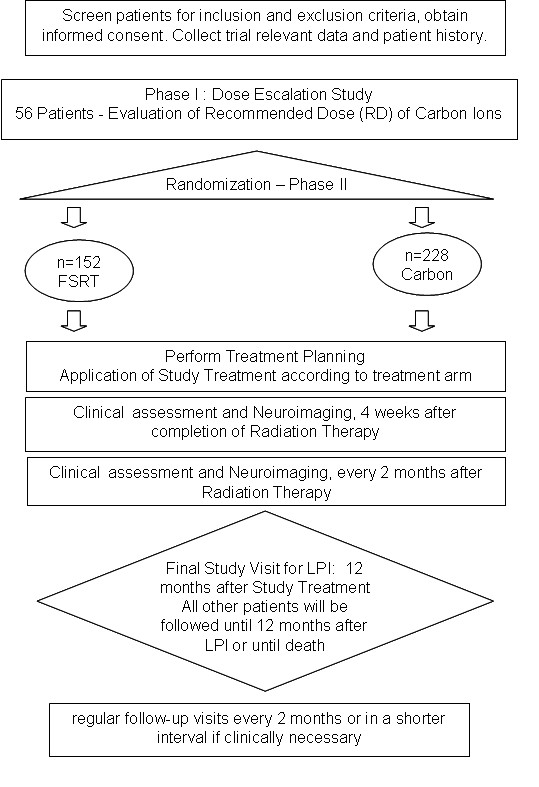
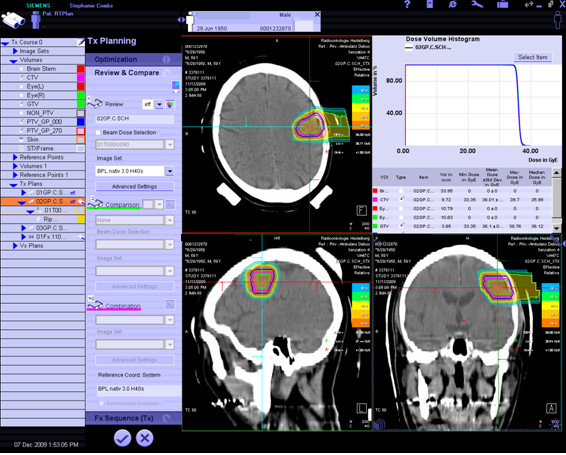
In the current Phase I/II-CINDERELLA-trial re-irradiation using carbon ions will be compared to FSRT applied to the area of contrast enhancement representing high-grade tumor areas in patients with recurrent gliomas. Within the Phase I Part of the trial, the Recommended Dose (RD) of carbon ion radiotherapy will be determined in a dose escalation scheme. In the subsequent randomized Phase II part, the RD will be evaluated in the experimental arm, compared to the standard arm, FSRT with a total dose of 36 Gy in single doses of 2 Gy.Primary endpoint of the Phase I part is toxicity. Primary endpoint of the randomized part II is survival after re-irradiation at 12 months, secondary endpoint is progression-free survival.
The Cinderella trial is the first study to evaluate carbon ion radiotherapy for recurrent gliomas, and to compare this treatment to photon FSRT in a randomized setting using an ion beam delivered by intensity modulated rasterscanning.
NCT01166308.
复发性神经胶质瘤的治疗包括神经外科切除、化疗或放射治疗。在大多数情况下,在初次诊断后已进行了全疗程放疗,因此必须谨慎应用再放疗。随着分次立体定向放疗(FSRT)等现代精确光子技术的应用,再次放疗是安全有效的,可使复发的 WHO 二级、三级和四级胶质瘤的生存时间分别达到 22、16 和 8 个月。
碳离子具有物理和生物学特性。由于其剂量倒转分布以及在布拉格峰内高局部剂量沉积,可实现精确的剂量应用和正常组织的保护。此外,与光子相比,碳离子提供了更高的相对生物学效应(RBE),其值取决于 GBM 细胞系以及所分析的终点,在 2 到 5 之间。然而,质子提供的 RBE 与光子相当。
首次评估碳离子放疗治疗原发性高级别脑胶质瘤的日本数据显示,在一小部分异质性患者群体中,该疗法具有令人鼓舞的结果。
在当前的 I/II 期 CINDERELLA 试验中,将使用碳离子对复发性神经胶质瘤患者的增强对比区进行再放疗,与应用于高级别肿瘤区域的 FSRT 进行比较。在试验的 I 期部分,将采用剂量递增方案确定碳离子放疗的推荐剂量(RD)。在随后的随机 II 期部分,将在实验组评估 RD,并与标准组(FSRT,单次剂量 2 Gy,总剂量 36 Gy)进行比较。I 期部分的主要终点是毒性。随机 II 期部分的主要终点是 12 个月时再放疗后的生存,次要终点是无进展生存期。
Cinderella 试验是第一项评估碳离子放疗治疗复发性神经胶质瘤的研究,也是第一项在随机分组中使用强度调制光栅扫描提供的离子束将这种治疗方法与光子 FSRT 进行比较的研究。
NCT01166308。