Department of Radiation Oncology, University Hospital of Heidelberg, Im Neuenheimer Feld 400, 69120 Heidelberg, Germany.
BMC Cancer. 2010 Sep 6;10:478. doi: 10.1186/1471-2407-10-478.
Treatment standard for patients with primary glioblastoma (GBM) is combined radiochemotherapy with temozolomide (TMZ). Radiation is delivered up to a total dose of 60 Gy using photons. Using this treatment regimen, overall survival could be extended significantly however, median overall survival is still only about 15 months. Carbon ions offer physical and biological advantages. Due to their inverted dose profile and the high local dose deposition within the Bragg peak precise dose application and sparing of normal tissue is possible. Moreover, in comparison to photons, carbon ions offer an increase relative biological effectiveness (RBE), which can be calculated between 2 and 5 depending on the GBM cell line as well as the endpoint analyzed. Protons, however, offer an RBE which is comparable to photons. First Japanese Data on the evaluation of carbon ion radiation therapy showed promising results in a small and heterogeneous patient collective.
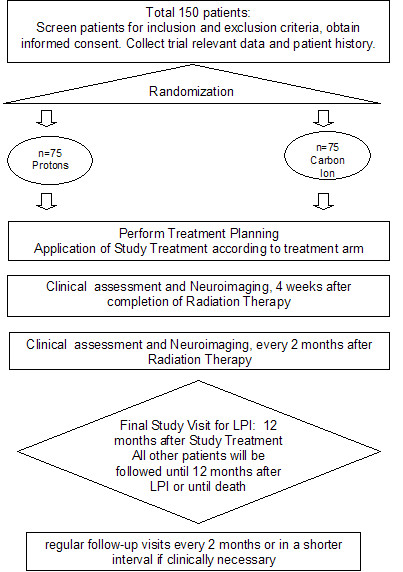
METHODS/DESIGN: In the current Phase II-CLEOPATRA-Study a carbon ion boost will be compared to a proton boost applied to the macroscopic tumor after surgery at primary diagnosis in patients with GBM applied after standard radiochemotherapy with TMZ up to 50 Gy. In the experimental arm, a carbon ion boost will be applied to the macroscopic tumor up to a total dose of 18 Gy E in 6 fractions at a single dose of 3 Gy E. In the standard arm, a proton boost will be applied up to a total dose 10 Gy E in 5 single fractions of 2 Gy E. Primary endpoint is overall survival, secondary objectives are progression-free survival, toxicity and safety.
The Cleopatra Trial is the first study to evaluate the effect of carbon ion radiotherapy within multimodality treatment of primary glioblastoma in a randomized trial comparing this innovative treatment of the treatment standard, consisitng of photon radiotherapy in combination with temozolomide.
ISRCTN37428883 and NCT01165671.
原发性神经胶质瘤(GBM)患者的治疗标准是替莫唑胺(TMZ)联合放化疗。使用光子进行放射治疗,总剂量可达 60Gy。采用这种治疗方案,总生存期显著延长,但中位总生存期仍仅约 15 个月。碳离子具有物理和生物学优势。由于其剂量分布倒置和在布喇格峰内的高局部剂量沉积,可以实现精确的剂量应用和正常组织的保护。此外,与光子相比,碳离子提供相对生物学效应(RBE)的增加,其可以根据 GBM 细胞系以及所分析的终点在 2 到 5 之间计算。质子的 RBE 与光子相当。关于碳离子放射治疗评估的第一批日本数据显示,在接受替莫唑胺标准放化疗后 50Gy 的小而异质的患者群体中,这种治疗方法具有前景。
方法/设计:在当前的 II 期 CLEOPATRA 研究中,将比较碳离子增强放疗与质子增强放疗在原发性 GBM 患者手术后的宏观肿瘤中的应用,这些患者在接受 TMZ 标准放化疗后,直到 50Gy 时应用。在实验组中,将对宏观肿瘤进行碳离子增强放疗,总剂量达 18GyE,单次剂量为 3GyE,共 6 次。在标准组中,将进行质子增强放疗,总剂量达 10GyE,单次剂量为 2GyE,共 5 次。主要终点是总生存期,次要终点是无进展生存期、毒性和安全性。
Cleopatra 试验是第一项在多模式治疗原发性神经胶质瘤的随机试验中评估碳离子放射治疗效果的研究,该试验比较了这种创新治疗方法与标准治疗(光子放疗联合替莫唑胺)的疗效。
ISRCTN37428883 和 NCT01165671。