Department of Surgery, Division of Surgical Sciences, UMDNJ-Robert Wood Johnson Medical School, New Brunswick, New Jersey, USA.
Crit Care. 2010;14(5):R177. doi: 10.1186/cc9283. Epub 2010 Oct 7.
An endotoxin challenge, sepsis, and injury/trauma, trigger significant changes in human peripheral blood leukocytes (PBL) gene expression. In this study, we have sought to test the hypothesis that the Toll-like receptor 4 (TLR4) induced transcription patterns elicited in humans exposed to in vivo endotoxin would parallel gene expression patterns observed in trauma patients with initial non-infectious injury. In addition, we sought to identify functional modules that are commonly affected by these two insults of differing magnitude and duration.
PBL were obtained from seven adult human subject experimental groups. The groups included a group of healthy, hospitalized volunteers (n = 15), that comprised four study groups of subjects challenged with intravenous endotoxin, without or with cortisol, and two serial samplings of trauma patients (n = 5). The PBL were analyzed for gene expression using a 8,793 probe microarray platform (Gene Chip® Focus, Affymetrix). The expression of a subset of genes was determined using qPCR.
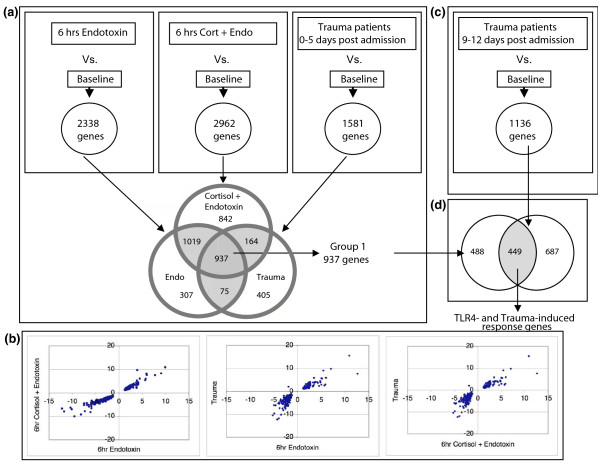
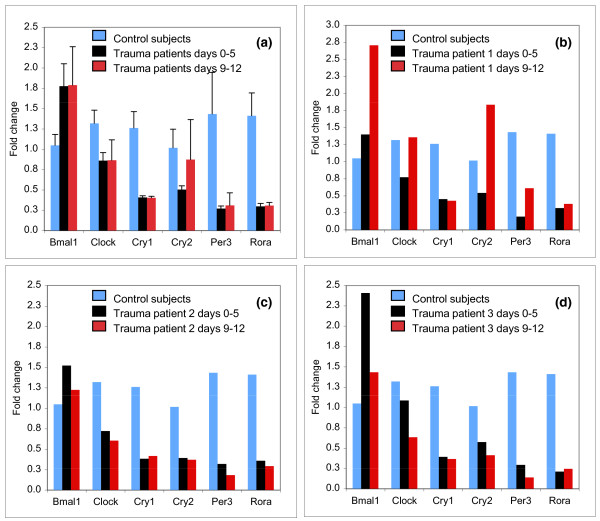
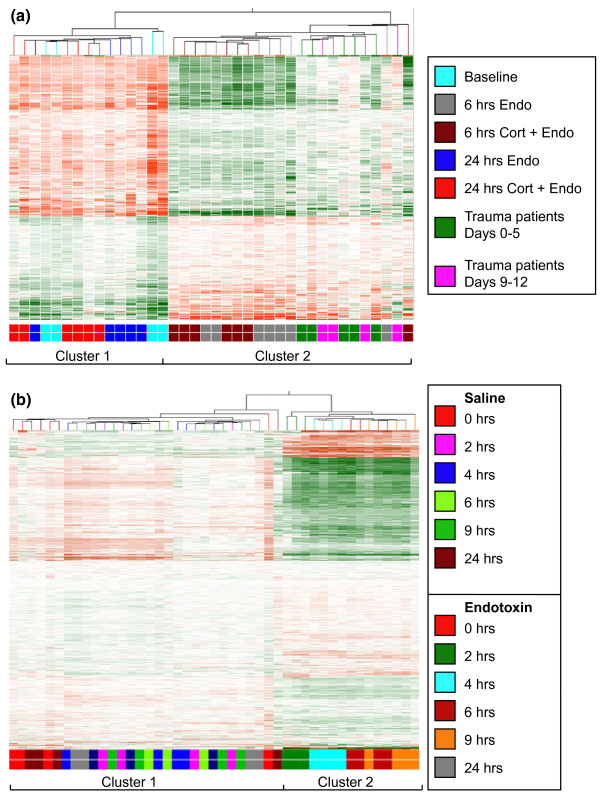
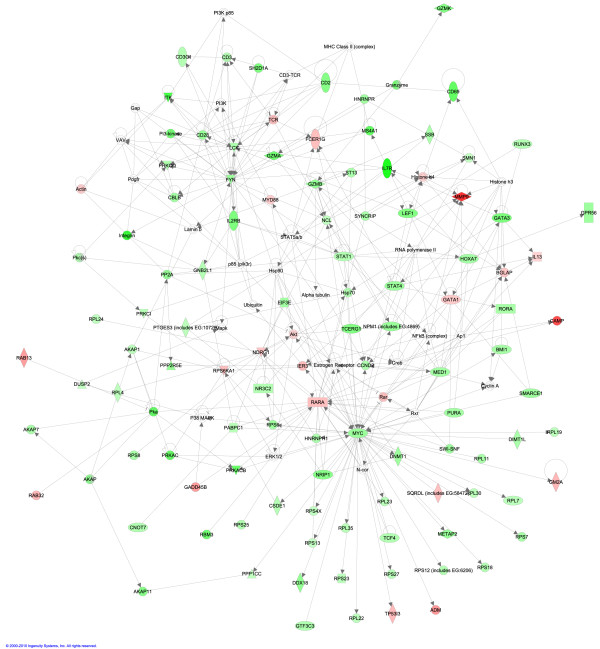
We describe sequential selection criteria of gene expression data that identifies 445 genes that are significantly differentially expressed (both P ≤ 0.05 and > 1.2 fold-change) in PBL derived from human subjects during the peak of systemic inflammatory responses induced by in vivo endotoxin, as well as in PBL obtained from trauma patients at 1 to 12 days after admission. We identified two functional modules that are commonly represented by this analysis. The first module includes more than 50 suppressed genes that encode ribosomal proteins or translation regulators. The second module includes up-regulated genes encoding key enzymes associated with glycolysis. Finally, we show that several circadian clock genes are also suppressed in PBL of surgical ICU patients.
We identified a group of > 400 genes that exhibit similar expression trends in PBL derived from either endotoxin-challenged subjects or trauma patients. The suppressed translational and circadian clock modules, and the upregulated glycolytic module, constitute a robust and long lasting PBL gene expression signature that may provide a tool for monitoring systemic inflammation and injury.
内毒素挑战、败血症和损伤/创伤会导致人体外周血白细胞(PBL)的基因表达发生显著变化。在这项研究中,我们试图验证以下假设:在暴露于内毒素的人体中,Toll 样受体 4(TLR4)诱导的转录模式与最初无感染性损伤的创伤患者的基因表达模式相似。此外,我们还试图确定受这两种不同程度和持续时间的刺激影响的常见功能模块。
从 7 名成年人类实验对象组中获取 PBL。这些组包括一组健康的住院志愿者(n = 15),包括四组静脉内给予内毒素但不给予或给予皮质醇的对象组,以及两组创伤患者的连续采样(n = 5)。使用 8793 探针微阵列平台(Gene Chip® Focus,Affymetrix)分析 PBL 的基因表达。使用 qPCR 确定了一组亚基因的表达。
我们描述了基因表达数据的顺序选择标准,该标准确定了 445 个基因,这些基因在体内内毒素诱导的全身炎症反应高峰期源自人类对象的 PBL 中以及在入院后 1 至 12 天的创伤患者的 PBL 中差异表达(两者 P≤0.05 和 > 1.2 倍变化)。我们确定了两个常用的分析功能模块。第一个模块包括 50 多个编码核糖体蛋白或翻译调节剂的受抑制基因。第二个模块包括上调的基因,编码与糖酵解相关的关键酶。最后,我们发现几个生物钟基因也在外科重症监护病房患者的 PBL 中受到抑制。
我们鉴定了一组> 400 个在源自内毒素挑战的对象或创伤患者的 PBL 中表达趋势相似的基因。受抑制的翻译和生物钟模块以及上调的糖酵解模块构成了一种强大而持久的 PBL 基因表达特征,可能为监测全身炎症和损伤提供一种工具。