Departments of Animal Science, Iowa State University, Ames, Iowa 50011, USA.
BMC Genomics. 2010 Oct 8;11:545. doi: 10.1186/1471-2164-11-545.
Macrophages play essential roles in both innate and adaptive immune responses. Bacteria require endotoxin, a complex lipopolysaccharide, for outer membrane permeability and the host interprets endotoxin as a signal to initiate an innate immune response. The focus of this study is kinetic and global transcriptional analysis of the chicken macrophage response to in vitro stimulation with endotoxin from Salmonella typhimurium-798.
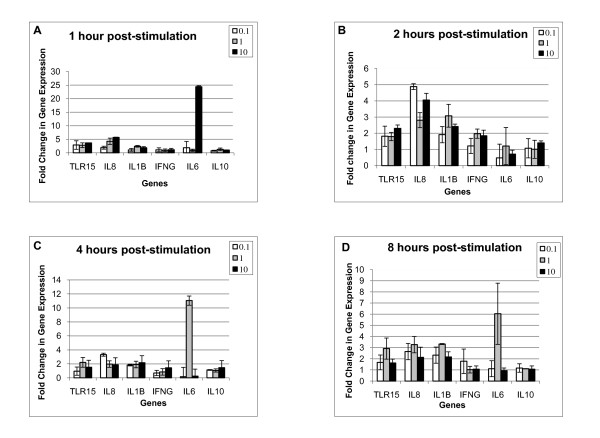
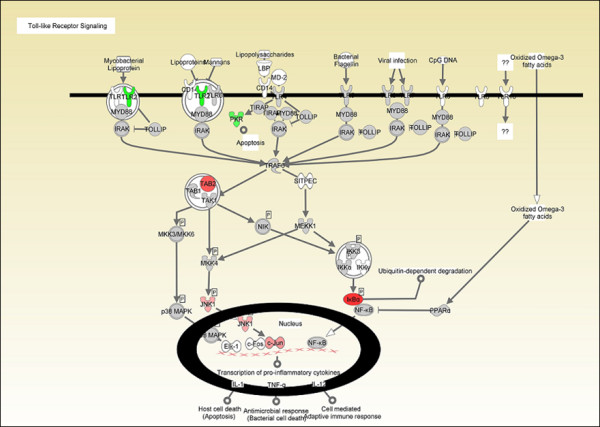
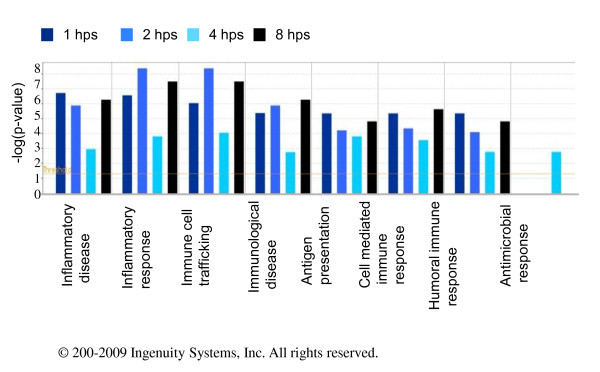
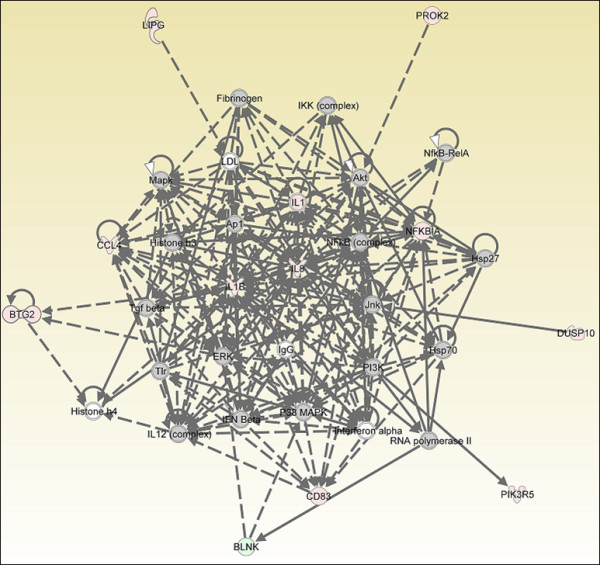
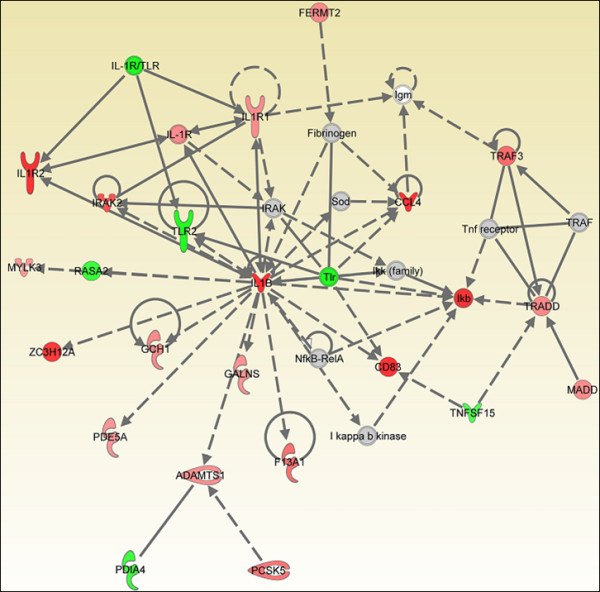
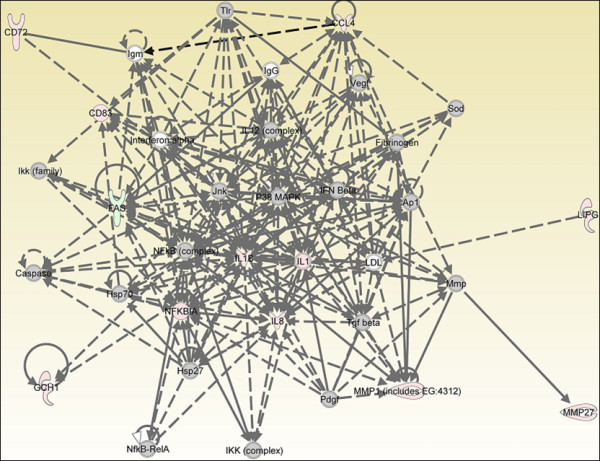
The 38535-probeset Affymetrix GeneChip Chicken Genome array was used to profile transcriptional response to endotoxin 1, 2, 4, and 8 hours post stimulation (hps). Using a maximum FDR (False Discovery Rate) of 0.05 to declare genes as differentially expressed (DE), we found 13, 33, 1761 and 61 DE genes between endotoxin-stimulated versus non-stimulated cells at 1, 2, 4 and 8 hps, respectively. QPCR demonstrated that endotoxin exposure significantly affected the mRNA expression of IL1B, IL6, IL8, and TLR15, but not IL10 and IFNG in HD 11 cells. Ingenuity Pathway Analysis showed that 10% of the total DE genes were involved in inflammatory response. Three, 9.7, 96.8, and 11.8% of the total DE inflammatory response genes were significantly differentially expressed with endotoxin stimulation at 1, 2, 4 and 8 hps, respectively. The NFKBIA, IL1B, IL8 and CCL4 genes were consistently induced at all times after endotoxin treatment. NLRC5 (CARD domain containing, NOD-like receptor family, RCJMB04_18i2), an intracellular receptor, was induced in HD11 cells treated with endotoxin.
As above using an in vitro model of chicken response to endotoxin, our data revealed the kinetics of gene networks involved in host response to endotoxin and extend the known complexity of networks in chicken immune response to Gram-negative bacteria such as Salmonella. The induction of NFKBIA, IL1B, IL8, CCL4 genes is a consistent signature of host response to endotoxin over time. We make the first report of induction of a NOD-like receptor family member in response to Salmonella endotoxin in chicken macrophages.
巨噬细胞在先天和适应性免疫反应中都发挥着重要作用。细菌需要内毒素,一种复杂的脂多糖,来维持外膜通透性,而宿主则将内毒素视为启动先天免疫反应的信号。本研究的重点是对鸡巨噬细胞对来自鼠伤寒沙门氏菌-798 的内毒素的体外刺激的动力学和全转录组分析。
使用 Affymetrix GeneChip Chicken Genome 芯片上的 38535 个探针对刺激后 1、2、4 和 8 小时(hps)的内毒素刺激的鸡巨噬细胞的转录反应进行了分析。使用最大 FDR(假发现率)为 0.05 来宣布基因的差异表达(DE),我们发现,在 1、2、4 和 8 hps 时,内毒素刺激与非刺激细胞之间分别有 13、33、1761 和 61 个 DE 基因。QPCR 表明,内毒素暴露显著影响了 HD11 细胞中 IL1B、IL6、IL8 和 TLR15 的 mRNA 表达,但对 IL10 和 IFNG 没有影响。Ingenuity Pathway Analysis 显示,10%的总 DE 基因参与了炎症反应。在 1、2、4 和 8 hps 时,分别有 3、9.7、96.8 和 11.8%的总 DE 炎症反应基因显著差异表达。NFKBIA、IL1B、IL8 和 CCL4 基因在内毒素处理后所有时间都持续诱导。NLRC5(CARD 结构域包含,NOD 样受体家族,RCJMB04_18i2),一种细胞内受体,在被内毒素处理的 HD11 细胞中被诱导。
使用鸡对内毒素反应的体外模型,我们的数据揭示了宿主对内毒素反应中涉及的基因网络的动力学,并扩展了鸡对革兰氏阴性菌(如沙门氏菌)免疫反应中网络的已知复杂性。NFKBIA、IL1B、IL8 和 CCL4 基因的诱导是宿主对内毒素反应随时间推移的一致特征。我们首次报告了 NOD 样受体家族成员在鸡巨噬细胞对内毒素的反应中的诱导。