Uni Bjerknes Centre, Bergen, Norway.
Environ Health Perspect. 2011 Mar;119(3):299-305. doi: 10.1289/ehp.1002060. Epub 2010 Oct 6.
Climate change is expected to have large impacts on health at low latitudes where droughts and malnutrition, diarrhea, and malaria are projected to increase.
The main objective of this study was to indicate a method to assess a range of plausible health impacts of climate change while handling uncertainties in a unambiguous manner. We illustrate this method by quantifying the impacts of projected regional warming on diarrhea in this century.
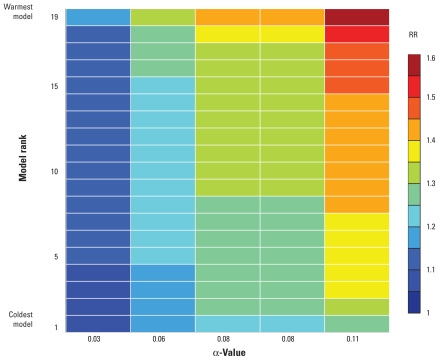
We combined a range of linear regression coefficients to compute projections of future climate change-induced increases in diarrhea using the results from five empirical studies and a 19-member climate model ensemble for which future greenhouse gas emissions were prescribed. Six geographical regions were analyzed.
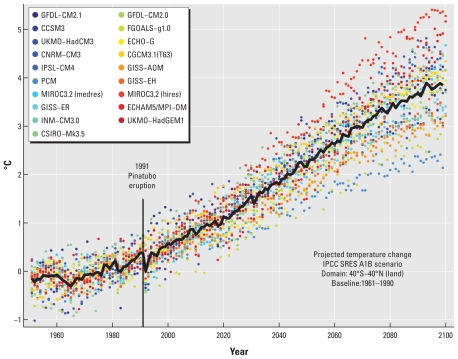
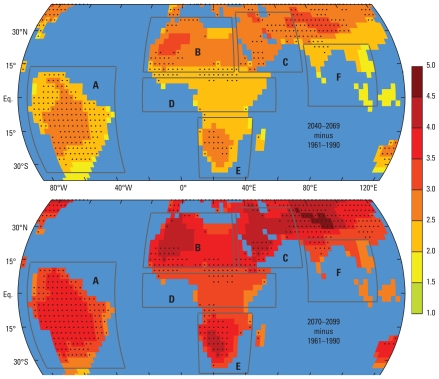
The model ensemble projected temperature increases of up to 4°C over land in the tropics and subtropics by the end of this century. The associated mean projected increases of relative risk of diarrhea in the six study regions were 8-11% (with SDs of 3-5%) by 2010-2039 and 22-29% (SDs of 9-12%) by 2070-2099.
Even our most conservative estimates indicate substantial impacts from climate change on the incidence of diarrhea. Nevertheless, our main conclusion is that large uncertainties are associated with future projections of diarrhea and climate change. We believe that these uncertainties can be attributed primarily to the sparsity of empirical climate-health data. Our results therefore highlight the need for empirical data in the cross section between climate and human health.
预计气候变化将对低纬度地区的健康产生重大影响,这些地区预计将出现干旱和营养不良、腹泻和疟疾增加的情况。
本研究的主要目的是指出一种方法,以便以明确的方式处理不确定性,评估气候变化可能对健康造成的一系列影响。我们通过量化本世纪预期区域变暖对腹泻的影响来说明这种方法。
我们结合了一系列线性回归系数,利用五项实证研究和一个未来温室气体排放被规定的 19 成员气候模型集合的结果,计算未来气候变化引起的腹泻增加的预测。分析了六个地理区域。
模型集合预计到本世纪末,热带和亚热带地区陆地温度将升高 4°C。六个研究区域的相关平均预测风险增加幅度为 2010-2039 年期间腹泻的相对风险增加 8-11%(标准差为 3-5%),2070-2099 年期间增加 22-29%(标准差为 9-12%)。
即使我们采用最保守的估计,气候变化对腹泻发病率也会产生重大影响。然而,我们的主要结论是,未来腹泻和气候变化的预测存在很大的不确定性。我们认为,这些不确定性主要归因于气候与人类健康交叉领域的实证气候健康数据的稀缺性。因此,我们的研究结果强调了在气候和人类健康的交叉领域需要实证数据。