Centre de Génétique Moléculaire, Université Paris-Sud, CNRS FRE3144, Gif-sur-Yvette, France.
BMC Genomics. 2010 Oct 8;11:547. doi: 10.1186/1471-2164-11-547.
The genome of Paramecium tetraurelia, a unicellular model that belongs to the ciliate phylum, has been shaped by at least 3 successive whole genome duplications (WGD). These dramatic events, which have also been documented in plants, animals and fungi, are resolved over evolutionary time by the loss of one duplicate for the majority of genes. Thanks to a low rate of large scale genome rearrangement in Paramecium, an unprecedented large number of gene duplicates of different ages have been identified, making this organism an outstanding model to investigate the evolutionary consequences of polyploidization. The most recent WGD, with 51% of pre-duplication genes still in 2 copies, provides a snapshot of a phase of rapid gene loss that is not accessible in more ancient polyploids such as yeast.
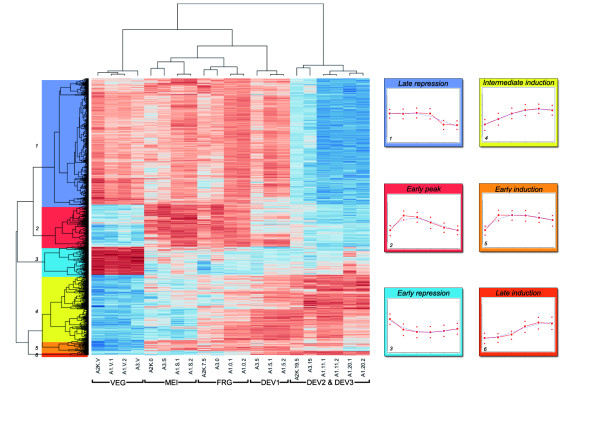
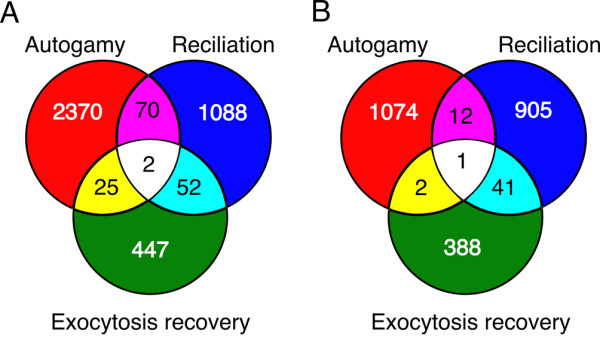
We designed a custom oligonucleotide microarray platform for P. tetraurelia genome-wide expression profiling and used the platform to measure gene expression during 1) the sexual cycle of autogamy, 2) growth of new cilia in response to deciliation and 3) biogenesis of secretory granules after massive exocytosis. Genes that are differentially expressed during these time course experiments have expression patterns consistent with a very low rate of subfunctionalization (partition of ancestral functions between duplicated genes) in particular since the most recent polyploidization event.
A public transcriptome resource is now available for Paramecium tetraurelia. The resource has been integrated into the ParameciumDB model organism database, providing searchable access to the data. The microarray platform, freely available through NimbleGen Systems, provides a robust, cost-effective approach for genome-wide expression profiling in P. tetraurelia. The expression data support previous studies showing that at short evolutionary times after a whole genome duplication, gene dosage balance constraints and not functional change are the major determinants of gene retention.
四膜虫是纤毛门的一种单细胞模式生物,其基因组经历了至少 3 次全基因组复制(WGD)的塑造。这些戏剧性的事件也在植物、动物和真菌中得到了记录,随着时间的推移,大多数基因的一个副本丢失,这些事件得到了解决。由于四膜虫的大规模基因组重排率较低,已经鉴定出了数量空前的不同年龄的基因重复,这使得该生物成为研究多倍体化进化后果的杰出模型。最近的 WGD 导致 51%的前复制基因仍保持 2 份拷贝,这为快速基因丢失阶段提供了一个快照,而在更古老的多倍体如酵母中,这种阶段是无法获得的。
我们为四膜虫基因组设计了一个定制的寡核苷酸微阵列平台,用于全基因组表达谱分析,并使用该平台测量了 1)自体受精的有性周期、2)新纤毛生长以响应去纤毛和 3)大量胞吐后分泌颗粒生物发生期间的基因表达。在这些时间过程实验中差异表达的基因具有表达模式,与非常低的亚功能化(复制基因之间祖先功能的划分)率一致,特别是在最近的多倍化事件之后。
现在有了一个公共的四膜虫转录组资源。该资源已整合到 ParameciumDB 模式生物数据库中,提供了对数据的可搜索访问。微阵列平台通过 NimbleGen Systems 免费提供,为四膜虫的全基因组表达谱分析提供了一种强大、经济有效的方法。表达数据支持先前的研究表明,在全基因组复制后很短的进化时间内,基因剂量平衡约束而不是功能变化是基因保留的主要决定因素。