Université Paris-Saclay, CEA, CNRS, Institute for Integrative Biology of the Cell (I2BC), Gif-sur-Yvette, France.
University of Geneva, Section of Biology, Department of Molecular and Cellular Biology, Geneva, Switzerland.
PLoS Biol. 2022 Sep 7;20(9):e3001782. doi: 10.1371/journal.pbio.3001782. eCollection 2022 Sep.
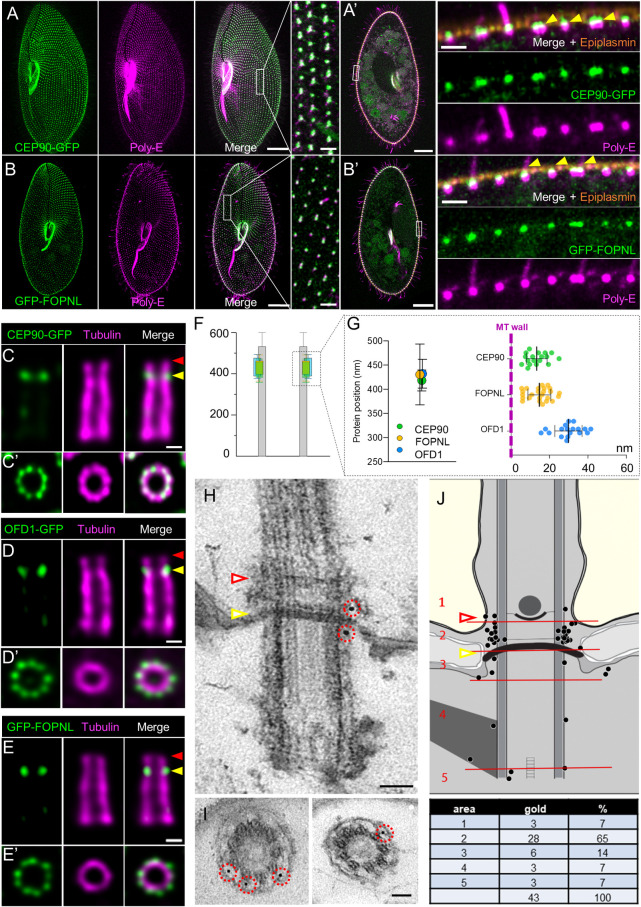
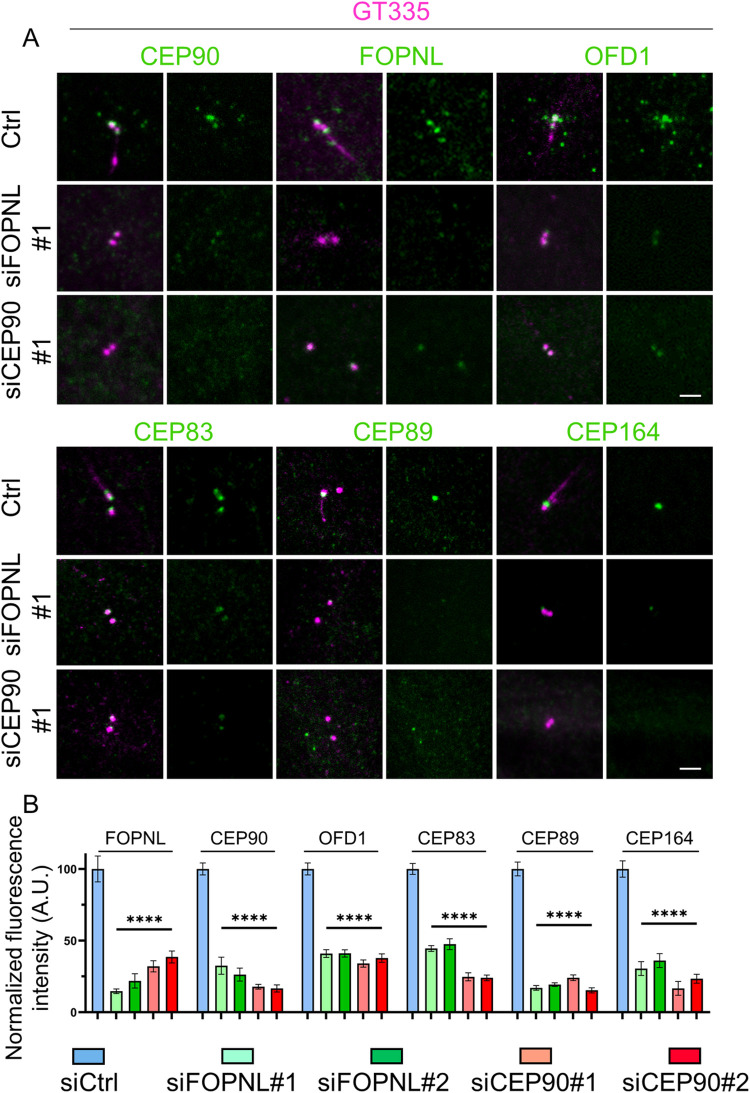
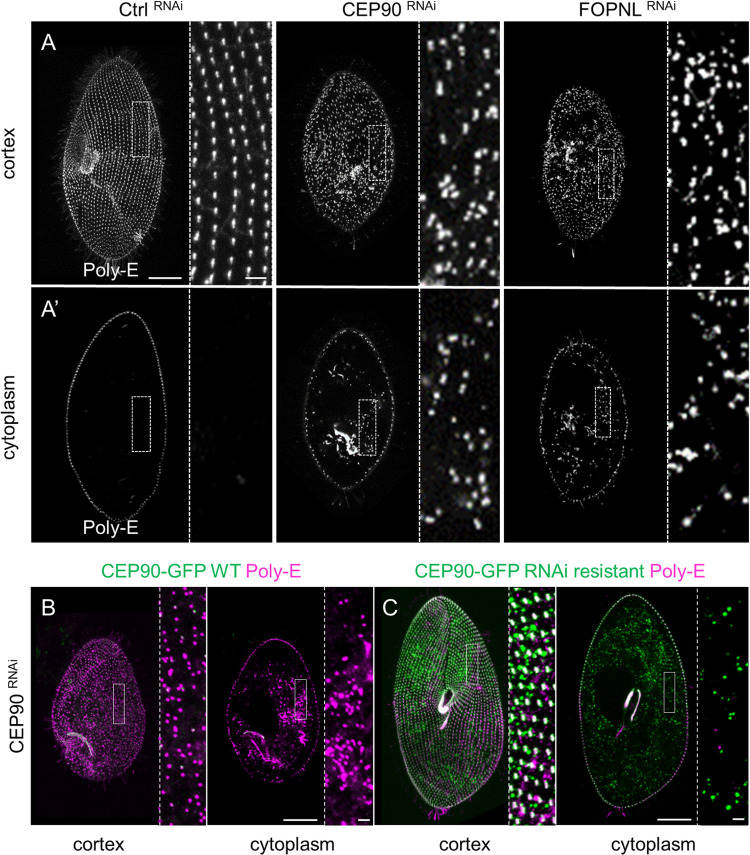
In metazoa, cilia assembly is a cellular process that starts with centriole to basal body maturation, migration to the cell surface, and docking to the plasma membrane. Basal body docking involves the interaction of both the distal end of the basal body and the transition fibers/distal appendages, with the plasma membrane. Mutations in numerous genes involved in basal body docking and transition zone assembly are associated with the most severe ciliopathies, highlighting the importance of these events in cilium biogenesis. In this context, the ciliate Paramecium has been widely used as a model system to study basal body and cilia assembly. However, despite the evolutionary conservation of cilia assembly events across phyla, whether the same molecular players are functionally conserved, is not fully known. Here, we demonstrated that CEP90, FOPNL, and OFD1 are evolutionary conserved proteins crucial for ciliogenesis. Using ultrastructure expansion microscopy, we unveiled that these proteins localize at the distal end of both centrioles/basal bodies in Paramecium and mammalian cells. Moreover, we found that these proteins are recruited early during centriole duplication on the external surface of the procentriole. Functional analysis performed both in Paramecium and mammalian cells demonstrate the requirement of these proteins for distal appendage assembly and basal body docking. Finally, we show that mammalian centrioles require another component, Moonraker (MNR), to recruit OFD1, FOPNL, and CEP90, which will then recruit the distal appendage proteins CEP83, CEP89, and CEP164. Altogether, we propose that this OFD1, FOPNL, and CEP90 functional module is required to determine in mammalian cells the future position of distal appendage proteins.
在原生动物中,纤毛组装是一个细胞过程,从中心粒到基体成熟、迁移到细胞表面,以及与质膜对接开始。基体对接涉及基体的远端和过渡纤维/远端附属物与质膜的相互作用。与基体对接和过渡区组装相关的许多基因的突变与最严重的纤毛病有关,这突出了这些事件在纤毛发生中的重要性。在这种情况下,草履虫已被广泛用作研究基体和纤毛组装的模型系统。然而,尽管纤毛组装事件在门之间具有进化保守性,但相同的分子是否在功能上保守尚不完全清楚。在这里,我们证明 CEP90、FOPNL 和 OFD1 是对纤毛发生至关重要的进化保守蛋白。使用超微结构扩展显微镜,我们揭示了这些蛋白在草履虫和哺乳动物细胞中的中心粒/基体的远端定位。此外,我们发现这些蛋白在中心粒复制过程中早期在原中心粒的外表面被募集。在草履虫和哺乳动物细胞中进行的功能分析表明,这些蛋白对于远端附属物的组装和基体的对接是必需的。最后,我们表明哺乳动物中心粒需要另一个组件 Moonraker (MNR) 来募集 OFD1、FOPNL 和 CEP90,然后这些蛋白将募集远端附属蛋白 CEP83、CEP89 和 CEP164。总之,我们提出,这个 OFD1、FOPNL 和 CEP90 功能模块对于确定哺乳动物细胞中远端附属蛋白的未来位置是必需的。