Division of Biological Science, Graduate School of Science, Nagoya University, Chikusa-ku, Nagoya 464-8602, Japan.
J Cell Biol. 2010 Oct 18;191(2):259-67. doi: 10.1083/jcb.201004150. Epub 2010 Oct 11.
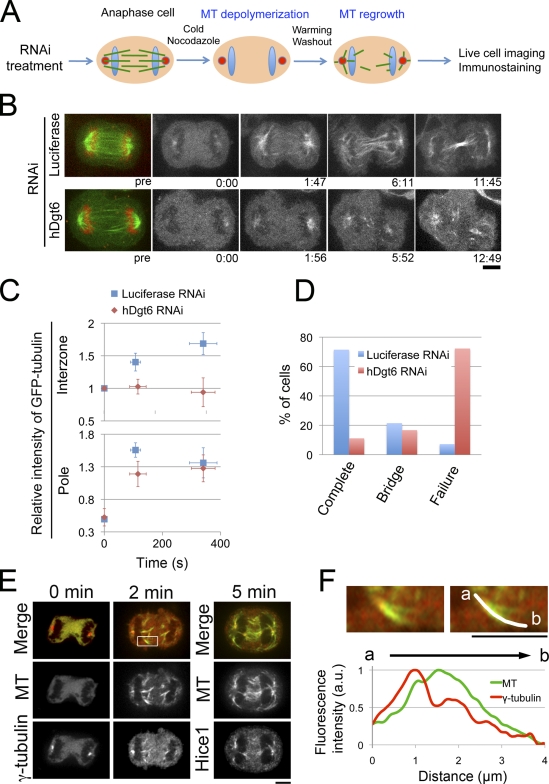
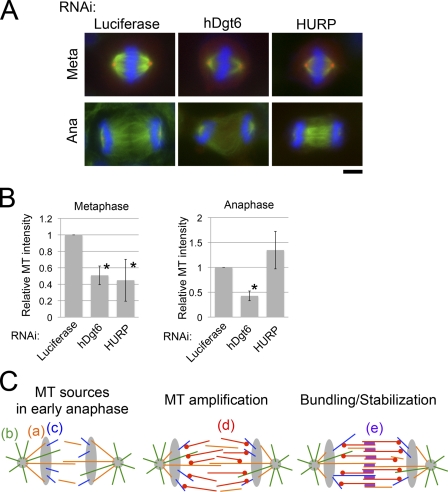
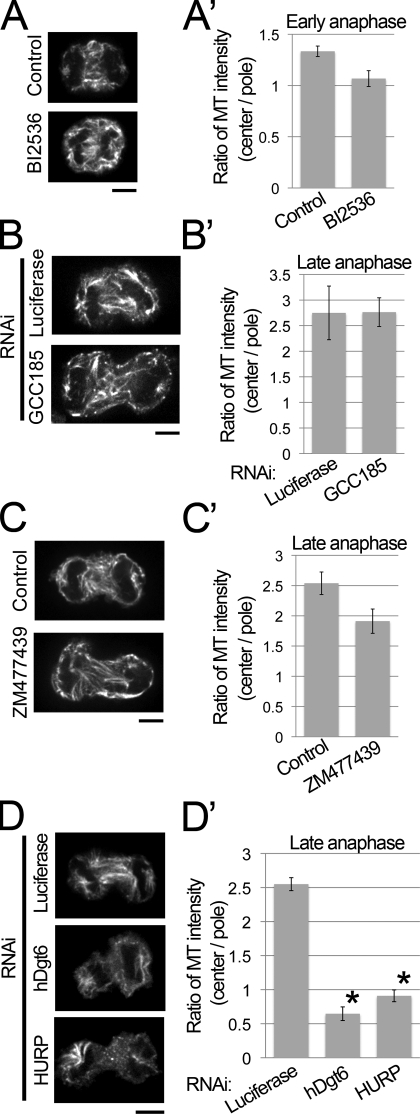
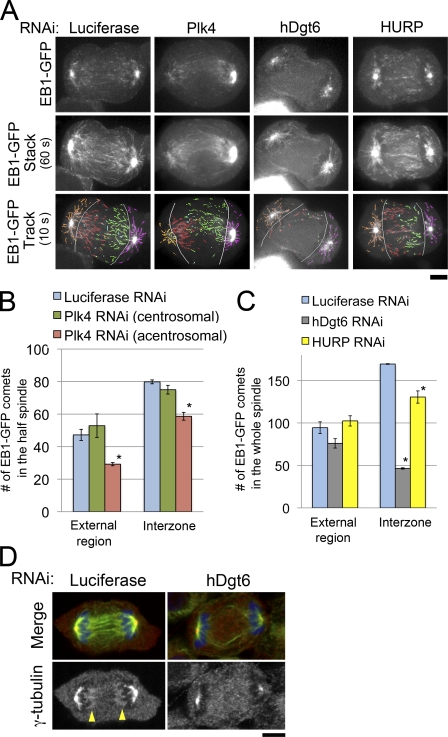
The central spindle forms between segregating chromosomes during anaphase and is required for cytokinesis. Although anaphase-specific bundling and stabilization of interpolar microtubules (MTs) contribute to formation of the central spindle, it remains largely unknown how these MTs are prepared. Using live imaging of MT plus ends and an MT depolymerization and regrowth assay, we show that de novo MT generation in the interchromosomal region during anaphase is important for central spindle formation in human cells. Generation of interchromosomal MTs and subsequent formation of the central spindle occur independently of preanaphase MTs or centrosomal MT nucleation but require augmin, a protein complex implicated in nucleation of noncentrosomal MTs during preanaphase. MTs generated in a hepatoma up-regulated protein (HURP)-dependent manner during anaphase also contribute to central spindle formation redundantly with preanaphase MTs. Based on these results, a new model for central spindle assembly is proposed.
在有丝分裂后期,着丝粒分裂形成纺锤体的中心体,对于胞质分裂是必需的。虽然有丝分裂特异性的束状排列和稳定的两极间微管(MTs)有助于中央纺锤体的形成,但这些 MTs 是如何被准备的仍然很大程度上是未知的。通过对 MT 末端的实时成像和 MT 解聚和再生测定,我们表明,在有丝分裂后期,着丝粒之间区域中新的 MT 的产生对于人类细胞中中央纺锤体的形成是重要的。染色体间 MT 的产生和随后的中央纺锤体的形成独立于前期 MT 或中心体 MT 成核,但需要参与前期非中心体 MT 成核的蛋白复合物 augmin。在有丝分裂期间以肝细胞上调蛋白(HURP)依赖性方式产生的 MT 也与前期 MT 冗余地有助于中央纺锤体的形成。基于这些结果,提出了一个新的中央纺锤体组装模型。