Division of Biological Science, Graduate School of Science, Nagoya University, Chikusa-ku, Nagoya 464-8602, Japan.
J Cell Biol. 2013 Aug 19;202(4):623-36. doi: 10.1083/jcb.201302123.
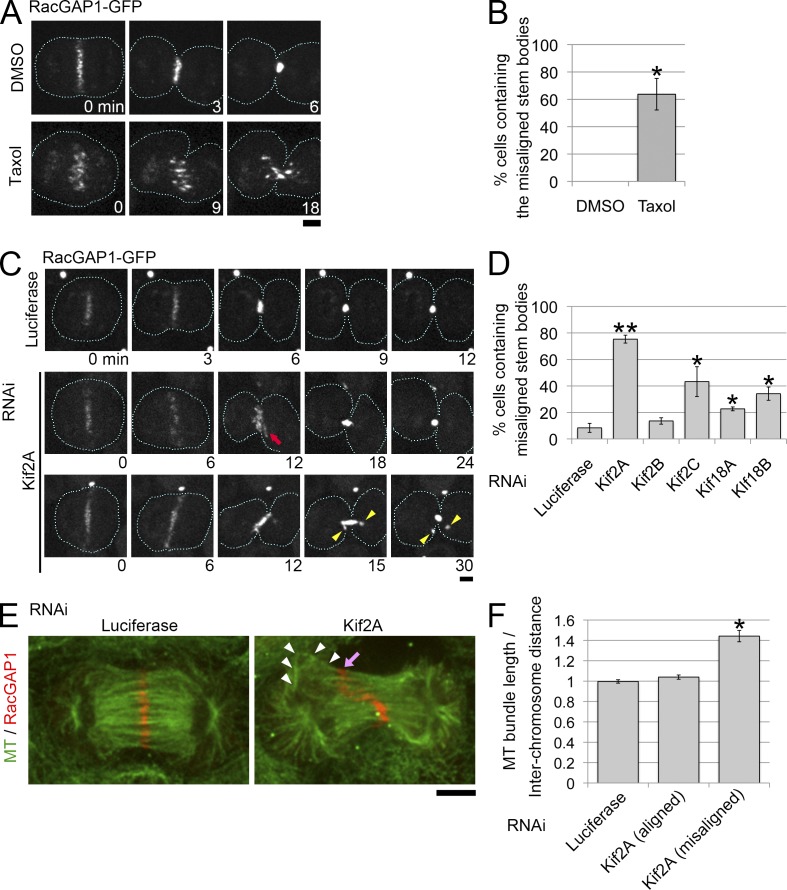
The central spindle is built during anaphase by coupling antiparallel microtubules (MTs) at a central overlap zone, which provides a signaling scaffold for the regulation of cytokinesis. The mechanisms underlying central spindle morphogenesis are still poorly understood. In this paper, we show that the MT depolymerase Kif2A controls the length and alignment of central spindle MTs through depolymerization at their minus ends. The distribution of Kif2A was limited to the distal ends of the central spindle through Aurora B-dependent phosphorylation and exclusion from the spindle midzone. Overactivation or inhibition of Kif2A affected interchromosomal MT length and disorganized the central spindle, resulting in uncoordinated cell division. Experimental data and model simulations suggest that the steady-state length of the central spindle and its symmetric position between segregating chromosomes are predominantly determined by the Aurora B activity gradient. On the basis of these results, we propose a robust self-organization mechanism for central spindle formation.
中心纺锤体在后期通过在中央重叠区偶联平行的微管(MTs)构建,为胞质分裂的调节提供信号支架。中心纺锤体形态发生的机制仍知之甚少。本文表明,MT 解聚酶 Kif2A 通过在其负端解聚来控制中心纺锤体 MT 的长度和排列。Kif2A 的分布通过 Aurora B 依赖性磷酸化被限制在中心纺锤体的远端,并被排除在纺锤体中部区之外。Kif2A 的过度激活或抑制会影响染色体间 MT 的长度并使中心纺锤体紊乱,导致细胞分裂不协调。实验数据和模型模拟表明,中央纺锤体的稳态长度及其在分离染色体之间的对称位置主要由 Aurora B 活性梯度决定。基于这些结果,我们提出了一个用于中心纺锤体形成的稳健自组织机制。