Department of Nephrology, The Second Xiangya Hospital, Central South University, Changsha, China.
Department of Ophthalmology, The Second Xiangya Hospital, Central South University, Changsha, China.
Front Immunol. 2022 Jan 26;12:798683. doi: 10.3389/fimmu.2021.798683. eCollection 2021.
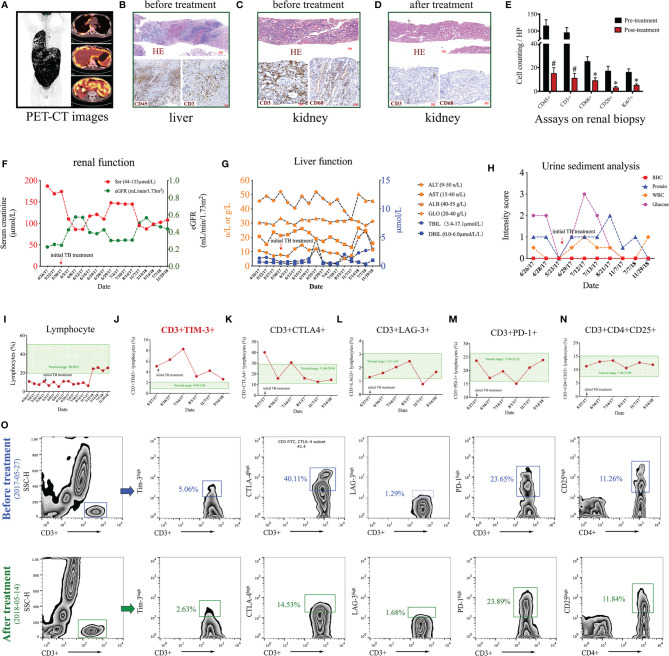
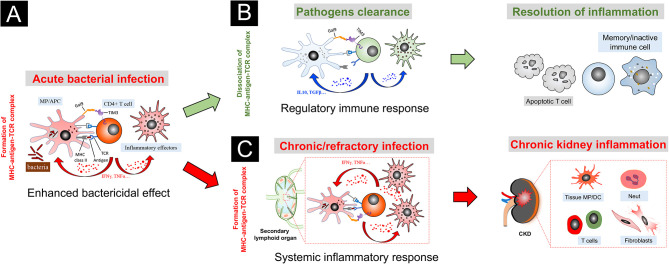
T cell immunoglobulin domain and mucin domain 3 (TIM3) was initially identified as an inhibitory molecule on IFNγ-producing T cells. Further research discovered the broad expression of TIM3 on different immune cells binding to multiple ligands. Apart from its suppressive effects on the Th1 cells, recent compelling experiments highlighted the indispensable role of TIM3 in the myeloid cell-mediated inflammatory response, supporting that TIM3 exerts pleiotropic effects on both adaptive and innate immune cells in a context-dependent manner. A large number of studies have been conducted on TIM3 biology in the disease settings of infection, cancer, and autoimmunity. However, there is a lack of clinical evidence to closely evaluate the role of T cell-expressing TIM3 in the pathogenesis of chronic kidney disease (CKD). Here, we reported an intriguing case of (Mtb) infection that was characterized by persistent overexpression of TIM3 on circulating T cells and ongoing kidney tubulointerstitial inflammation for a period of 12 months. In this case, multiple histopathological biopsies revealed a massive accumulation of recruited T cells and macrophages in the enlarged kidney and liver. After standard anti-Mtb treatment, repeated renal biopsy identified a dramatic remission of the infiltrated immune cells in the tubulointerstitial compartment. This is the first clinical report to reveal a time-course expression of TIM3 on the T cells, which is pathologically associated with the progression of severe kidney inflammation in a non-autoimmunity setting. Based on this case, we summarize the recent findings on TIM3 biology and propose a novel model of CKD progression due to the aberrant crosstalk among immune cells.
T 细胞免疫球蛋白域和粘蛋白域 3(TIM3)最初被鉴定为 IFNγ 产生 T 细胞上的抑制分子。进一步的研究发现 TIM3 在不同免疫细胞上广泛表达,与多种配体结合。除了对 Th1 细胞的抑制作用外,最近令人信服的实验强调了 TIM3 在髓样细胞介导的炎症反应中的不可或缺作用,支持 TIM3 以依赖于上下文的方式对适应性和先天免疫细胞发挥多效性作用。大量研究已经在感染、癌症和自身免疫疾病的疾病环境中进行了 TIM3 生物学研究。然而,缺乏临床证据来密切评估表达 TIM3 的 T 细胞在慢性肾脏病(CKD)发病机制中的作用。在这里,我们报告了一例(Mtb)感染的有趣病例,其特征是循环 T 细胞上 TIM3 的持续过表达和持续 12 个月的肾脏小管间质炎症。在该病例中,多次组织病理学活检显示在增大的肾脏和肝脏中募集的 T 细胞和巨噬细胞大量积聚。在标准抗-Mtb 治疗后,重复肾活检发现肾小管间质腔内浸润的免疫细胞明显缓解。这是首例临床报告揭示 TIM3 在 T 细胞上的时间表达,该表达与非自身免疫环境中严重肾脏炎症的进展具有病理相关性。基于该病例,我们总结了最近关于 TIM3 生物学的发现,并提出了一个新的 CKD 进展模型,该模型归因于免疫细胞之间的异常串扰。