Department of Epidemiology, Erasmus MC, Rotterdam, 3000 CA, The Netherlands.
BMC Genet. 2010 Oct 13;11:92. doi: 10.1186/1471-2156-11-92.
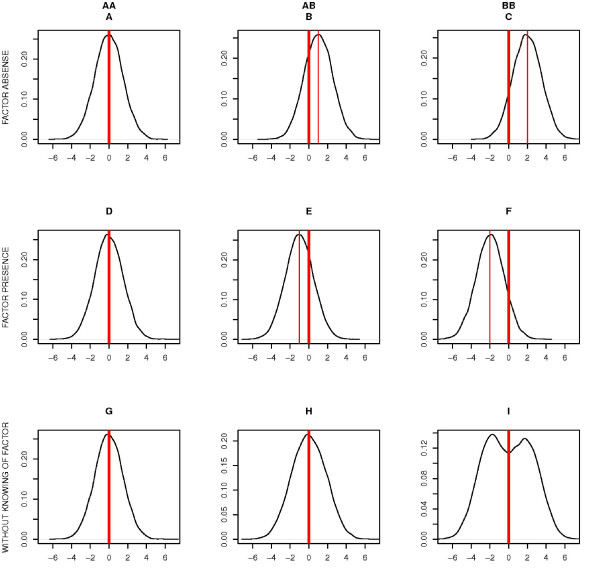
Presence of interaction between a genotype and certain factor in determination of a trait's value, it is expected that the trait's variance is increased in the group of subjects having this genotype. Thus, test of heterogeneity of variances can be used as a test to screen for potentially interacting single-nucleotide polymorphisms (SNPs). In this work, we evaluated statistical properties of variance heterogeneity analysis in respect to the detection of potentially interacting SNPs in a case when an interaction variable is unknown.
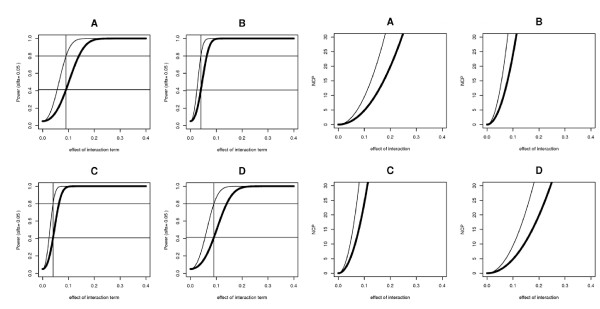
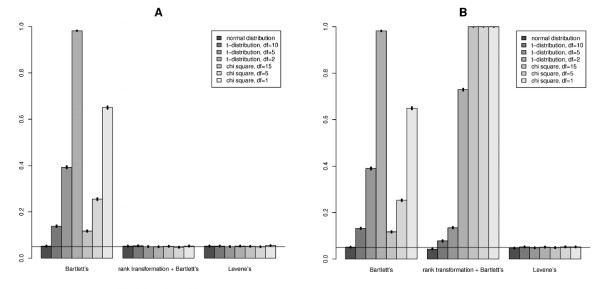
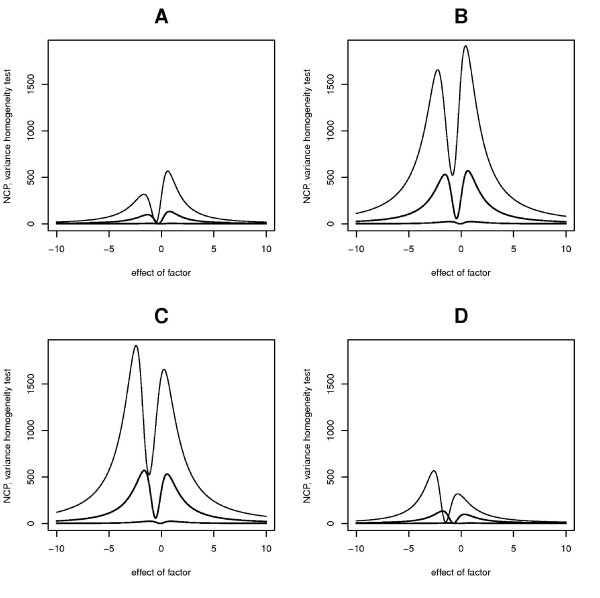
Through simulations, we investigated type I error for Bartlett's test, Bartlett's test with prior rank transformation of a trait to normality, and Levene's test for different genetic models. Additionally, we derived an analytical expression for power estimation. We showed that Bartlett's test has acceptable type I error in the case of trait following a normal distribution, whereas Levene's test kept nominal Type I error under all scenarios investigated. For the power of variance homogeneity test, we showed (as opposed to the power of direct test which uses information about known interacting factor) that, given the same interaction effect, the power can vary widely depending on the non-estimable direct effect of the unobserved interacting variable. Thus, for a given interaction effect, only very wide limits of power of the variance homogeneity test can be estimated. Also we applied Levene's approach to test genome-wide homogeneity of variances of the C-reactive protein in the Rotterdam Study population (n = 5959). In this analysis, we replicate previous results of Pare and colleagues (2010) for the SNP rs12753193 (n = 21,799).
Screening for differences in variances among genotypes of a SNP is a promising approach as a number of biologically interesting models may lead to the heterogeneity of variances. However, it should be kept in mind that the absence of variance heterogeneity for a SNP can not be interpreted as the absence of involvement of the SNP in the interaction network.
当基因型与决定特征值的某个因素之间存在相互作用时,预计具有这种基因型的受试者群体中特征值的方差会增加。因此,可以使用方差异质性检验来筛选潜在的相互作用单核苷酸多态性(SNP)。在这项工作中,我们评估了方差异质性分析在检测未知相互作用变量时检测潜在相互作用 SNP 的统计特性。
通过模拟,我们针对不同的遗传模型研究了巴特利特检验、对特征正态性进行先验秩转换的巴特利特检验以及莱文检验的Ⅰ型错误。此外,我们还推导出了一个用于功效估计的解析表达式。我们表明,当特征值服从正态分布时,巴特利特检验的Ⅰ型错误具有可接受性,而莱文检验在所有研究的情况下都保持了名义Ⅰ型错误。对于方差同质性检验的功效,我们表明(与使用已知相互作用因素的直接检验的功效相反),在给定相同的相互作用效应的情况下,功效可以根据不可估计的未观察到的相互作用变量的直接效应而广泛变化。因此,对于给定的相互作用效应,只能估计方差同质性检验的非常宽的功效范围。我们还将莱文的方法应用于鹿特丹研究人群(n = 5959)的 C 反应蛋白的全基因组方差同质性检验。在这项分析中,我们复制了 Pare 及其同事(2010)对 SNP rs12753193(n = 21,799)的先前结果。
筛选 SNP 基因型之间的方差差异是一种很有前途的方法,因为许多具有生物学意义的模型可能导致方差异质性。然而,应该记住,SNP 不存在方差异质性不能解释为 SNP 不参与相互作用网络。