
小鼠共济失调-3 功能敲除模型。
Mouse ataxin-3 functional knock-out model.
机构信息
Laboratory of Cancer Genetics, Institute of Bioorganic Chemistry, Polish Academy of Sciences, Noskowskiego 12/14, 61-704, Poznan, Poland.
出版信息
Neuromolecular Med. 2011 Mar;13(1):54-65. doi: 10.1007/s12017-010-8137-3. Epub 2010 Oct 14.
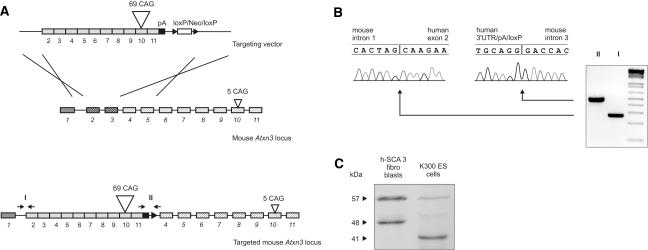
Spinocerebellar ataxia 3 (SCA3) is a genetic disorder resulting from the expansion of the CAG repeats in the ATXN3 gene. The pathogenesis of SCA3 is based on the toxic function of the mutant ataxin-3 protein, but the exact mechanism of the disease remains elusive. Various types of transgenic mouse models explore different aspects of SCA3 pathogenesis, but a knock-in humanized mouse has not yet been created. The initial aim of this study was to generate an ataxin-3 humanized mouse model using a knock-in strategy. The human cDNA for ataxin-3 containing 69 CAG repeats was cloned from SCA3 patient and introduced into the mouse ataxin-3 locus at exon 2, deleting it along with exon 3 and intron 2. Although the human transgene was inserted correctly, the resulting mice acquired the knock-out properties and did not express ataxin-3 protein in any analyzed tissues, as confirmed by western blot and immunohistochemistry. Analyses of RNA expression revealed that the entire locus consisting of human and mouse exons was expressed and alternatively spliced. We detected mRNA isoforms composed of exon 1 spliced with mouse exon 4 or with human exon 7. After applying 37 PCR cycles, we also detected a very low level of the correct exon 1/exon 2 isoform. Additionally, we confirmed by bioinformatic analysis that the structure and power of the splicing site between mouse intron 1 and human exon 2 (the targeted locus) was not changed compared with the native mouse locus. We hypothesized that these splicing aberrations result from the deletion of further splicing sites and the presence of a strong splicing site in exon 4, which was confirmed by bioinformatic analysis. In summary, we created a functional ataxin-3 knock-out mouse model that is viable and fertile and does not present a reduced life span. Our work provides new insights into the splicing characteristics of the Atxn3 gene and provides useful information for future attempts to create knock-in SCA3 models.
脊髓小脑共济失调 3 型(SCA3)是一种遗传性疾病,由 ATXN3 基因中 CAG 重复序列的扩展引起。SCA3 的发病机制基于突变的 ataxin-3 蛋白的毒性作用,但疾病的确切机制仍不清楚。各种类型的转基因小鼠模型探索了 SCA3 发病机制的不同方面,但尚未创建敲入人类化小鼠。本研究的最初目的是使用敲入策略生成 ataxin-3 人类化小鼠模型。从 SCA3 患者中克隆出含有 69 个 CAG 重复的 ataxin-3 人 cDNA,并将其插入到小鼠 ataxin-3 基因的外显子 2 中,同时删除外显子 3 和内含子 2。尽管人类转基因被正确插入,但所得的小鼠获得了敲除特性,并且在任何分析的组织中都不表达 ataxin-3 蛋白,这一点通过 Western blot 和免疫组织化学得到证实。RNA 表达分析表明,由人类和小鼠外显子组成的整个基因座都被表达并发生了选择性剪接。我们检测到由外显子 1 与小鼠外显子 4 或人类外显子 7 剪接组成的 mRNA 异构体。在应用 37 个 PCR 循环后,我们还检测到非常低水平的正确外显子 1/外显子 2 异构体。此外,通过生物信息学分析证实,与天然小鼠基因座相比,在小鼠内含子 1 和人类外显子 2 之间(目标基因座)的剪接位点的结构和强度没有改变。我们假设这些剪接异常是由于进一步剪接位点的缺失和外显子 4 中存在强剪接位点所致,这一点通过生物信息学分析得到了证实。总之,我们创建了一种功能性的 ataxin-3 敲除小鼠模型,该模型具有活力和繁殖能力,并且不会缩短寿命。我们的工作为 Atxn3 基因的剪接特征提供了新的见解,并为未来尝试创建 SCA3 敲入模型提供了有用的信息。
 Zotero 插件