Division of Infection and Immunity, Wohl Virion Centre, University College London, London, United Kingdom.
PLoS One. 2010 Oct 6;5(10):e13203. doi: 10.1371/journal.pone.0013203.
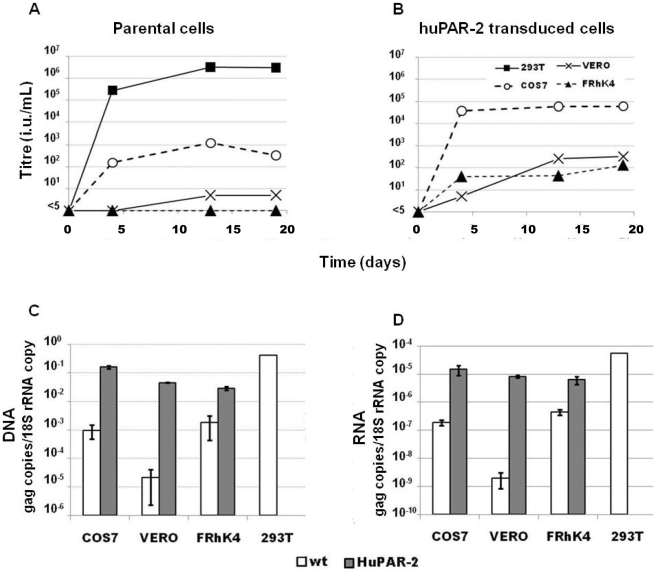
Porcine endogenous retrovirus (PERV) poses a potential risk of zoonotic infection in xenotransplantation. Preclinical transplantation trials using non-human primates (NHP) as recipients of porcine xenografts present the opportunity to assess the zoonosis risk in vivo. However, PERV poorly infects NHP cells for unclear reasons and therefore NHP may represent a suboptimal animal model to assess the risk of PERV zoonoses. We investigated the mechanism responsible for the low efficiency of PERV-A infection in NHP cells.
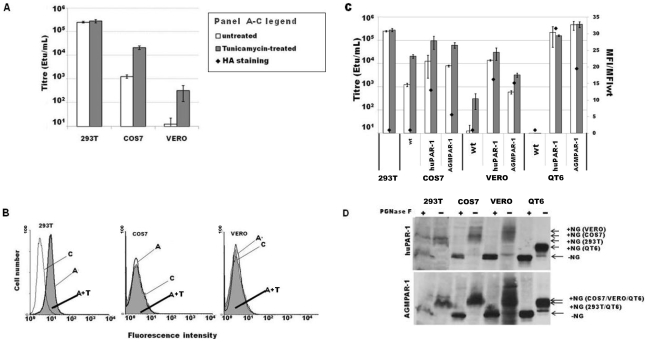
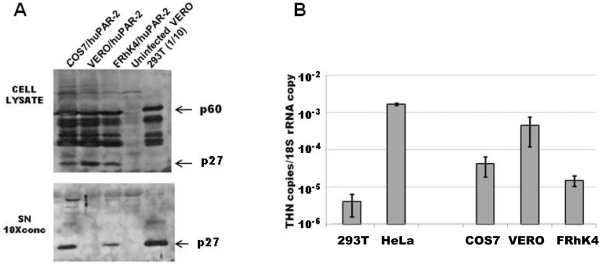
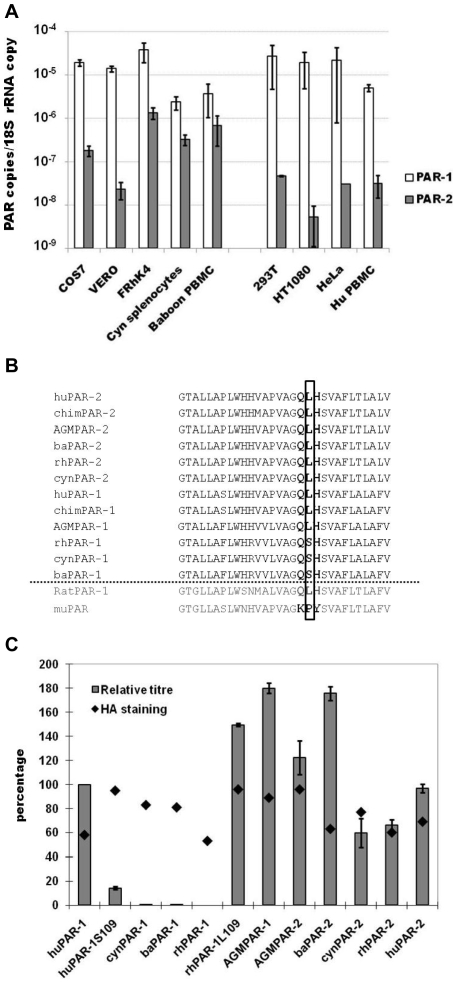
Two steps, cell entry and exit, were inefficient for the replication of high-titer, human-tropic A/C recombinant PERV. A restriction factor, tetherin, is likely to be responsible for the block to matured virion release, supported by the correlation between the levels of inhibition and tetherin expression. In rhesus macaque, cynomolgus macaque and baboon the main receptor for PERV entry, PERV-A receptor 1 (PAR-1), was found to be genetically deficient: PAR-1 genes in these species encode serine at amino acid 109 in place of the leucine in human PAR-1. This genetic defect inevitably impacts in vivo sensitivity to PERV infection of these species. In contrast, African green monkey (AGM) PAR-1 is functional, but PERV infection is still poor. Although the mechanism is unclear, tunicamycin treatment, which removes N-glycosylated sugar chains, increases PERV infection, suggesting a possible role for the glycosylation of the receptors.
Since cynomolgus macaque and baboon, species often used in pig-to-NHP xenotransplantation experiments, have a defective PAR-1, they hardly represent an ideal animal model to assess the risk of PERV transmission in xenotransplantation. Alternatively, NHP species, like AGM, whose both PARs are functional may represent a better model than baboon and cynomolgus macaque for PERV zoonosis in vivo studies.
猪内源性逆转录病毒(PERV)在异种移植中存在人畜共患病感染的潜在风险。使用非人类灵长类动物(NHP)作为猪异种移植物受体的临床前移植试验提供了体内评估人畜共患病风险的机会。然而,由于不明原因,PERV 很难感染 NHP 细胞,因此 NHP 可能代表评估 PERV 人畜共患病风险的非最佳动物模型。我们研究了导致 PERV-A 感染 NHP 细胞效率低下的机制。
两步,细胞进入和退出,对于高滴度、人源嗜性 A/C 重组 PERV 的复制效率低下。一种限制因子, tetherin,可能是导致成熟病毒粒子释放受阻的原因,这与抑制水平和 tetherin 表达之间的相关性相吻合。在恒河猴、食蟹猴和狒狒中,发现 PERV 进入的主要受体 PERV-A 受体 1(PAR-1)在遗传上存在缺陷:这些物种的 PAR-1 基因在第 109 位氨基酸处编码丝氨酸,而不是人类 PAR-1 中的亮氨酸。这种遗传缺陷不可避免地影响这些物种体内对 PERV 感染的敏感性。相比之下,非洲绿猴(AGM)的 PAR-1 是功能性的,但 PERV 感染仍然很差。虽然机制尚不清楚,但用 tunicamycin 处理,去除 N-糖基化糖链,会增加 PERV 感染,这表明受体的糖基化可能起作用。
由于食蟹猴和狒狒在猪到 NHP 异种移植实验中经常被使用,但它们的 PAR-1 存在缺陷,因此它们几乎不能代表评估异种移植中 PERV 传播风险的理想动物模型。相比之下,NHP 物种,如 AGM,其两个 PAR 都是功能性的,可能比狒狒和食蟹猴更适合用于体内 PERV 人畜共患病研究。