Institute of Genetics, QMC, University of Nottingham, Nottingham NG7 2UH, UK.
Cell Host Microbe. 2010 Oct 21;8(4):377-87. doi: 10.1016/j.chom.2010.09.006.
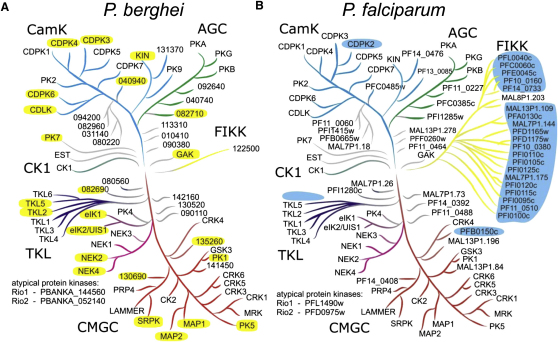
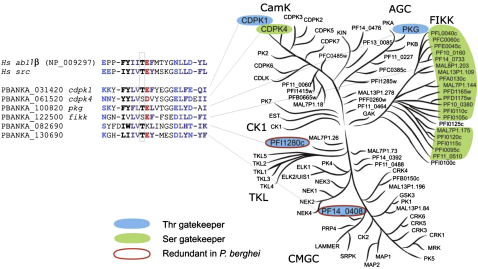
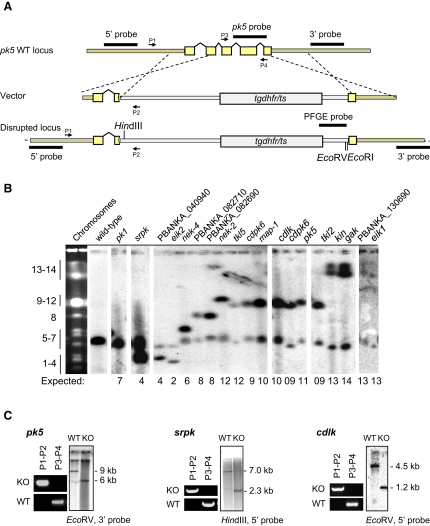
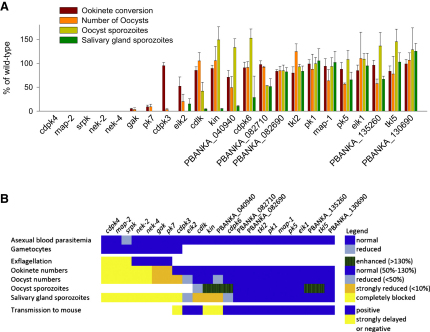
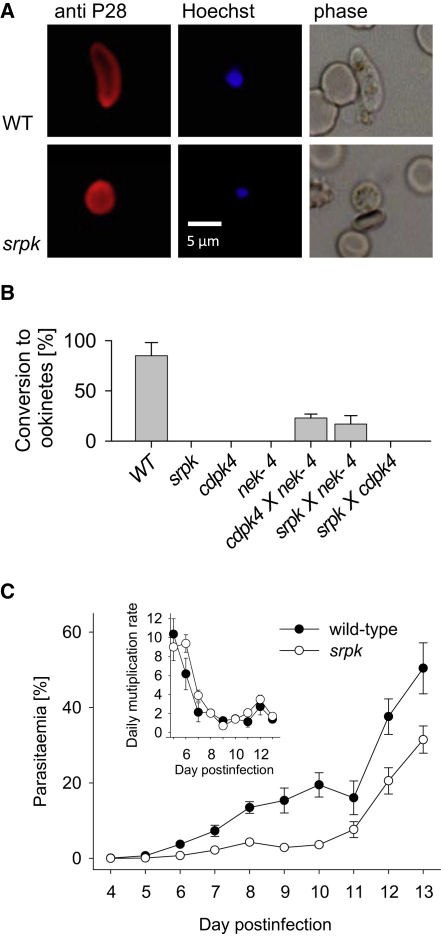
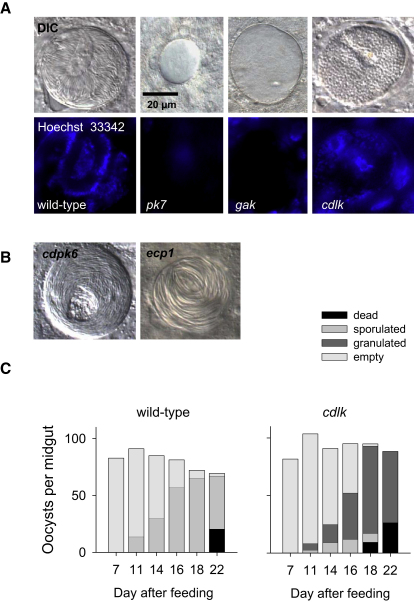
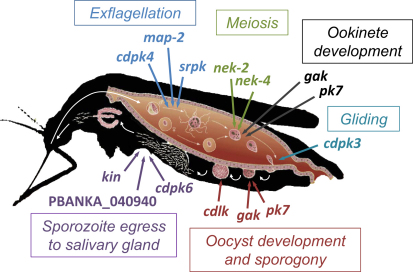
Although eukaryotic protein kinases (ePKs) contribute to many cellular processes, only three Plasmodium falciparum ePKs have thus far been identified as essential for parasite asexual blood stage development. To identify pathways essential for parasite transmission between their mammalian host and mosquito vector, we undertook a systematic functional analysis of ePKs in the genetically tractable rodent parasite Plasmodium berghei. Modeling domain signatures of conventional ePKs identified 66 putative Plasmodium ePKs. Kinomes are highly conserved between Plasmodium species. Using reverse genetics, we show that 23 ePKs are redundant for asexual erythrocytic parasite development in mice. Phenotyping mutants at four life cycle stages in Anopheles stephensi mosquitoes revealed functional clusters of kinases required for sexual development and sporogony. Roles for a putative SR protein kinase (SRPK) in microgamete formation, a conserved regulator of clathrin uncoating (GAK) in ookinete formation, and a likely regulator of energy metabolism (SNF1/KIN) in sporozoite development were identified.
尽管真核蛋白激酶(ePKs)对许多细胞过程都有贡献,但迄今为止,只有三种疟原虫 ePK 被确定为寄生虫无性血期发育所必需。为了鉴定寄生虫在其哺乳动物宿主和蚊子媒介之间传播所必需的途径,我们对遗传上可操作的啮齿动物寄生虫疟原虫伯氏疟原虫中的 ePK 进行了系统的功能分析。通过对传统 ePK 结构域特征的建模,鉴定出了 66 种推定的疟原虫 ePK。种间疟原虫的激酶组高度保守。通过反向遗传学,我们证明了 23 种 ePK 在小鼠的无性红细胞寄生虫发育中是冗余的。在疟蚊按蚊的四个生活史阶段对突变体进行表型分析,揭示了性发育和孢子形成所必需的激酶功能群。鉴定出一种假定的 SR 蛋白激酶(SRPK)在小配子形成中的作用、一种在动合子形成中保守的网格蛋白脱壳调节剂(GAK)以及一种可能在孢子形成中调节能量代谢的 SNF1/KIN 的作用。