Department of Medical Parasitology and Infection Biology, Swiss Tropical and Public Health Institute, Allschwil, Switzerland.
2University of Basel, Basel, Switzerland.
mSphere. 2024 Sep 25;9(9):e0046524. doi: 10.1128/msphere.00465-24. Epub 2024 Sep 5.
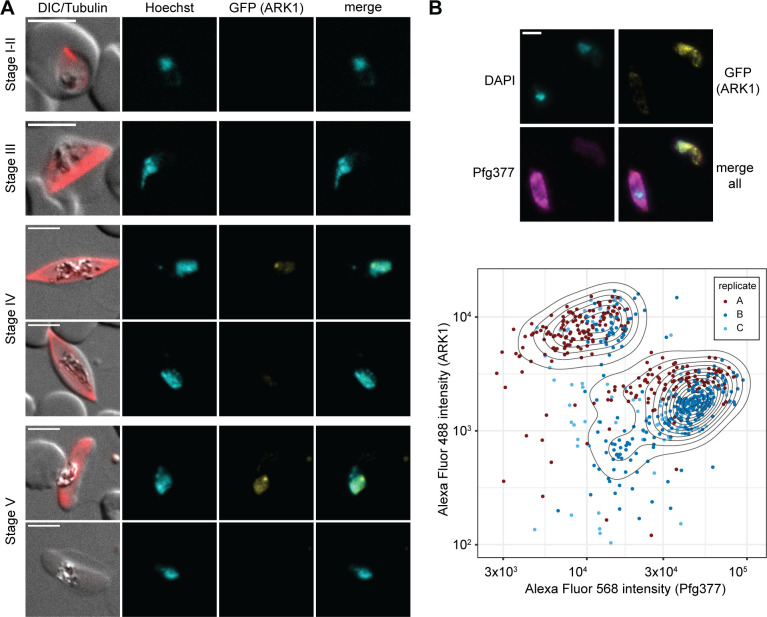
Aurora kinases are crucial regulators of mitotic cell cycle progression in eukaryotes. The protozoan malaria parasite replicates via schizogony, a specialized mode of cell division characterized by consecutive asynchronous rounds of nuclear division by closed mitosis followed by a single cytokinesis event producing dozens of daughter cells. encodes three Aurora-related kinases (PfARKs) that have been reported essential for parasite proliferation, but their roles in regulating schizogony have not yet been explored in great detail. Here, we engineered transgenic parasite lines expressing GFP-tagged PfARK1-3 to provide a systematic analysis of their expression timing and subcellular localization throughout schizogony as well as in the non-dividing gametocyte stages, which are essential for malaria transmission. We demonstrate that all three PfARKs display distinct and highly specific and exclusive spatiotemporal associations with the mitotic machinery. In gametocytes, PfARK3 is undetectable, and PfARK1 and PfARK2 show male-specific expression in late-stage gametocytes, consistent with their requirement for endomitosis during male gametogenesis in the mosquito vector. Our combined data suggest that PfARK1 and PfARK2 have non-overlapping roles in centriolar plaque maturation, assembly of the mitotic spindle, kinetochore-spindle attachment and chromosome segregation, while PfARK3 seems to be exquisitely involved in daughter cell cytoskeleton assembly and cytokinesis. These important new insights provide a reliable foundation for future research aiming at the functional investigation of these divergent and possibly drug-targetable Aurora-related kinases in mitotic cell division of and related apicomplexan parasites.IMPORTANCEMalaria parasites replicate via non-conventional modes of mitotic cell division, such as schizogony, employed by the disease-causing stages in the human blood or endomitosis during male gametogenesis in the mosquito vector. Understanding the molecular mechanisms regulating cell division in these divergent unicellular eukaryotes is not only of scientific interest but also relevant to identify potential new antimalarial drug targets. Here, we carefully examined the subcellular localization of all three Aurora-related kinases (ARKs), distantly related homologs of Aurora kinases that coordinate mitosis in model eukaryotes. Detailed fluorescence microscopy-based analyses revealed distinct, specific, and exclusive spatial associations for each parasite ARK with different components of the mitotic machinery and at different phases of the cell cycle during schizogony and gametocytogenesis. This comprehensive set of results closes important gaps in our fragmentary knowledge on this important group of kinases and offers a valuable source of information for future functional studies.

极光激酶是真核生物有丝分裂细胞周期进程的关键调节因子。原生动物疟原虫通过裂殖生殖进行复制,裂殖生殖是一种特殊的细胞分裂方式,其特征是通过封闭的有丝分裂进行连续的异步核分裂,然后进行一次胞质分裂,产生数十个子细胞。该寄生虫编码三种极光相关激酶(PfARKs),据报道这些激酶对于寄生虫的增殖至关重要,但它们在调控裂殖生殖中的作用尚未得到详细探索。在这里,我们构建了表达 GFP 标记的 PfARK1-3 的转基因寄生虫系,以系统分析它们在裂殖生殖过程中的表达时间和亚细胞定位,以及在非分裂配子体阶段的表达,配子体阶段对于疟疾传播至关重要。我们证明,所有三种 PfARK 都与有丝分裂机制具有独特且高度特异性和排他性的时空关联。在配子体中,PfARK3 无法检测到,PfARK1 和 PfARK2 在晚期配子体中表现出雄性特异性表达,这与它们在蚊子媒介中的雄性配子发生过程中需要末端有丝分裂一致。我们的综合数据表明,PfARK1 和 PfARK2 在中心粒斑成熟、有丝纺锤体组装、动粒-纺锤体附着和染色体分离中具有非重叠的作用,而 PfARK3 似乎高度参与子细胞细胞骨架组装和胞质分裂。这些重要的新见解为未来旨在研究这些在疟原虫和相关顶复门寄生虫有丝分裂细胞分裂中具有不同功能且可能成为药物靶点的极光相关激酶的功能提供了可靠的基础。重要性疟原虫通过非传统的有丝分裂细胞分裂方式进行复制,例如裂殖生殖,裂殖生殖是人类血液中的致病阶段所采用的方式,或者在蚊子媒介中的雄性配子发生过程中进行末端有丝分裂。了解这些在不同的单细胞真核生物中调节细胞分裂的分子机制不仅具有科学意义,而且与鉴定潜在的新抗疟药物靶点也相关。在这里,我们仔细检查了所有三种疟原虫极光相关激酶(ARKs)的亚细胞定位,ARKs 是在模型真核生物中协调有丝分裂的极光激酶的远亲同源物。详细的荧光显微镜分析显示,在裂殖生殖和配子体发生过程中,每个寄生虫 ARK 与有丝分裂机制的不同成分以及细胞周期的不同阶段都有独特、特异和排他性的空间关联。这一组全面的结果填补了我们对这一重要激酶组的零碎知识中的重要空白,并为未来的功能研究提供了有价值的信息来源。