Delatour Benoît, Epelbaum Stéphane, Petiet Alexandra, Dhenain Marc
CRICM-Team "Alzheimer's and Prion Diseases", UPMC/Inserm UMR-S 975, CNRS UMR 7225, G.H. Pitié Salpêtrière, 47-83 Boulevard de l'Hôpital, 75651 Paris Cedex 13, France.
Int J Alzheimers Dis. 2010 Sep 30;2010:604853. doi: 10.4061/2010/604853.
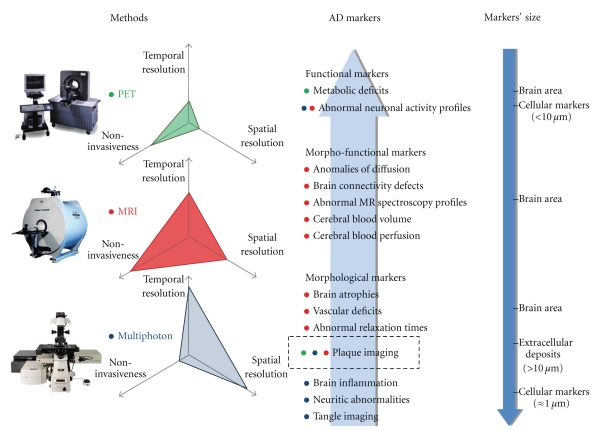
Identification of biomarkers of Alzheimer's Disease (AD) is a critical priority to efficiently diagnose the patients, to stage the progression of neurodegeneration in living subjects, and to assess the effects of disease-modifier treatments. This paper addresses the development and usefulness of preclinical neuroimaging biomarkers of AD. It is today possible to image in vivo the brain of small rodents at high resolution and to detect the occurrence of macroscopic/microscopic lesions in these species, as well as of functional alterations reminiscent of AD pathology. We will outline three different types of imaging biomarkers that can be used in AD mouse models: biomarkers with clear translational potential, biomarkers that can serve as in vivo readouts (in particular in the context of drug discovery) exclusively for preclinical research, and finally biomarkers that constitute new tools for fundamental research on AD physiopathogeny.
识别阿尔茨海默病(AD)的生物标志物是高效诊断患者、确定活体受试者神经退行性变进程以及评估疾病修饰治疗效果的关键优先事项。本文探讨了AD临床前神经影像学生物标志物的发展及其用途。如今,已能够以高分辨率对小型啮齿动物的大脑进行活体成像,并检测这些物种中宏观/微观病变的发生情况,以及类似于AD病理学的功能改变。我们将概述可用于AD小鼠模型的三种不同类型的成像生物标志物:具有明确转化潜力的生物标志物、仅用于临床前研究(特别是在药物发现背景下)可作为活体读数的生物标志物,以及最后构成AD生理发病机制基础研究新工具的生物标志物。