California Pacific Medical Center Research Institute, San Francisco, California 94107, United States.
Biochemistry. 2010 Nov 23;49(46):10006-12. doi: 10.1021/bi101423j. Epub 2010 Oct 27.
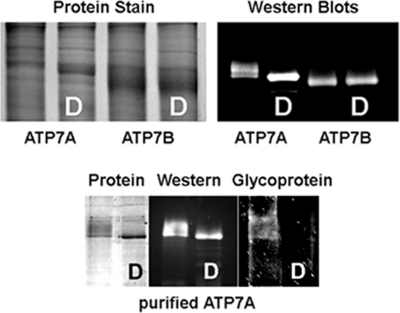
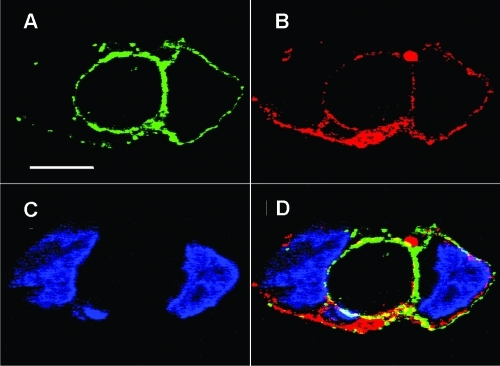
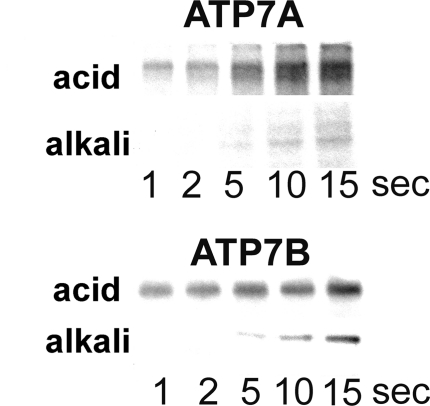
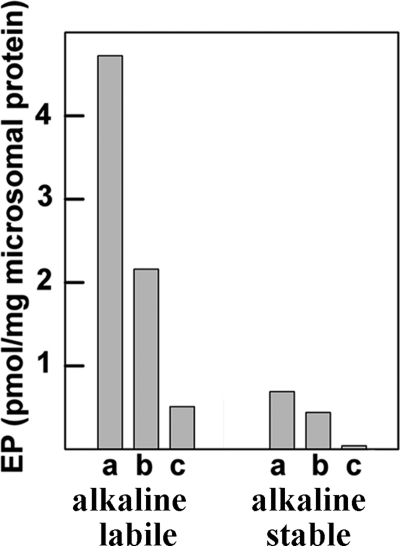
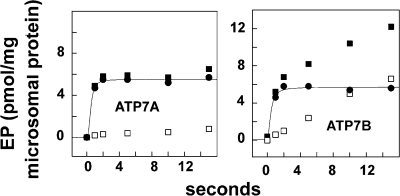
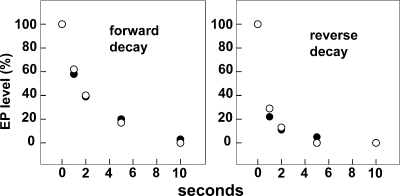
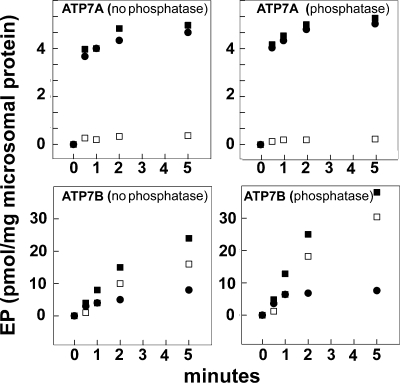
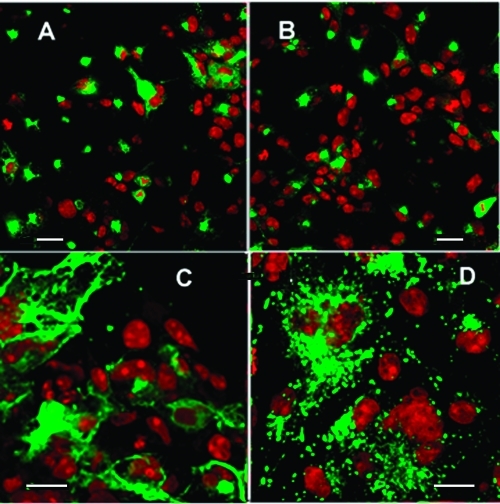
ATP7A and ATP7B are P-type ATPases required for copper homeostasis and involved in the etiology of Menkes and Wilson diseases. We used heterologous expression of ATP7A or ATP7B in COS-1 cells infected with adenovirus vectors to characterize differential features pertinent to each protein expressed in the same mammalian cell type, rather than to extrinsic factors related to different cells sustaining expression. Electrophoretic analysis of the expressed protein, before and after purification, prior or subsequent to treatment with endoglycosidase, and evidenced by protein or glycoprotein staining as well as Western blotting, indicates that the ATP7A protein is glycosylated while ATP7B is not. This is consistent with the prevalence of glycosylation motifs in the ATP7A sequence, and not in ATP7B. ATP7A and ATP7B undergo copper-dependent phosphorylation by utilization of ATP, forming equal levels of an "alkali labile" phosphoenzyme intermediate that undergoes similar catalytic (P-type ATPase) turnover in both enzymes. In addition, incubation with ATP yields an "alkali stable" phosphoprotein fraction, attributed to phosphorylation of serines. Alkali stable phosphorylation occurs at lower levels in ATP7A, consistent with a different distribution of serines in the amino acid sequence. Immunostaining of COS-1 cells sustaining heterologous expression shows initial association of both ATP7A and ATP7B with Golgi and the trans-Golgi network. However, in the presence of added copper, ATP7A undergoes prevalent association with the plasma membrane while ATP7B exhibits intense trafficking with cytosolic vesicles. Glycosylation of ATP7A and phosphorylation of ATP7B apparently contribute to their different trafficking and membrane association when expressed in the same cell type.
ATP7A 和 ATP7B 是 P 型 ATP 酶,对于铜稳态是必需的,并与 Menkes 和 Wilson 病的病因有关。我们使用在感染腺病毒载体的 COS-1 细胞中异源表达 ATP7A 或 ATP7B,来描述与在同一哺乳动物细胞类型中表达相关的每个蛋白的差异特征,而不是与维持表达的不同细胞的外在因素相关。在纯化之前和之后、在用内糖苷酶处理之前或之后,对表达的蛋白进行电泳分析,通过蛋白或糖蛋白染色以及 Western 印迹证实,ATP7A 蛋白被糖基化,而 ATP7B 则没有。这与 ATP7A 序列中普遍存在糖基化基序,而在 ATP7B 序列中则没有相一致。ATP7A 和 ATP7B 通过利用 ATP 进行铜依赖性磷酸化,形成相同水平的“碱不稳定”磷酸酶中间产物,在两种酶中都经历类似的催化(P 型 ATP 酶)周转。此外,用 ATP 孵育会产生“碱稳定”的磷酸蛋白部分,归因于丝氨酸的磷酸化。碱稳定的磷酸化在 ATP7A 中发生的水平较低,与氨基酸序列中丝氨酸的不同分布相一致。对维持异源表达的 COS-1 细胞进行免疫染色显示,ATP7A 和 ATP7B 最初与高尔基体和反高尔基网络相关联。然而,在添加铜的情况下,ATP7A 主要与质膜相关联,而 ATP7B 则表现出与胞质小泡的强烈运输。在相同的细胞类型中表达时,ATP7A 的糖基化和 ATP7B 的磷酸化显然有助于它们的不同运输和膜关联。