Bio-signals Lab, School of Electrical and Computer Engineering, RMIT University, Melbourne, Victoria, Australia.
J Neuroeng Rehabil. 2010 Oct 21;7:53. doi: 10.1186/1743-0003-7-53.
Identifying finger and wrist flexion based actions using a single channel surface electromyogram (sEMG) can lead to a number of applications such as sEMG based controllers for near elbow amputees, human computer interface (HCI) devices for elderly and for defence personnel. These are currently infeasible because classification of sEMG is unreliable when the level of muscle contraction is low and there are multiple active muscles. The presence of noise and cross-talk from closely located and simultaneously active muscles is exaggerated when muscles are weakly active such as during sustained wrist and finger flexion. This paper reports the use of fractal properties of sEMG to reliably identify individual wrist and finger flexion, overcoming the earlier shortcomings.
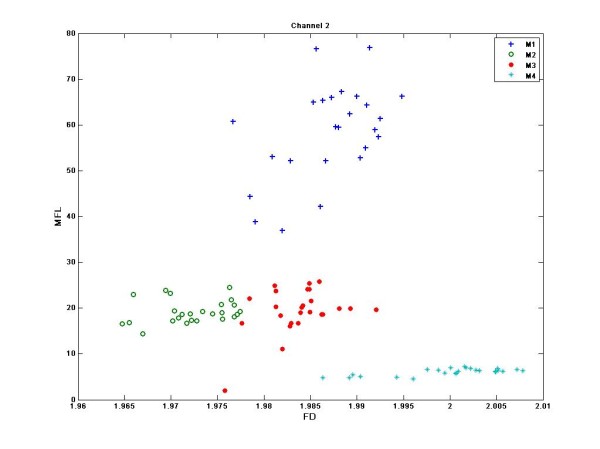
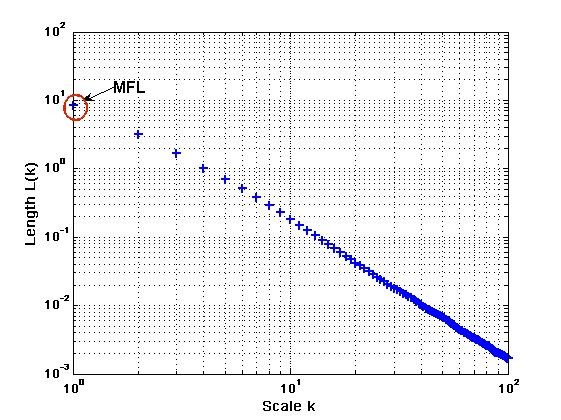
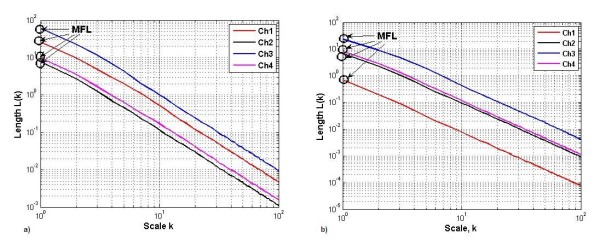
SEMG signal was recorded when the participant maintained pre-specified wrist and finger flexion movements for a period of time. Various established sEMG signal parameters such as root mean square (RMS), Mean absolute value (MAV), Variance (VAR) and Waveform length (WL) and the proposed fractal features: fractal dimension (FD) and maximum fractal length (MFL) were computed. Multi-variant analysis of variance (MANOVA) was conducted to determine the p value, indicative of the significance of the relationships between each of these parameters with the wrist and finger flexions. Classification accuracy was also computed using the trained artificial neural network (ANN) classifier to decode the desired subtle movements.
The results indicate that the p value for the proposed feature set consisting of FD and MFL of single channel sEMG was 0.0001 while that of various combinations of the five established features ranged between 0.009 - 0.0172. From the accuracy of classification by the ANN, the average accuracy in identifying the wrist and finger flexions using the proposed feature set of single channel sEMG was 90%, while the average accuracy when using a combination of other features ranged between 58% and 73%.
The results show that the MFL and FD of a single channel sEMG recorded from the forearm can be used to accurately identify a set of finger and wrist flexions even when the muscle activity is very weak. A comparison with other features demonstrates that this feature set offers a dramatic improvement in the accuracy of identification of the wrist and finger movements. It is proposed that such a system could be used to control a prosthetic hand or for a human computer interface.
使用单通道表面肌电图 (sEMG) 识别手指和手腕弯曲动作可应用于许多领域,例如为近肘部截肢者提供基于 sEMG 的控制器、为老年人和国防人员提供人机界面 (HCI) 设备。这些目前是不可行的,因为当肌肉收缩水平较低且存在多个活跃肌肉时,sEMG 的分类是不可靠的。当肌肉活动较弱时,例如持续手腕和手指弯曲时,来自位置相近且同时活跃的肌肉的噪声和串扰会被夸大。本文报告了使用 sEMG 的分形特性来可靠地识别单个手腕和手指弯曲,克服了早期的缺点。
参与者在一段时间内保持特定的手腕和手指弯曲运动时,记录 sEMG 信号。计算了各种已建立的 sEMG 信号参数,例如均方根 (RMS)、均值绝对值 (MAV)、方差 (VAR) 和波形长度 (WL) 以及建议的分形特征:分形维数 (FD) 和最大分形长度 (MFL)。进行多变量方差分析 (MANOVA) 以确定 p 值,该值表示这些参数中的每一个与手腕和手指弯曲之间关系的显著性。还使用经过训练的人工神经网络 (ANN) 分类器计算分类准确性,以解码所需的微妙运动。
结果表明,由单通道 sEMG 的 FD 和 MFL 组成的建议特征集的 p 值为 0.0001,而由五个已建立特征的各种组合组成的 p 值范围为 0.009 至 0.0172。从 ANN 的分类准确性来看,使用单通道 sEMG 的建议特征集识别手腕和手指弯曲的平均准确性为 90%,而使用其他特征组合的平均准确性在 58%至 73%之间。
结果表明,即使肌肉活动非常弱,也可以使用从前臂记录的单通道 sEMG 的 MFL 和 FD 来准确识别一组手指和手腕弯曲。与其他特征的比较表明,该特征集显著提高了对手腕和手指运动的识别准确性。建议可以将此类系统用于控制假肢手或用于人机界面。