Key Laboratory of Pesticide and Chemical Biology, Ministry of Education, Central China Normal University, Wuhan 430079, China.
Molecules. 2010 Oct 22;15(10):7438-49. doi: 10.3390/molecules15107438.
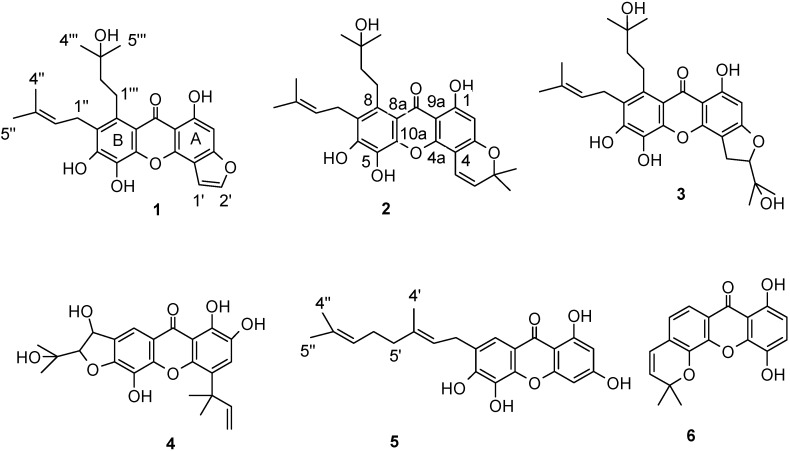
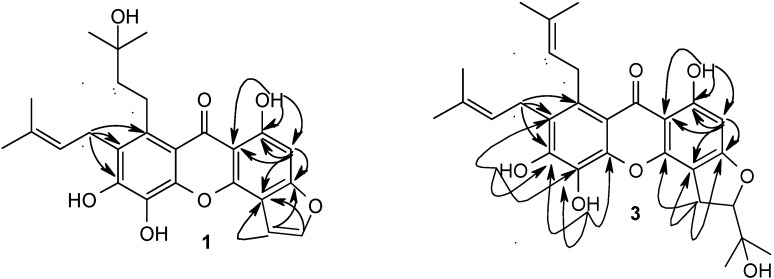
Garcinia xanthochymus has been widely used in traditional Chinese medicine for expelling worms and removing food toxins. Bioassay-guided fractionation of an EtOAc-soluble extract of G. xanthochymus stem bark led to the isolation of six new xanthones. Their structures were elucidated by spectroscopic methods, especially 2D-NMR techniques. Free-radical-scavenging activities of the isolated compounds were elucidated through DPPH method. Most of the isolated compounds showed considerable free radical scavenging activity on DPPH assay. Compound 1 exhibited effective antioxidant scavenging activity against DPPH radical with an IC₅₀ value of 19.64 μM, and compound 6 showed the lowest activity among all the tested molecules, with an IC₅₀ value of 66.88 μM. These findings support the notion that the plant genus Garcinia is a good source of bioactive compounds.
软枝诃子在传统中药中被广泛用于驱虫和去除食物毒素。生物测定指导的软枝诃子茎皮的乙酸乙酯可溶部分的分级分离导致了六个新的紫檀烷的分离。通过光谱方法,特别是二维 NMR 技术,阐明了它们的结构。通过 DPPH 法阐明了分离化合物的自由基清除活性。大多数分离的化合物在 DPPH 测定中表现出相当大的自由基清除活性。化合物 1 对 DPPH 自由基表现出有效的抗氧化清除活性,IC₅₀值为 19.64 μM,而化合物 6 在所有测试分子中表现出最低的活性,IC₅₀值为 66.88 μM。这些发现支持了植物属软枝诃子是生物活性化合物的良好来源的观点。