Office of Research Analysis and Foresight, Max Planck Society, Munich, Germany.
PLoS One. 2010 Oct 13;5(10):e13327. doi: 10.1371/journal.pone.0013327.
In contrast to Newton's well-known aphorism that he had been able "to see further only by standing on the shoulders of giants," one attributes to the Spanish philosopher Ortega y Gasset the hypothesis saying that top-level research cannot be successful without a mass of medium researchers on which the top rests comparable to an iceberg.
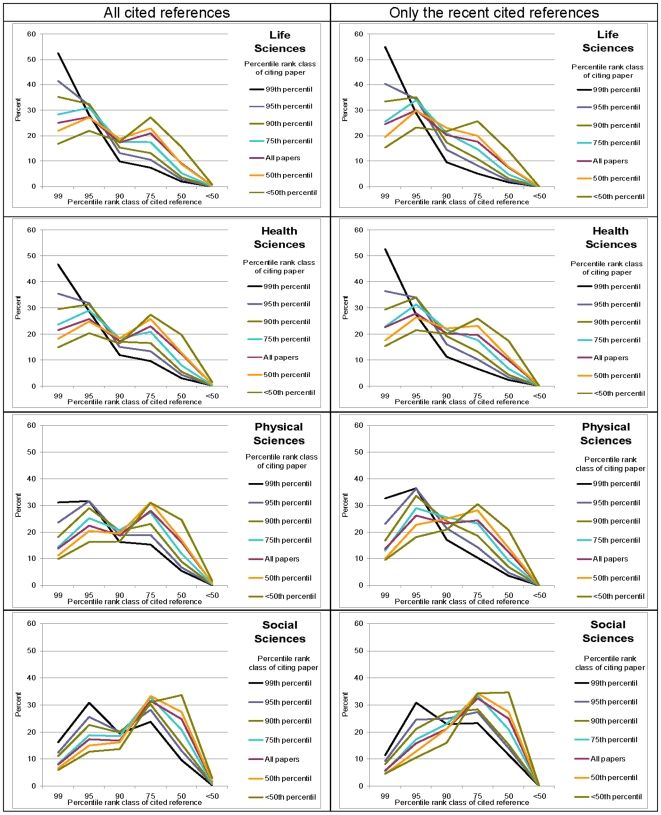
METHODOLOGY/PRINCIPAL FINDINGS: The Ortega hypothesis predicts that highly-cited papers and medium-cited (or lowly-cited) papers would equally refer to papers with a medium impact. The Newton hypothesis would be supported if the top-level research more frequently cites previously highly-cited work than that medium-level research cites highly-cited work. Our analysis is based on (i) all articles and proceedings papers which were published in 2003 in the life sciences, health sciences, physical sciences, and social sciences, and (ii) all articles and proceeding papers which were cited within these publications. The results show that highly-cited work in all scientific fields more frequently cites previously highly-cited papers than that medium-cited work cites highly-cited work.
CONCLUSIONS/SIGNIFICANCE: We demonstrate that papers contributing to the scientific progress in a field lean to a larger extent on previously important contributions than papers contributing little. These findings support the Newton hypothesis and call into question the Ortega hypothesis (given our usage of citation counts as a proxy for impact).
与牛顿著名的格言“我之所以看得更远,是因为我站在巨人的肩膀上”相反,有人将西班牙哲学家奥尔特加·加塞特的假设归因于,没有大量的中层研究人员作为支撑,顶级研究是不可能成功的,就像冰山一样,中层研究人员相当于冰山水下的部分。
方法/主要发现:奥尔特加假设预测,高引用论文和中引用(或低引用)论文同样会引用具有中等影响力的论文。如果顶级研究比中层研究更频繁地引用以前的高引用工作,那么牛顿假设将得到支持。我们的分析基于(i)2003 年发表在生命科学、健康科学、物理科学和社会科学领域的所有文章和会议论文,以及(ii)在这些出版物中被引用的所有文章和会议论文。结果表明,所有科学领域的高引用工作比中等引用工作更频繁地引用以前的高引用论文。
结论/意义:我们证明,在一个领域中对科学进步有贡献的论文比贡献较小的论文在更大程度上依赖于以前的重要贡献。这些发现支持牛顿假设,并对奥尔特加假设提出质疑(鉴于我们使用引文计数作为影响力的替代指标)。