Department of Biological Sciences, University of Wisconsin, Milwaukee, Wisconsin, United States of America.
PLoS One. 2010 Oct 19;5(10):e13472. doi: 10.1371/journal.pone.0013472.
Dickeya dadantii is a necrotrophic pathogen causing disease in many plants. Previous studies have demonstrated that the type III secretion system (T3SS) of D. dadantii is required for full virulence. HrpL is an alternative sigma factor that binds to the hrp box promoter sequence of T3SS genes to up-regulate their expression.
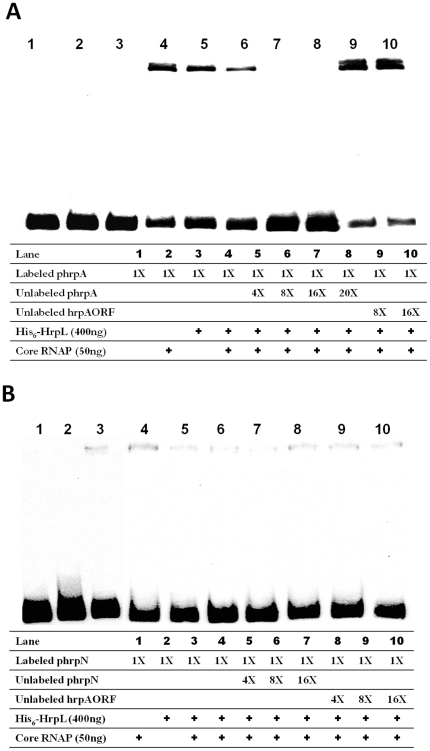
METHODOLOGY/PRINCIPAL FINDINGS: To explore the inventory of HrpL-regulated genes of D. dadantii 3937 (3937), transcriptome profiles of wild-type 3937 and a hrpL mutant grown in a T3SS-inducing medium were examined. Using a cut-off value of 1.5, significant differential expression was observed in sixty-three genes, which are involved in various cellular functions such as type III secretion, chemotaxis, metabolism, regulation, and stress response. A hidden Markov model (HMM) was used to predict candidate hrp box binding sites in the intergenic regions of 3937, including the promoter regions of HrpL-regulated genes identified in the microarray assay. In contrast to biotrophic phytopathgens such as Pseudomonas syringae, among the HrpL up-regulated genes in 3937 only those within the T3SS were found to contain a hrp box sequence. Moreover, direct binding of purified HrpL protein to the hrp box was demonstrated for hrp box-containing DNA fragments of hrpA and hrpN using the electrophoretic mobility shift assay (EMSA). In this study, a putative T3SS effector DspA/E was also identified as a HrpL-upregulated gene, and shown to be translocated into plant cells in a T3SS-dependent manner. CONCLUSION/SIGNIFICANCES: We provide the genome-wide study of HrpL-regulated genes in a necrotrophic phytopathogen (D. dadantii 3937) through a combination of transcriptomics and bioinformatics, which led to identification of several effectors. Our study indicates the extent of differences for T3SS effector protein inventory requirements between necrotrophic and biotrophic pathogens, and may allow the development of different strategies for disease control for these different groups of pathogens.
迪氏棒形杆菌是一种坏死型病原体,可引起多种植物发病。先前的研究表明,迪氏棒形杆菌的 III 型分泌系统(T3SS)是其完全毒力所必需的。HrpL 是一种替代 sigma 因子,可与 T3SS 基因的 hrp 盒启动子序列结合,上调其表达。
方法/主要发现:为了探索迪氏棒形杆菌 3937(3937)中 HrpL 调控基因的种类,我们检测了野生型 3937 和在 T3SS 诱导培养基中生长的 HrpL 突变体的转录组图谱。使用 1.5 的截止值,观察到 63 个基因的表达存在显著差异,这些基因参与了各种细胞功能,如 III 型分泌、趋化作用、代谢、调控和应激反应。使用隐马尔可夫模型(HMM)预测了 3937 中基因间区的候选 Hrp 盒结合位点,包括微阵列分析中鉴定的 HrpL 调控基因的启动子区。与丁香假单胞菌等生物性植物病原体不同,在 3937 中 HrpL 上调的基因中,只有那些位于 T3SS 内的基因才含有 Hrp 盒序列。此外,使用电泳迁移率变动分析(EMSA),我们证明了纯化的 HrpL 蛋白与包含 Hrp 盒的 hrpA 和 hrpN 的 DNA 片段直接结合。在这项研究中,还鉴定了一个假定的 T3SS 效应子 DspA/E 作为 HrpL 上调的基因,并证明其以 T3SS 依赖的方式被转运到植物细胞中。
结论/意义:通过转录组学和生物信息学的结合,我们对一种坏死性植物病原体(迪氏棒形杆菌 3937)中的 HrpL 调控基因进行了全基因组研究,从而鉴定了几个效应子。我们的研究表明,坏死型和生物性病原体对 T3SS 效应蛋白库存要求的差异程度,并可能为这些不同病原体群体的疾病控制制定不同的策略。